Data Masking vs Tokenization: Which Fits Your Test Data?
Compare data masking and tokenization with examples, reversibility, joins and test-data use cases. See when generated synthetic records are a better fit.
By Vincent RuanPublished June 25, 2026Last updated September 6, 20267 min read
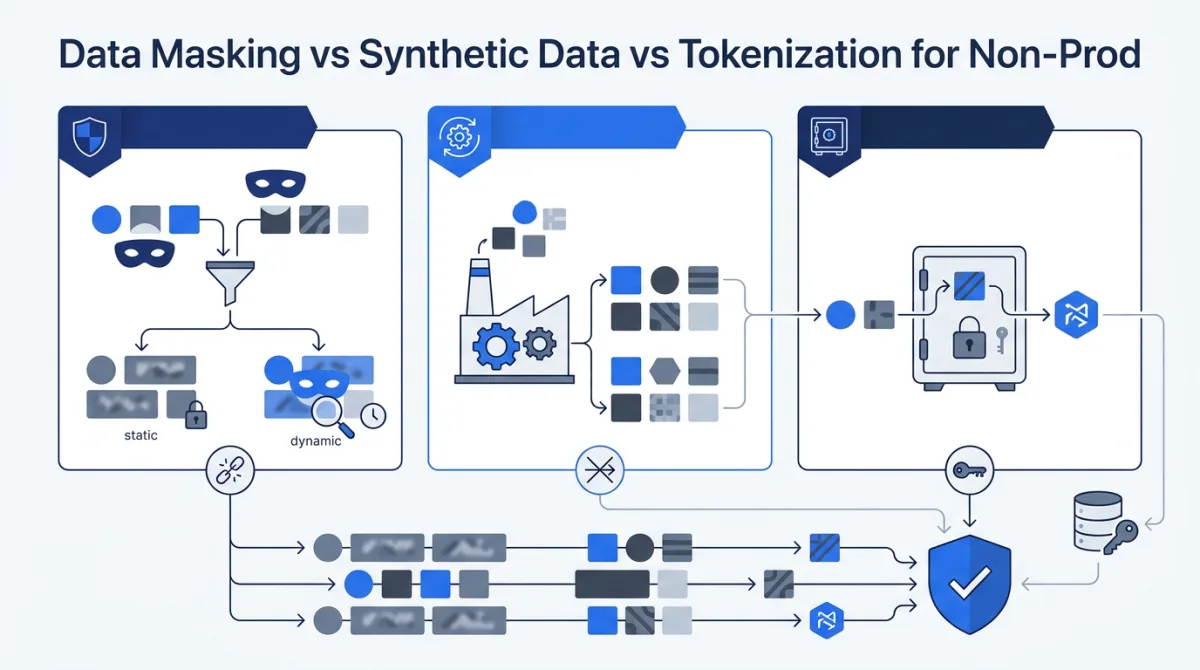
Data masking vs tokenization is a choice about what happens to the original data and who can still use it. Masking covers techniques that obscure or replace sensitive values. Tokenization substitutes a token for a value; in a vaulted system, a separate service holds the mapping. AWS describes both as ways to limit data exposure, with different recovery and operational tradeoffs [aws-masking]. For development and QA, begin with the test's requirements before choosing a technique.
Data masking vs tokenization: a comparison
| Question | Static masking | Dynamic masking | Vaulted tokenization |
|---|---|---|---|
| What changes? | Values in a copied dataset | What a query or user can see | Sensitive values are replaced by tokens |
| Where is the original? | Still in the source unless separately removed | In the underlying data store | In a protected vault or source system |
| Can a reader recover it? | Depends on the transform and retained information | A privileged reader may access the source | Only with the authorized mapping/recovery path |
| Do joins survive? | Only if key transforms are consistent and collision handling is correct | Usually unchanged in the source | Only if the same source key resolves consistently |
| Typical test-data role | Prepare a reduced production copy | Exercise access and display behavior | Exercise token-aware integrations |
| Main check | Residual identifiers, collisions and unmasked fields | Paths that bypass the mask | Vault permissions and exposure of recovered values |
A concrete example: email addresses and customer IDs
Suppose a fictional source row has customer ID C-1042 and email alex@example.com. A display mask might show a***@example.com while leaving the source unchanged. A static test-data transform might replace the email with person-1042@example.net. A vaulted tokenizer might replace the ID with tok_7Q and keep the C-1042 mapping in a protected service. These are illustrative values, not outputs promised by every masking or tokenization product.
Now add an orders table containing customer ID C-1042. If customers gets tok_7Q but orders gets tok_9R, the relationship breaks. If two distinct customer IDs become the same output, joins can silently attach an order to the wrong customer. Your test should therefore check both missing references and accidental collisions. Counting rows before and after a transformation will not reveal either error reliably.
Static vs dynamic data masking
Static masking prepares a transformed copy before it reaches another environment. Dynamic masking changes the values returned to particular readers while the source data remains present. These solve different tasks: a masked screen can demonstrate permission behavior, but it does not establish that a downloadable database copy is safe to distribute. Inspect exports, background jobs and administrator access as well as the application screen [aws-masking].
For a copied test database, inventory free-text fields and secondary stores before deciding which columns to transform. An email removed from the customer table can still exist in a support note, audit log or generated PDF. Include attachments and exported files in the review boundary when the test workflow uses them. A transform only covers the inputs it actually receives.
How to test that relationships and behavior still work
- Define the behaviors the dataset must support: imports, joins, search, pagination, permissions or a specific integration failure.
- List primary and foreign keys before transforming data. Use a consistent mapping for repeated values and check uniqueness after transformation.
- Verify that every required child reference resolves to an allowed parent and that row counts and nullability remain intentional.
- Run the same transformation again under the documented version and settings. Stable input mapping is different from simply reseeding a random-number stream.
- Exercise export and logging paths. Confirm that failures do not write original sensitive values into test artifacts.
- Keep a small expected-result dataset for regression checks and a separate larger dataset for volume tests.
Repeatability needs more than a seed when generation depends on library versions, locale pools, dates or iteration order. Record those inputs alongside your fixtures. Our deterministic test-data guide explains the distinction between reproducing a generated sequence and preserving a mapping from each production value.
When synthetic test data is a better fit
Newly generated records are useful when no production copy is available, when a demo only needs plausible field values, or when a test needs a deliberately chosen boundary value. A CSV import can often be tested with a small fabricated contact table. An analytics model that depends on real correlations has a different requirement: independently sampled names and addresses do not reproduce those correlations.
| Task | Useful starting point | What still needs checking |
|---|---|---|
| CSV import or customer-list demo | Generated contact rows | Types, quoting, leading zeros and row counts |
| Regression involving production relationships | A carefully transformed subset or purpose-built relational fixtures | Keys, distributions, permissions and residual sensitive data |
| Token-aware integration | The provider's sandbox and test tokens | Token lifecycle, errors and recovery permissions |
| Name/date/phone boundary validation | Explicit cases with expected outcomes | Application policy and exact normalization behavior |
| Model training or statistical analysis | A dataset evaluated for the intended statistical task | Utility, privacy leakage and evaluation against a suitable baseline |
Synthetic does not automatically mean anonymous. Generation trained on sensitive source records needs a different assessment from a collection of independently assembled examples. NIST treats de-identification as a combination of techniques, governance and evaluation rather than a blanket label [nist-deid]. Establish the relevant disclosure risks and acceptable utility for the actual release; do not rank every synthetic dataset as safer than every masked dataset.
What Fakenamely can generate for this workflow
The CSV, JSON and SQL test data generator produces one flat set of records with selected fields, a seed and a fixed reference date. It can help test an import, fill a demo table or provide contact-field examples. It does not accept your production database, perform masking, store reversible tokens, or create linked customer and order tables. If your test needs those relationships, build explicit fixtures or use a tool that supports your schema.
For an immediate example, download the sample customer data: 100 or 1,000 generated US contact records with a field dictionary. For boundary testing, use the name validation cases and date-of-birth cases. Random samples and boundary fixtures serve different purposes; use both when your test needs variety and guaranteed coverage of a specific failure.
Payment testing needs processor-specific fixtures
A card-shaped number that passes Luhn does not define an approval, decline or authentication response. Those outcomes come from the payment provider's documented test environment and fixtures. Stripe, for example, publishes test payment methods and numbers for named scenarios [stripe-testing]. Use those within the designated sandbox. Our Stripe testing guide covers that separate task; generating a checksum-valid value is not a substitute for processor integration testing.
References & sources
Frequently asked questions
What is the main difference between data masking and tokenization?
Masking hides or changes a value to reduce exposure. Tokenization replaces it with a surrogate token. A vaulted tokenization service stores a mapping so authorized systems can recover the original. Masking is a broad term: static replacement and dynamic display masking have different behavior, so the label alone does not tell you whether source data remains accessible.
Should I use masking or tokenization for a test database?
Use requirements to decide. A transformed production subset may need consistent static masking and checks for leftover sensitive fields. Vaulted tokenization fits a workflow that needs controlled recovery of original values, but test environments should not gain that recovery access by accident. Generated records can be enough when tests need field shapes and examples rather than production distributions.
Can masking and tokenization preserve joins?
Both can if repeated keys are mapped consistently across all related tables. Stable output alone is insufficient: check collisions, unique constraints, missing parents and relationships after transformation. A seeded random generator does not automatically implement a stable source-value mapping.
Is tokenization the same as encryption?
No. Encryption transforms data using a cryptographic algorithm and key. In a vaulted tokenization design, a token refers to an entry in a protected mapping service. Other tokenization architectures exist; review the actual storage, recovery and access model rather than assuming every token is backed by the same kind of vault.
Is synthetic data always anonymous?
No. A model trained on sensitive records may reveal information about them, and a generated dataset still needs evaluation for its intended use. Independently assembled examples avoid copying a production dataset, but generated names and addresses can coincide with real ones. Neither a generator label nor the absence of names proves anonymity.
Can Fakenamely mask an existing database or generate foreign keys?
No. The bulk tool generates a single flat set of records with selected fields and a repeatable seed. It does not import production databases, maintain a token vault, or coordinate customer/order tables. The customer sample download is a standalone contact table for imports and demos.
More on privacy law and anonymization
- CCPA vs GDPR for Non-Production Test Data
- Data Anonymization Techniques Compared
- How to Protect Your Privacy Online With Fictional Details
- Disposable Email vs Fake Email Generator: What & When to Use
- Synthetic Data for GDPR Compliance: Anonymization Done Right
- PII in Test Environments: Risks & Replacements