Fakenamely vs Fake Name Generator: An Honest Comparison
An objective comparison of Fakenamely and the 2006-era Fake Name Generator: features, country breadth, developer tools, speed, and which to use.
By Vincent RuanPublished June 27, 2026Last updated June 27, 20269 min read
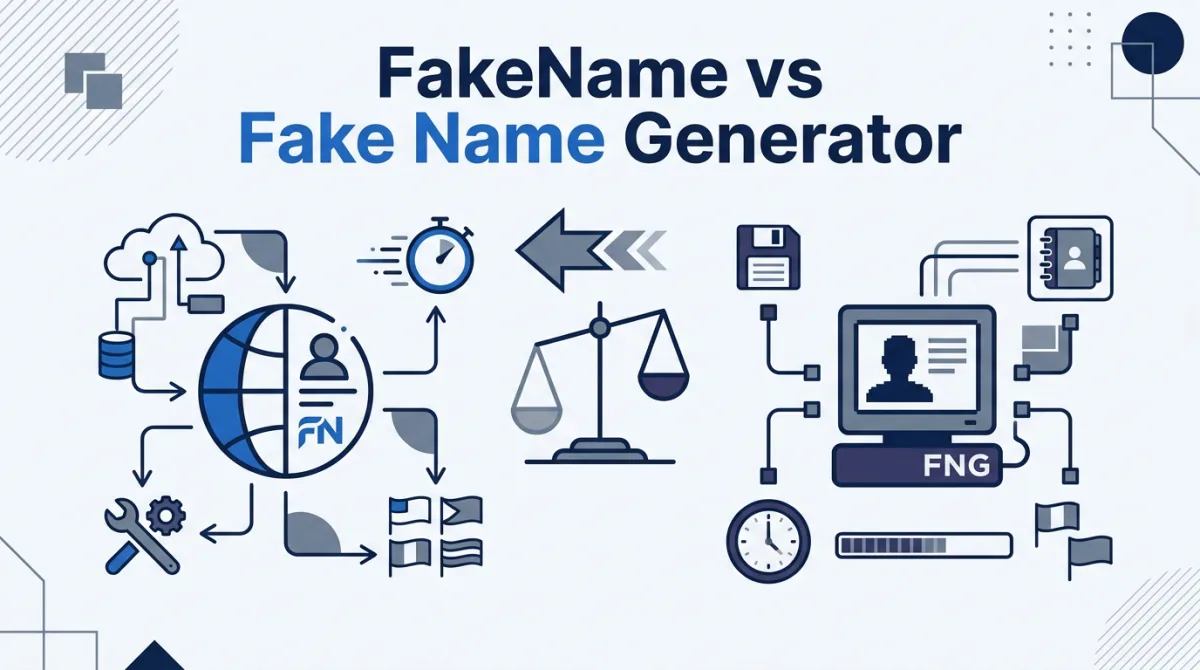
Short answer: both are good, and the right choice depends on your task. Fake Name Generator (fakenamegenerator.com) has been online since 2006 and is the most field-complete random-identity tool on the web. Fakenamely (fakenamely.com) is a newer alternative built around a fast interface and developer-focused generators. If you want one comprehensive profile with every conceivable field, the incumbent is hard to beat. If you want quick, dev-friendly test data and modern tooling, an alternative like ours fits better. This page compares them honestly, including where the incumbent is genuinely stronger.
What is Fake Name Generator?
Fake Name Generator is a random-identity website operated by Corban Works, LLC that has run continuously since 2006 [fng-home]. In two decades it has become the reference point for the category. It produces a complete fictional profile from a single click: name, address, phone, email, and then a long tail of extra fields that few competitors match, including occupation, company, vehicle, blood type, height and weight, mother's maiden name, and even a UPS tracking number [fng-features]. It supports 31 countries and localizes name sets across 37 languages, and it offers its own utilities such as a credit card validator [fng-features].
That longevity matters. A tool that has been refined for twenty years has deep name dictionaries, plausible address formatting for many locales, and a brand that ranks at the top of search for good reason. When people ask for the canonical fake-name tool, this is usually the one they mean.
What is Fakenamely?
Fakenamely (fakenamely.com) is a newer entrant in the same category. Its design priorities are different: a fast, modern interface; browser-side validators for sensitive test inputs; broad country coverage; and a set of developer-oriented tools aimed at test-data workflows rather than a single all-in-one profile. The identity generator produces the core fields you would expect, and the rest of the site fans out into specialized generators and validators.
Where the incumbent optimizes for one rich profile with maximum field variety, Fakenamely optimizes for the things a developer or QA engineer reaches for repeatedly: Luhn-valid sandbox card numbers, ZIP and coordinate data, bulk generation, and standalone validators. Neither approach is universally better; they serve overlapping but distinct needs.
Feature comparison
The table below compares both tools on concrete, checkable attributes. We have tried to keep every row defensible and to avoid inventing weaknesses. Where the incumbent leads, the table says so.
| Attribute | Fake Name Generator | Fakenamely |
|---|---|---|
| Online since | 2006 (Corban Works, LLC) | Newer (modern entrant) |
| Cost | Free, ad-supported | Free, ad-supported |
| Account required | No | No |
| Countries / locales | 31 countries, 37 languages | Country-specific generators across many locales |
| Core identity fields | Name, address, phone, email | Name, address, phone, email |
| Extended fields | Occupation, company, vehicle, blood type, height/weight, UPS tracking, maiden name | Core profile plus targeted dev fields |
| Interface | Established, dense, dated styling | Modern, fast, responsive |
| Browser-side privacy | Server-rendered profiles | Validators run client-side |
| Developer test data | Credit card validator, order-form fields | Luhn-valid test cards by network, ZIP/coords, validators |
| Bulk generation | Available (order-style bulk) | Bulk export oriented |
| Validators | Credit card validator | SSN, IBAN, VIN, ABA routing, Luhn, and more |
| Brand recognition | Very high; category-defining | Lower; growing |
Where Fake Name Generator is genuinely stronger
An honest comparison has to credit the incumbent where it leads, and it leads in several real ways.
- Field breadth. Few tools match its tail of fields. If your test form needs a blood type, a fictional employer, a vehicle, or a UPS tracking number alongside the name and address, Fake Name Generator gives you all of it in one profile [fng-features].
- Track record. Twenty years online means mature data sets, predictable behavior, and a tool that countless tutorials and Stack Overflow answers already point to [fng-home].
- Brand and trust. It is the name people recognize. For a non-technical user who just needs one believable profile, sending them to the most established option is the safe recommendation.
- Single-profile completeness. Its all-in-one output is ideal when you want one rich identity rather than a stream of records for a database seed.
The most advanced fake name generator. Generate random names, addresses, usernames, passwords, email addresses, and more.
Where a modern alternative differs
Fakenamely is not trying to out-field the incumbent. It differs on workflow, speed, and developer ergonomics.
Speed and interface
The most immediate difference is the interface. A tool designed in 2026 loads fast, works cleanly on mobile, and gets out of your way. Fakenamely's validators run client-side, so when you paste a card number or routing number into a checker, the value is not submitted to our servers. The identity pages also lazy-load regeneration code after the first click, so repeat generation feels quick without bloating the first page load.
Country breadth and localization
Both tools cover international data. Fakenamely's country generators localize names, address formats, postal codes, and phone patterns per locale, which is useful when you are testing forms that must accept region-specific formats. The incumbent's 31 countries are deeply built out, so for a given country the right call is to check both and compare the realism of the output for that specific locale.
Developer-focused generators
This is where Fakenamely diverges most. Beyond identities, it ships a set of free tools aimed squarely at engineers and QA — a VIN validator, a password generator and a QR code generator — plus a keyless JSON API and a bulk CSV/JSON/SQL exporter. It deliberately does not offer a credit-card generator or any national-ID tooling: those were removed in September 2026 so the site stays a test-data tool rather than an identity kit. For test-data seeding, ZIP and coordinate generators round out data that an all-in-one profile tool typically does not expose individually.
Which should you use?
There is no single winner. Match the tool to the job.
| Your task | Better fit | Why |
|---|---|---|
| One rich, complete fictional profile | Fake Name Generator | Unmatched field breadth in a single output |
| You need exotic fields (blood type, UPS tracking, vehicle) | Fake Name Generator | Those fields exist out of the box [fng-features] |
| You want the most established, recognized tool | Fake Name Generator | 20-year track record since 2006 [fng-home] |
| Fast, modern UI for quick generation | Fakenamely | Built around speed and a clean interface |
| Test card numbers, validators, ZIP/coords | Fakenamely | Dedicated developer tools and generators |
| Browser-side privacy for inputs you check | Fakenamely | Validators run client-side |
| Bulk records for a database seed | Either | Both support bulk; compare export format |
| Country-specific form testing | Either | Compare locale realism on both |
If you are a non-technical user who needs one believable identity and a deep set of fields, Fake Name Generator is the safe recommendation and we will happily send you there. If you are a developer or QA engineer who generates test data often and values a fast interface plus purpose-built tools, a modern alternative like Fakenamely will likely fit your workflow better. Many people end up using both.
Are they safe and legitimate?
Both are legitimate tools that produce fictional data. The legal and ethical line is identical for both: generated identities are for testing, demos, design mockups, and reasonable privacy, never for fraud, impersonation of a real person, or evading identity verification. The data itself is harmless because it corresponds to no real individual; risk comes entirely from misuse. For a broader safety and alternatives review, see our separate guide to whether fakenamegenerator.com is safe and which alternatives fit different jobs.
The one technical safety nuance is where computation happens. Fakenamely's validators run in your browser, so values you check there are not submitted to our servers. For the generated identities themselves, both tools are equally fine, because the output is fictional whichever site produced it.
The honest bottom line
Fake Name Generator earned its position. It is capable, well-maintained, broader on fields than almost anything else, and backed by twenty years of refinement. A newer alternative like Fakenamely is not better across the board; it is different, optimized for speed, developer tooling, and a modern interface. Try the incumbent when you want one comprehensive profile or an obscure field, and try our identity generator and free tools when you want fast, dev-friendly test data. Pick by task, not by hype.
References & sources
- Fake Name Generator — homepage (operating since 2006, Corban Works, LLC) — Fake Name Generator
- Fake Name Generator — generated fields, 31 countries and 37 languages — Fake Name Generator
- Testing — Test card numbers for sandbox use — Stripe
- ISO/IEC 7812-1: Identification cards — Identification of issuers — Numbering system — ISO
Frequently asked questions
Is fakenamegenerator.com still good in 2026?
Yes. Fake Name Generator has operated since 2006, is run by Corban Works, LLC, and remains one of the most capable random-identity tools online. It supports 31 countries and 37 languages and generates an unusually wide set of fields, including occupation, blood type, mother's maiden name, and UPS tracking numbers. It is well-maintained and a reasonable default for anyone who wants a single, comprehensive generated profile.
What is the difference between Fakenamely and Fake Name Generator?
Fake Name Generator is the long-established incumbent: extremely broad field coverage and a 20-year track record, wrapped in an older interface. Fakenamely is a newer alternative built around a fast, modern UI with developer-focused generators (Luhn-valid test card numbers, ZIP and coordinate data, validators) and bulk export. The two overlap heavily on core identity fields; they differ most in interface speed, developer tooling, and field exotica.
Is one safer than the other?
Both produce fictional data intended for testing, demos, and privacy, and neither should be used to deceive, defraud, or bypass identity verification. The main practical safety difference is where computation happens: Fakenamely's validators run in your browser, so values you check are not submitted to our servers. For generated identity data, both are equally fine because the output is fictional by design. Safety depends mostly on how you use the data, not which site produced it.
Which is better for developers?
For developers, a modern alternative usually wins on workflow. Fakenamely provides Luhn-valid sandbox test card numbers by network, ZIP and coordinate generators, and free validators for SSN, IBAN, VIN, and routing numbers, plus fast bulk generation. Fake Name Generator also offers a credit card validator and order-form-friendly fields, so it is far from useless to developers, but its interface and export flow feel dated next to a tool designed around test-data workflows.
Are both Fake Name Generator and Fakenamely free?
Yes. Both are free to use and ad-supported. Fake Name Generator has been free since 2006, and Fakenamely is free with no account required. Neither charges for the core generators, and you should be cautious of any 'fake name' site that asks for payment or personal details to produce fictional data.
Can I generate fake identities for many countries on both?
Both support international data. Fake Name Generator covers 31 countries with name sets localized across 37 languages. Fakenamely offers country-specific generators that localize names, addresses, postal formats, and phone patterns. If a specific nationality is your priority, check both for that exact locale, since name-set quality and address realism vary country by country on every generator.