Is Using a Fake Name Generator Legal? Lawful Uses vs Fraud
Fake name generators are legal in the US, EU, and UK; legality turns on use. A jurisdiction breakdown of lawful testing and privacy uses versus fraud.
By Vincent RuanPublished June 25, 2026Last updated June 25, 20269 min read
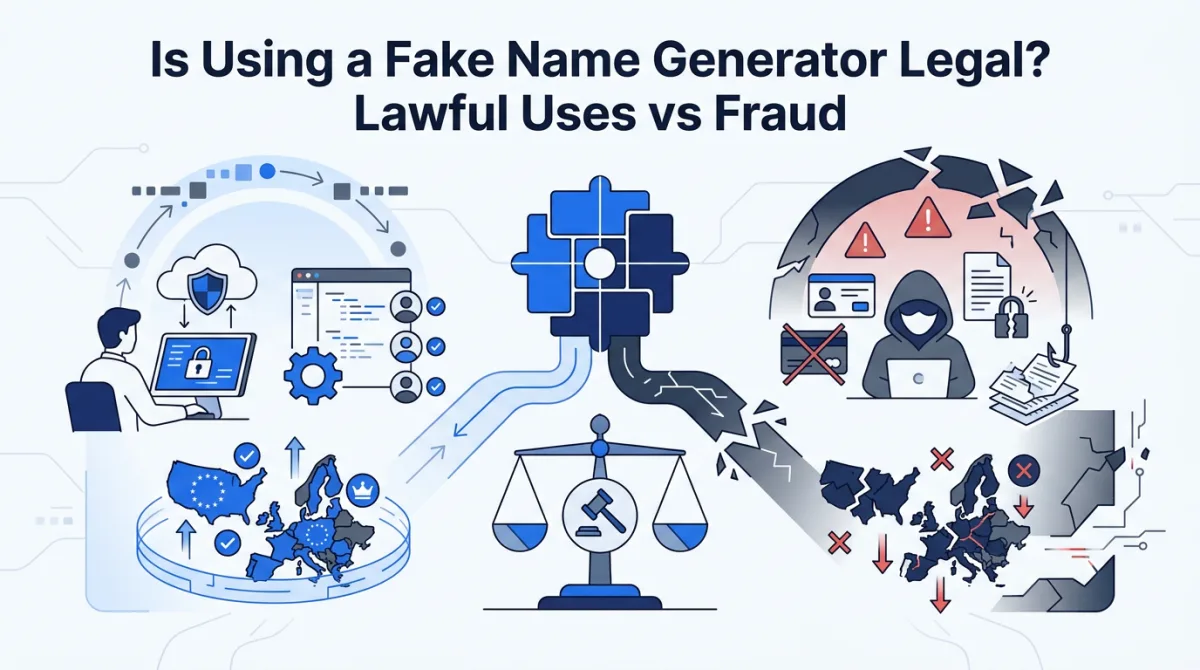
Using a fake name generator is legal in the United States, the European Union, and the United Kingdom. Inventing a name breaks no law in any major jurisdiction. A name assembled from word lists belongs to no one, and no person is harmed simply because it exists. What the law judges is never the generator. It is what you do with the output. This article maps the lawful uses, the genuine gray areas, and the points where a use becomes fraud.
Everything below assumes the on-brand purpose of a generator like the one at /: producing fictional placeholder data for testing, QA, demos, and privacy. The tools are not built for, and must not be used for, deceiving anyone, impersonating a real individual, or slipping past a legally required identity check.
Is generating a fake name a crime anywhere?
No major jurisdiction criminalizes the act of inventing a name. Pen names, stage names, and online handles have been ordinary for centuries. Identity-theft and fraud statutes are written around deception that causes or risks harm, not around fiction. US federal law on identification-document fraud, 18 U.S.C. 1028, turns on the use of a *means of identification of another person* with intent to commit an unlawful act [usc1028].
The phrase "of another person" does all the work. A name an algorithm just generated is, by construction, not the means of identification of another person, which is exactly why generators favor reserved, never-issued ranges for numeric identifiers. The useful question is therefore not "is a fake name generator legal" (it is) but "is *this particular use* legal." The table below sorts common uses into clear-legal, gray-area, and clear-illegal.
| Use case | Status | Why | Notes |
|---|---|---|---|
| Seeding a test/staging database | Legal | No real person, no deception, no required check | The intended use; removes real PII from test systems |
| QA and form-fill testing | Legal | Exercises validation logic with fictional input | Use reserved ranges for ID numbers |
| Demos, screenshots, documentation | Legal | Illustrative, no harm, no impersonation | Standard industry practice |
| Privacy: minimizing data to over-collecting sites | Legal (may break ToS) | Data minimization is lawful; deceiving no one of value | Contract risk, not criminal, in most cases |
| Loyalty/newsletter signup with a pseudonym | Gray area | Often a ToS breach; rarely criminal | Avoid where benefits have monetary value |
| Dating or social profile with invented details | Gray area | Lawful unless used to defraud a specific person | Catfishing for money or sex-by-deception can be a crime |
| Bank account, loan, or KYC check | Illegal | Law requires accurate identification; this is fraud | 18 U.S.C. 1028; UK Fraud Act 2006 |
| Tax filing or government benefit claim | Illegal | False statement to government for gain | Serious criminal offense everywhere |
| Impersonating a real, named person | Illegal | Identity theft / impersonation | Harms an identifiable victim |
Two boundaries recur in that table. The first separates *no required check* from *legally required accuracy*: the moment a form is backed by a legal duty to tell the truth, fictional data is out. The second separates a *private contract breach* (terms of service) from a *crime* (fraud, impersonation). Confusing those two is the most common mistake people make about this topic.
When does using generated data become identity fraud in the US?
In the US, generated data becomes identity fraud the moment you use the *means of identification of another person* with intent to commit an unlawful act, under 18 U.S.C. 1028 [usc1028]. Inventing a name and a reserved-range number for a test suite touches no real person and carries no fraudulent intent, so it stays lawful. Taking a real individual's name and Social Security Number to open an account is squarely criminal.
The phrase "of another person" is load-bearing. The Federal Trade Commission frames the harm identically: identity theft is the misuse of *a real person's* information [ftc-idtheft]. The FTC logged 1.1 million identity-theft reports in 2024, and every one of them involved a real victim's data, not invented placeholder values.
Identity theft happens when someone steals your personal information and uses it without your permission.
Is breaking a website's terms of service a federal crime under the CFAA?
No. Breaking a website's terms of service is a contract breach, not a federal crime under the Computer Fraud and Abuse Act. In Van Buren v. United States (decided June 3, 2021), the Supreme Court read the CFAA narrowly, holding that exceeding authorized *use* of a system you are allowed to access is not automatically a CFAA violation [cfaa][vanburen]. A site's remedy for a pseudonym is to suspend or close your account.
So a terms-of-service breach is a private contract matter, while the CFAA targets genuinely unauthorized access. Neither turns a fictional name into a felony on its own. Neither protects you if you use that name to defraud someone.
Are fake identities legal under GDPR in the EU?
Genuinely fabricated identities sit entirely outside GDPR. The regulation governs personal data, defined in Article 4 as information relating to an identified or identifiable natural person [gdpr-art4]. Recital 26 states that data-protection principles do not apply to information that does not relate to an identified or identifiable person [gdpr-recital26][gdpr-eurlex]. Data invented by a generator relates to no real person, so it is not personal data at all.
That makes GDPR a positive case for synthetic data, not a restriction. Replacing real customer records in a test environment with generated identities is a recognized way to cut GDPR exposure, because it strips personal data out of a place it does not belong. Regulators back this: the EU's anonymization guidance treats data with no link to an identifiable person as out of scope. The table below contrasts the categories that matter.
| Category | Relates to a real person? | Inside GDPR scope? | Typical example |
|---|---|---|---|
| Personal data | Yes, identified or identifiable | Yes | A real customer's name and email [gdpr-art4] |
| Pseudonymized data | Yes, re-identifiable with extra info | Yes | Customer ID mapped to a key held separately [gdpr-art4] |
| Anonymized data | No longer identifiable | No | Aggregated stats with re-identification removed [gdpr-recital26] |
| Synthetic / generated data | No, fabricated | No | A generated name and reserved-range ID for test seeding [gdpr-recital26] |
One caveat: synthetic data must be *genuinely* synthetic. If generated values are derived from, or can be mapped back to, real individuals, they may count as pseudonymized rather than synthetic and stay within GDPR. Drawing names from neutral word lists and numeric identifiers from reserved ranges keeps generated output on the safe side of that line.
How does UK law treat fake names under the Fraud Act 2006?
UK law follows the same intent-based logic. The Fraud Act 2006, section 2, defines fraud by *false representation*: dishonestly making a representation you know to be untrue or misleading, intending to make a gain or cause a loss [ukfraud2006]. A fictional name on a comment form makes no dishonest representation aimed at gain. The same name on a credit application does, and falls squarely within the Act.
For data protection, the Information Commissioner's Office applies the UK GDPR definition of personal data as information about an identifiable living individual [ico-personaldata]. Wholly fabricated data is outside that regime for the same reason it is under the EU GDPR. Across all three jurisdictions the offense is the dishonest, harm-causing *use*; fiction with no such use is lawful. The table summarizes the controlling law.
| Jurisdiction | Key law | What it targets | Status of fabricated data |
|---|---|---|---|
| United States | 18 U.S.C. 1028; CFAA (18 U.S.C. 1030) | Use of a real person's identity to commit unlawful acts; unauthorized access | Lawful unless used to defraud or impersonate [usc1028][cfaa] |
| European Union | GDPR Art. 4, Recital 26 | Processing of real, identifiable persons' data | Out of GDPR scope; encouraged for test data [gdpr-art4][gdpr-recital26] |
| United Kingdom | Fraud Act 2006; UK GDPR | Dishonest false representation for gain; real-person data | Lawful unless dishonest and aimed at gain/loss [ukfraud2006][ico-personaldata] |
Which gray-area uses carry real risk?
Gray-area uses carry real risk in proportion to how much value you extract from someone else by deception. A pseudonym on a forum carries none. Multiple free-trial signups or referral-bonus farming can tip into fraud once they pull paid value out dishonestly. The table reads the common cases. "Contract risk" means a terms-of-service breach with consequences like account loss; "criminal risk" means potential fraud or impersonation liability.
| Scenario | Contract risk | Criminal risk | Guidance |
|---|---|---|---|
| Pseudonym on a forum or comment section | Low | None | Long-standing norm; fine |
| Fake details to dodge marketing data collection | Medium (ToS) | Very low | Lawful data minimization; worst case account closure |
| Multiple free-trial signups with invented identities | High (ToS) | Low to medium | May become fraud if it extracts paid value dishonestly |
| Loyalty points or referral bonuses with fake identities | High | Medium | Avoid; gaining monetary benefit by deception can be fraud |
| Dating profile with invented bio details | Medium | Low to high | Lawful generally; sex-by-deception or romance scams are crimes |
| Test data that accidentally matches a real person | Low | Low | Use reserved ranges to make collisions impossible |
Here is the honest summary. The further a use moves from *protecting yourself* toward *extracting value or benefit from someone else by deception*, the closer it gets to fraud, regardless of how harmless the fictional data looked at the start.
How does this play out in real QA work?
In day-to-day testing, the legal questions almost never bite, because well-run teams keep fictional data inside fictional contexts. A typical QA pipeline seeds a staging database from a generator, runs end-to-end tests that submit forms with those values, and tears the data down afterward. None of it touches a real bank, a tax authority, or a real person's records, so none of it raises a fraud question. Trouble appears only when someone points sandbox data at a production system that performs a real check.
Two habits keep that boundary clean. First, prefer reserved and never-issued ranges for any structured identifier, so a generated value is structurally incapable of matching an issued one; the US SSN format guide lists those ranges. Second, keep test data clearly labeled and confined to non-production environments. For the privacy side, our privacy practices and the country-specific formats keep generated values realistic for testing without resembling a specific living person.
A short checklist before you use generated data anywhere real
- Does a law require accurate identification here (banking, tax, government, KYC)? If yes, stop. Fictional data is not allowed.
- Could this deceive a specific person or system into giving me money, access, or benefit? If yes, it may be fraud. Stop.
- Does this impersonate a real, named individual? If yes, that is identity fraud. Stop.
- Is the only risk a terms-of-service breach? Then the consequence is contractual (account loss), and you can decide accordingly.
- Is this purely test data, demo, or privacy minimization with no required check? Then it is the intended, lawful use.
The bottom line
Generating fictional names and identities is legal. Generate freely for testing, development, QA, demos, and privacy. The output is realistic-looking placeholder data that belongs to no one, which is why it is safe for those uses and why, under GDPR Recital 26 and UK data-protection law, it falls outside the rules that govern real people's information [gdpr-recital26][ico-personaldata]. The crime is never the fiction. It is using a fabricated identity to deceive for gain, to impersonate a real person, or to pass a check the law says must be answered truthfully [usc1028][ukfraud2006]. Stay on the right side of that single line and a fake name generator is simply a developer and privacy tool, used the way it was meant to be.
References & sources
- 18 U.S.C. 1028 - Fraud and related activity in connection with identification documents — Cornell Law School, Legal Information Institute
- 18 U.S.C. 1030 - Computer Fraud and Abuse Act — Cornell Law School, Legal Information Institute
- Van Buren v. United States (2021) — Wikipedia
- What To Know About Identity Theft — U.S. Federal Trade Commission
- GDPR Article 4 - Definitions (personal data, pseudonymisation) — Intersoft Consulting (GDPR text)
- GDPR Recital 26 - Not applicable to anonymous data — Intersoft Consulting (GDPR text)
- Regulation (EU) 2016/679 (General Data Protection Regulation), full text — EUR-Lex, Publications Office of the EU
- Fraud Act 2006, section 2 - Fraud by false representation — legislation.gov.uk, UK Government
- What is personal data? — UK Information Commissioner's Office
Frequently asked questions
Is it illegal to use a fake name online?
No, not by itself. Using a pseudonym or invented details online is generally lawful in the US, EU, and UK, and pen names and screen names are long-established. It crosses into illegality only when the fictional identity is used to commit fraud, impersonate a real person for gain, evade law enforcement, or pass a check where the law requires accurate identification, such as opening a bank account.
Can I use a generated identity to sign up for websites?
For ordinary consumer sites that demand more personal data than they need, supplying fictional details to limit exposure is common and low-risk. It may breach the site's terms of service, which is a contract matter, not a crime. Never use a fabricated identity where the law requires accurate information, such as financial services, tax filings, or government applications.
Is breaking a website's terms of service a crime?
Generally no. A terms-of-service violation is a breach of a private contract, and the usual remedy is account suspension. After the US Supreme Court's June 2021 Van Buren decision, merely violating a site's usage terms is not, on its own, a federal crime under the Computer Fraud and Abuse Act. Fraud, unauthorized system access, or impersonation are separate matters that can be criminal.
Are fake names and identities legal under GDPR?
GDPR governs personal data about identifiable living people. Wholly fabricated data that relates to no real, identifiable person is not personal data under Recital 26, so it sits outside GDPR. This is precisely why teams generate synthetic identities for test and staging environments: it removes real personal data from places it should not be.
Could I get in trouble for putting a fake name on a real form?
It depends entirely on the form. A fictional name in a newsletter signup is harmless. A fictional name or fabricated ID number on a loan application, a tax return, an immigration form, or any government document is fraud or false statement, and a serious offense in the US, UK, and EU. When a form is backed by a legal duty to tell the truth, generated data must never be used.
Is it legal to generate a real-looking SSN or ID number?
Generating a format-valid number for testing is lawful when the number is drawn from reserved, never-issued ranges so it cannot belong to a real person. Using any identifier, generated or not, to impersonate someone or pass a required identity check is identity fraud under 18 U.S.C. 1028 and equivalents. Our validators flag reserved ranges rather than asserting a number is real.
Can I use a fake name on PayPal?
No, you should not. Unlike a forum pseudonym, PayPal is a regulated financial service and must verify your identity under Know Your Customer (KYC) and anti-money-laundering rules, so it requires the full legal name shown on your government ID. Using a fabricated name breaches PayPal's terms and, because it defeats a legally required identity check on a financial account, it can also amount to identity fraud. The same caution applies to banks, crypto exchanges, Stripe, and any other payment platform that verifies who you are.
Is using a fake name on social media illegal?
Generally no. Using a pseudonym, handle, or screen name on social media is lawful, and it is not a crime even where a platform's terms require your real identity. Some platforms, such as Facebook, enforce an authentic-name policy, but breaching that policy is a private contract matter that risks account suspension, not prosecution. It becomes illegal only if you use the fake name to impersonate a real, identifiable person or to defraud someone for gain.
What is a fake name called?
The general term is a pseudonym, meaning a fictitious name a person uses in place of their real one. More specific words apply by context: an alias is any assumed name (and in everyday use often implies disguising a criminal identity), a pen name or nom de plume is used by authors, a stage name is used by performers, and a handle, screen name, or username is the online equivalent. All describe an invented name rather than a stolen one, which is why adopting a pseudonym is lawful on its own.
More on names and name data
- Why Random Name Generators Repeat: The Birthday Paradox
- Who Is John Doe? Meaning and History of the Placeholder Name
- Name Validation Test Cases — Free CSV & JSON
- What Is Synthetic Test Data? A Developer's Guide
- Test Data Generation Guide: Schemas, Rows & Edge Cases
- Mock Data vs. Real Data: Why Teams Test With Fake Profiles