How to Keep Your Phone Number Private When Signing Up Online
How to keep your phone number private online: why sites ask for it, the spam and SIM-swap risks, and tactics like secondary and placeholder numbers.
By Vincent RuanPublished June 25, 2026Last updated June 25, 20269 min read
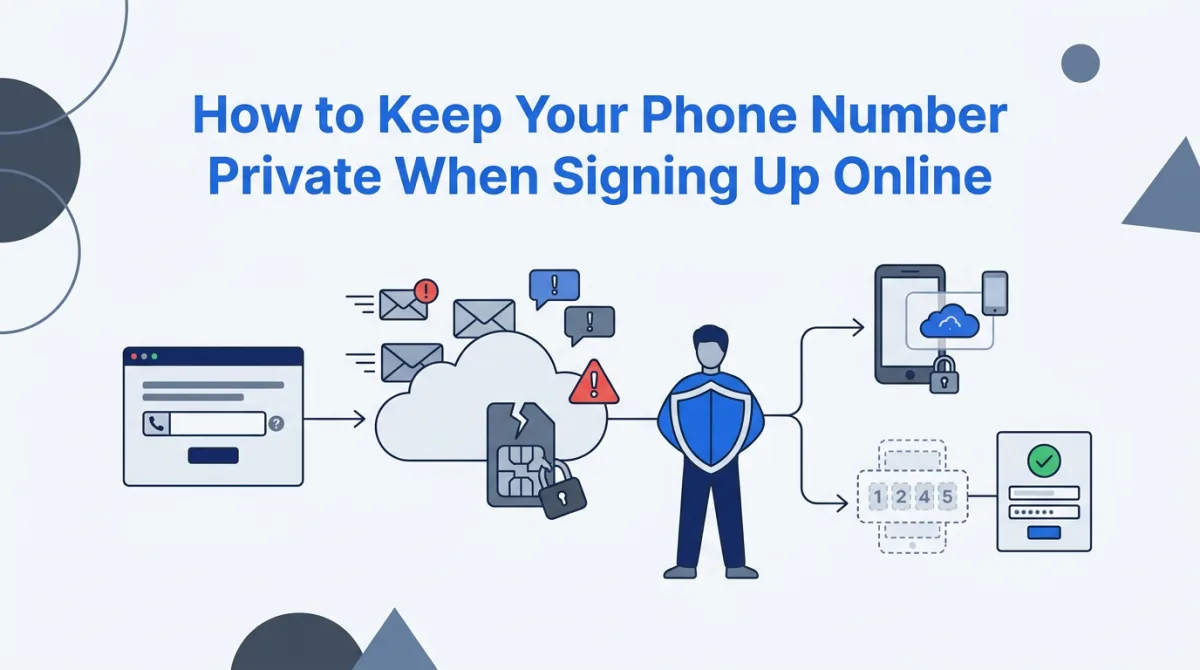
To keep your phone number private online, treat it as a permanent identifier and hand it over only when a service must actually reach you: leave optional fields blank, use an authenticator app instead of SMS, route required sign-ups through a dedicated secondary number, and use a reserved 555-0100 to 555-0199 placeholder for forms and test data that will never call you. The random phone number generator emits exactly those reserved-range US numbers on demand.
Your phone number is harder to change than your email and follows you across banks, social networks, loyalty programs, and government records. That permanence makes it the perfect key for linking your activity together, which is exactly why sign-up forms keep asking for it. This is a privacy guide, not a method for dodging verification you are legally required to complete. Where a use crosses into fraud, we say so plainly.
Why do websites ask for your phone number?
Websites ask for your phone number for one of three real reasons: account recovery and two-factor authentication, fraud and bot prevention, or marketing and identity matching with data brokers. Only the first two benefit you, and both usually have a safer alternative. A large share of phone fields exist only because they shipped with a form template.
| Stated reason | Who it really serves | Can you decline? |
|---|---|---|
| Two-factor authentication (2FA) | You, but an app or hardware key is safer | Often yes, choose an authenticator app instead |
| Account recovery | You, though email recovery usually works | Usually yes |
| Fraud and bot prevention | The business | Sometimes, depends on risk model |
| Marketing and SMS promotions | The business | Almost always yes |
| Identity matching with data brokers | The business and ad networks | Frequently, but rarely disclosed clearly |
| "Required" template field | Nobody, it is a default | Yes, the data is never used |
The U.S. Federal Trade Commission's 2014 report on nine data brokers found that those firms held information on nearly every U.S. household and stored billions of individual data elements, much of it collected without the consumer's knowledge [ftc-data-brokers]. When a checkout page demands a mobile number to ship a digital download, the field is almost always serving marketing or identity matching, not delivery.
What are the real risks of oversharing your number?
Oversharing your number creates four concrete harms: relentless spam from resold lead lists, cross-site tracking that links your accounts, targeted smishing that references your real services, and SIM-swap account takeover. Each risk grows every time your number lands in a new database, and the highest-severity ones turn your phone into a single point of failure for your logins.
How do data brokers turn your number into spam?
Once your number enters a data broker's file, it is sold, merged, and resold across lead lists. The FCC reports that Americans receive roughly 4 billion robocalls per month, and the agency issued a record $300 million robocall fine in 2023 against a single auto-warranty operation [fcc-robocalls]. To protect your phone number from spam, the most effective move is upstream: stop the number from spreading in the first place.
How does your phone number enable a SIM swap?
Because so many services use SMS for password resets and 2FA, your number is effectively a login credential. In a SIM-swap attack, a criminal ports your number to their own SIM and intercepts those codes. NIST Special Publication 800-63B classifies SMS as a 'restricted' authenticator and warns it can be redirected or intercepted [nist-63b]. The fewer places your real number appears, the smaller this attack surface becomes.
| Risk | How it happens | Likelihood | Severity |
|---|---|---|---|
| Spam calls and texts | Number sold by data brokers and lead lists | Very high | Low to medium |
| Cross-site tracking | Number used as a match key across ad platforms | High | Medium |
| Phishing and smishing | Targeted texts referencing your real accounts | High | Medium to high |
| SIM-swap takeover | Carrier social-engineered to port your line | Low to medium | Severe |
| Doxxing | Number reverse-looked-up to find name and address | Low | High |
Your phone number is a skeleton key. It unlocks your accounts, links your identities across services, and rarely changes. Treat it like a password you can never rotate.
How can you keep your phone number private?
You keep your phone number private by matching the tool to the situation: leave optional fields blank, swap SMS 2FA for an authenticator app, route must-reach sign-ups through a dedicated secondary or VoIP number, and use a reserved 555-0100 to 555-0199 placeholder for test data and forms that will never contact you. The table below ranks these tactics by protection against effort.
| Tactic | When to use it | Protection level | Effort |
|---|---|---|---|
| Data minimization (leave it blank) | Optional fields that do not block submission | High | Very low |
| Email or authenticator app instead of SMS | 2FA and account recovery | High | Low |
| Dedicated secondary number | Sign-ups that must text or call you | Medium to high | Medium |
| VoIP or virtual number | Public listings, marketplaces, dating apps | Medium | Medium |
| Format-valid placeholder (555-0100..555-0199) | Test data, QA, forms that never contact you | High | Very low |
| Carrier spam filtering plus Do Not Call registry | Cleaning up an already-exposed number | Low to medium | Low |
Start with data minimization
The cheapest privacy tactic is to share nothing. GDPR Article 5(1)(c) requires that personal data be limited to what is adequate, relevant, and necessary for a stated purpose, a principle EU regulators have enforced since the regulation took effect on May 25, 2018 [gdpr-minimization]. Apply the same logic as a user: if a phone field is optional, leave it empty. A service that refuses to function without a number it has no reason to call has told you how it will treat the rest of your data.
Use a secondary number when you must be reachable
When a sign-up genuinely needs to text or call you, a dedicated secondary number keeps your primary line clean. Use a second SIM, a VoIP line, or a virtual number from a reputable provider. The point is compartmentalization: if that number starts attracting spam, you can abandon it without disrupting your bank, your contacts, or your real 2FA codes.
Use a format-valid placeholder for test data and no-contact forms
For software testing, QA, demos, and the many forms that will never contact you, use a number guaranteed to be fictional. The North American Numbering Plan reserves 555-0100 through 555-0199, a block of exactly 100 numbers, for fictitious use, which is why 555-0123 shows up in films and documentation [nanpa-555]. These numbers are valid in format, so they pass length and pattern checks, yet they can never ring a real subscriber [wikipedia-555].
Our generator at / produces format-valid placeholder phone numbers drawn from this reserved range, alongside other fictional test data. It is built for QA engineers populating staging databases, designers mocking up forms, and privacy-minded users filling fields that have no business reaching them. You can read exactly how we handle and never retain your inputs on our /privacy page.
| Situation | Recommended choice | Why |
|---|---|---|
| Bank, brokerage, or other KYC signup | Your real, verified number | A verified number is legally required |
| You must receive an SMS one-time passcode | Real or dedicated secondary number | You need to actually receive the message |
| Newsletter or loyalty program | Leave blank or secondary number | No legal need; marketing is the real purpose |
| QA, staging database, automated tests | 555-0100..555-0199 placeholder | Never contacts anyone; passes format checks |
| Mockup, demo, or screenshot | 555-0100..555-0199 placeholder | Safe to publish; cannot ring a real line |
| Marketplace or dating profile | VoIP or virtual number | Reachable but disposable and compartmentalized |
Clean up a number that is already exposed
If your primary number is already circulating, you can still reduce the damage. Register it on the National Do Not Call Registry, which makes most legitimate telemarketing to your line unlawful and gives you a basis to report violators [donotcall]. Forward spam texts to 7726 so your carrier can act on them, enable built-in spam filtering, and submit opt-out requests to the major data-broker networks. These steps will not erase a number from every database, but they meaningfully slow the flow.
- Register your number at the National Do Not Call Registry and re-check it periodically.
- Forward unwanted texts to 7726 (SPAM) and block the sender.
- Switch every account you can from SMS 2FA to an authenticator app or hardware key.
- Use a separate secondary number for all future sign-ups that must reach you.
- Reserve a format-valid placeholder for test data and forms that never need to contact you.
How do you put it all together?
Put it together as a layered default, not a single switch. Share nothing first. When a service must reach you, decide whether it earns your real line or a compartmentalized secondary number. When a form will never contact you or you are generating test data, use a fake phone number for sign ups from the reserved 555-0100 to 555-0199 range. When the law or the service genuinely requires a verified, reachable number, use your real one.
That single distinction, between fields that need to reach you and fields that never will, separates smart privacy hygiene from fraud. Start with the placeholder generator at / for your test data and no-contact forms, and review how we protect your inputs at /privacy.
References & sources
- Data Brokers: A Call for Transparency and Accountability — U.S. Federal Trade Commission
- Stop Unwanted Robocalls and Texts — U.S. Federal Communications Commission
- NIST Special Publication 800-63B: Digital Identity Guidelines, Authentication — U.S. National Institute of Standards and Technology
- Article 5: Principles relating to processing of personal data (data minimisation) — GDPR-Info (EU General Data Protection Regulation)
- 555 Line Numbers — North American Numbering Plan Administrator (NANPA)
- 555 (telephone number) — Wikipedia
- National Do Not Call Registry — U.S. Federal Trade Commission
Frequently asked questions
Why do websites ask for my phone number?
Websites request a phone number for one of three reasons: account recovery and two-factor authentication, fraud prevention, or marketing and identity matching with data brokers. Only the first two benefit you, and both usually accept an authenticator app or email instead. Many forms ask only because the field ships with a template, not because the number is needed to deliver the service.
Is it illegal to use a fake phone number to sign up online?
Using a fictional or placeholder number on a form that does not legally require a verified number is generally not illegal. It becomes illegal when you use it to commit fraud, impersonate a real person, evade required identity verification (such as KYC for financial accounts), or obtain goods and services you do not intend to pay for. Never use a placeholder where the law or the service contract requires a reachable, verified number.
What is the 555-0100 to 555-0199 phone number range?
The North American Numbering Plan reserves 555-0100 through 555-0199, a block of 100 numbers, as fictitious numbers guaranteed never to be assigned to a real subscriber. They are the safe choice for movies, documentation, test data, and form fields that never need to reach you, because dialing one cannot accidentally ring a real person.
How do I stop spam calls and texts after giving out my number?
Register on the National Do Not Call Registry, enable your carrier's spam-blocking features, and report unwanted texts by forwarding them to 7726 (SPAM). For numbers already circulating among data brokers, file opt-out requests with the major broker networks and use a separate secondary number for future sign-ups so your primary line stays clean.
What is a SIM-swap attack and how does my phone number relate to it?
In a SIM-swap attack, a criminal convinces your carrier to move your number to a SIM card they control, intercepting your calls and SMS two-factor codes. Because your phone number doubles as a login credential on many services, exposing it widely increases your attack surface. App-based authentication and limiting where your real number appears both reduce the risk.
Should I use SMS two-factor authentication or an authenticator app?
Authenticator apps and hardware security keys are stronger than SMS because they cannot be intercepted by a SIM swap or SS7 network attack. NIST SP 800-63B classifies SMS as a 'restricted' authenticator. Use SMS only when no other option exists, and when a site forces it, a dedicated secondary number is safer than your main line.
More on phone numbers, texting and numbering plans
- Phone Number Validation Test Cases — CSV & JSON
- Fake Text Message Mockup: iMessage-Style Screenshots
- How to Protect Your Privacy Online With Fictional Details
- Disposable Email vs Fake Email Generator: What & When to Use
- ZIP Codes That Start With 0: States, List & Excel Fix
- Does Dubai Have a ZIP Code? UAE Postal Codes Explained