Mock Data vs. Real Data: Why Teams Test With Fake Profiles
Mock data vs real data: why testing with mock and synthetic profiles beats copying production, with a safety, compliance, and cost comparison.
By Vincent RuanPublished June 25, 2026Last updated June 25, 20269 min read
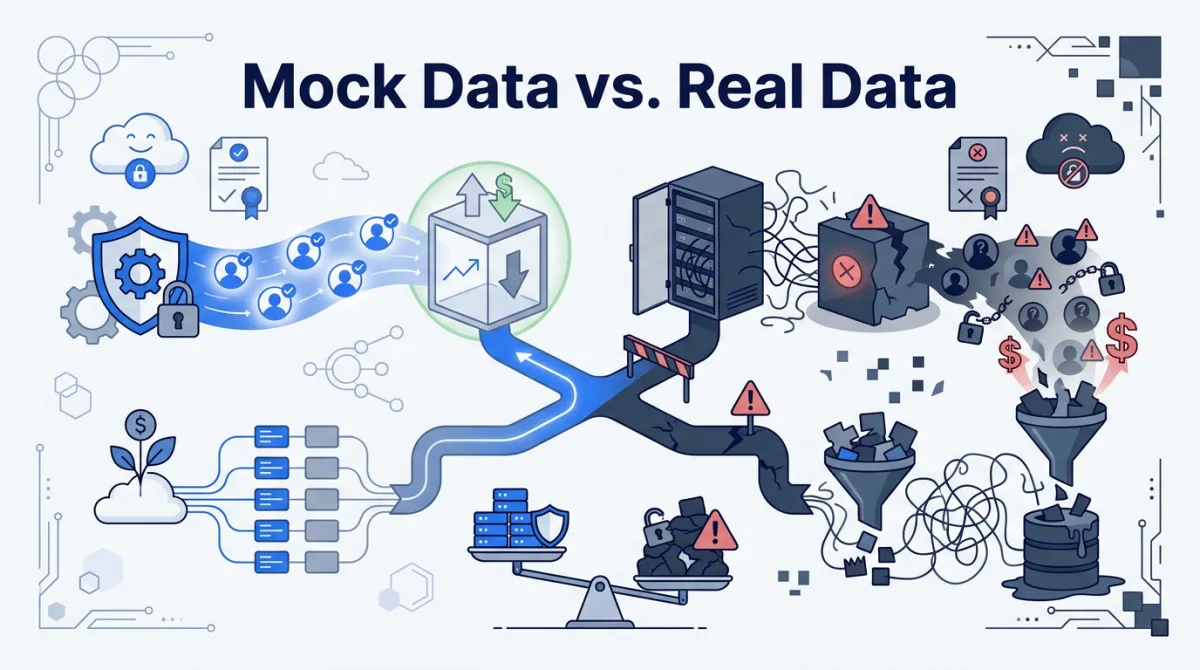
Mock data is fabricated test data that represents no real person; real data is a copy of live production records. For software testing, QA, and demos, mock and synthetic profiles are the safer default: they give you schema-valid, realistic data without pulling every laptop, CI runner, and staging database into GDPR scope or expanding your breach blast radius.
The pull toward real data is understandable. It is already there, it already matches your schema, and copying it feels like the honest way to find bugs. But what really separates the mock data vs real data options is how much legal, security, and operational risk you are willing to spread across every system that touches a copy; realism is a smaller part of the call than it first appears. This guide is for the people who own that call: engineering leads, QA, and compliance partners.
What are the three sources of test data?
Test data comes from exactly three sources: fully fabricated mock or synthetic data, masked production data (real records with identifiers obscured), and raw production data (a straight copy). Raw production wins only on realism and loses on privacy, regulatory scope, breach exposure, reproducibility, and shareability. Fabricated data is the only source you fully control.
| Factor | Mock / synthetic data | Masked production data | Raw production data |
|---|---|---|---|
| Privacy risk | Minimal — no real person represented | Reduced but not zero (re-identification risk) | High — full exposure of real individuals |
| Regulatory scope (GDPR/CCPA) | Generally out of scope | Often still in scope if re-identifiable | Fully in scope in every environment |
| Breach blast radius | Negligible | Partial — depends on masking quality | Maximal — every copy is a live target |
| Realism out of the box | High with good generation; tunable | High (it is real shape) | Highest |
| Edge-case coverage | Controllable — you can fabricate rare cases | Limited to what happened in prod | Limited to what happened in prod |
| Reproducibility | Deterministic with a fixed seed | Hard — data drifts with each refresh | Hard — data drifts constantly |
| Setup cost | Low to moderate | High — masking pipeline + validation | Low to copy, high in liability |
| Safe to share in tickets / demos | Yes | Risky | No |
Masked data sits in an awkward middle: expensive to build well, and still legally encumbered when the masking is weak. Mock and synthetic data is the one column where you set every variable yourself, including the rare edge cases production never happened to generate.
Why is production data in lower environments the real danger?
Copying production into staging, CI, or a developer's laptop is dangerous because lower environments have weaker access controls, logging, and segmentation than production, yet a copy there inherits the full legal weight of the original. The real cost shows up as three liabilities that rarely make it into the original ticket: breach exposure, regulatory scope, and the false safety of masking. Faking the data is the cheap part by comparison.
How does blast radius multiply with every copy?
Production usually carries your strongest controls: restricted access, network segmentation, audit logging, encryption at rest. Lower environments rarely match that. Copy real records into staging, a seeded local database, a CI artifact, or an analytics sandbox, and you have minted new copies of sensitive data in places with weaker defenses and broader reach. An attacker does not need your hardened production database when the same customer table sits in a staging box half the company can touch.
How does copying prod data drag every environment into regulatory scope?
Under the GDPR, personal data is any information relating to an identified or identifiable person, and the same protections apply wherever that data lives — there is no "it's only staging" exemption [gdpr-art4]. Copy real EU customer records into a test database and that database inherits lawful-basis, purpose-limitation, retention, and data-subject-rights duties in full.
When a user exercises their right to erasure under GDPR Article 17, you must find and delete them in every environment that holds a copy, including the CI cache nobody remembers seeding [gdpr-art17]. California's CCPA, in force since January 1, 2020 and expanded by the CPRA on January 1, 2023, works the same way: it governs personal information regardless of which system stores it, so a forgotten staging copy is still a record you must surface in access and deletion requests [ccpa-cppa]. Mock data describes no real person and generally falls outside both regimes.
| Obligation | Applies to raw prod copy? | Applies to good mock data? |
|---|---|---|
| Lawful basis for processing | Yes — including in test | No |
| Honoring deletion / erasure requests | Yes, in every copy | No |
| Honoring access (DSAR) requests | Yes, in every copy | No |
| Breach notification if exposed | Yes (within 72h under GDPR Art. 33) | No |
| Cross-border transfer controls | Yes | No |
| Retention limits / minimization | Yes | No |
Why is masking production data harder than it looks?
Masking fails because identity hides in field combinations, not single columns. Latanya Sweeney's foundational study found that 87 percent of the U.S. population was uniquely identifiable from just three quasi-identifiers — 5-digit ZIP code, full birth date, and gender [sweeney-reidentification]. Strip the name and email but leave those three intact, and records re-link to real people.
NIST Special Publication 800-188 makes the same point: effective de-identification means managing re-identification risk across the entire dataset, not just deleting obvious direct identifiers [nist-deid]. The more you mask to make data safe, the less it resembles production — so you pay for a complex masking pipeline to arrive at something a good fake-data generator gives you cheaply and without the liability.
Data can be either useful or perfectly anonymous but never both.
How do you make mock data realistic enough to trust?
Three techniques close the realism gap: deterministic seeding for reproducible runs, referential integrity so foreign keys resolve, and valid checksums plus country-correct formats so validators accept the data, all covered in depth in our test data generation guide. Done casually, mock data is a wall of "John Doe / 123 Main St / 555-0100" rows. Done with these techniques, synthetic profiles are indistinguishable from real ones to your code.
What is deterministic seeding and why does it matter?
Deterministic seeding means feeding a generator the same seed produces the exact same dataset every run. This is why fake data beats real data for testing, not just why it is safer. A flaky test that fails on "some customer" is hard to debug; a test seeded to produce customer #42 with a known profile fails the same way every time. Pin a seed per suite and your fixtures stay reproducible across machines and CI.
How do you keep referential integrity across tables?
Real systems are relational: an order points to a customer, which points to an address and a payment method. Mock data that ignores those links breaks the moment a join runs. Generate data where every foreign key resolves, every child row has a valid parent, and counts line up — a customer with three orders has exactly three order rows. This is where naive random generation falls apart and a purpose-built generator pays off.
How do you generate identifiers with valid checksums?
Many identifiers carry built-in check digits that validators reject when they fail. Payment cards use the Luhn mod-10 algorithm defined in ISO/IEC 7812 [luhn-iso], and the networks publish reserved test numbers (such as Visa's 4242 4242 4242 4242) that are Luhn-valid but never route to a real account [visa-test]. For card-shaped data that passes form validation, use known test numbers and confirm them with our credit card validator instead of inventing digits that fail at the first check. The same discipline governs names, addresses, and phone numbers, which must follow the conventions of the country you simulate.
| Field | Naive mock (fails) | Realistic mock (passes) | Technique |
|---|---|---|---|
| Credit card number | 1234 5678 9012 3456 | Network-published test number | Luhn-valid test ranges |
| test@test | ada.lovelace@example.org | RFC-shaped + reserved domain | |
| Phone (US) | 555-5555 | +1 415-555-0142 | 555-01xx reserved range, E.164 |
| Postal code (UK) | 00000 | EC1A 1BB | Country format rules |
| Customer → orders | Orphaned order rows | Every order has a valid customer | Referential integrity |
| Dataset across runs | Different every time | Identical for a fixed seed | Deterministic seeding |
How do you simulate many countries at once?
Single-locale test data hides a whole class of bugs: a form that assumes 5-digit US ZIP codes, a name field that chokes on diacritics, an address layout that breaks for Japan. If your product serves more than one market, generate profiles across the regions you actually serve. Our full identity generator produces complete, country-correct fictional profiles, and the generate by country page lets you target specific locales so QA covers the formats real users will type.
When does masked production data still earn its place?
A handful of cases genuinely benefit from real-shaped data: reproducing a specific production bug tied to a real record, load-testing against true distribution skew, or training models where statistical fidelity is the point. Even then, prefer high-quality synthetic data that mirrors production's statistics without copying records. If you must use masked production data, treat it as sensitive: scope it tightly, log access, and delete it on a schedule, exactly as you would the original.
| Scenario | Recommended source | Why |
|---|---|---|
| Unit / integration tests | Mock data, deterministic seed | Reproducible, fast, zero PII |
| Form & validation QA | Mock data, valid checksums | Exercises validators safely |
| Multi-country UX testing | Mock data across locales | Catches format-specific bugs |
| Demos and screenshots | Mock data only | Never expose real customers |
| Load testing at scale | Synthetic data (prod-shaped) | Realistic skew, no real records |
| Reproducing a specific prod bug | Minimal masked extract | Sometimes the only path; tightly scoped |
Is testing with fake profiles legitimate?
Yes. Fake profiles exist to make software testing safer, not to deceive anyone. Generated identities are fictional and represent no real person, which is exactly what makes them fit for QA, automated tests, form-filling, and protecting your own privacy. They are not a tool for fraud, impersonation, evading identity checks the law requires (KYC, AML, or age verification), or obtaining goods, services, or accounts under a false identity.
Those uses are illegal no matter how the data was generated, and a checksum-valid test card number will be declined by the networks precisely because it belongs to no one. Used for their intended purpose, mock and synthetic profiles let your team ship faster while keeping real people's data out of the places it was never meant to go.
References & sources
- Cost of a Data Breach Report 2024 — IBM
- GDPR Article 4 — Definitions (personal data) — GDPR.eu / Intersoft Consulting
- GDPR Article 17 — Right to erasure ('right to be forgotten') — GDPR.eu / Intersoft Consulting
- California Consumer Privacy Act (CCPA) — Official Resource — California Office of the Attorney General
- Simple Demographics Often Identify People Uniquely — Latanya Sweeney, Carnegie Mellon University
- NIST SP 800-188: De-Identifying Government Data Sets — National Institute of Standards and Technology (NIST)
- Luhn algorithm (mod 10 check digit, ISO/IEC 7812) — Wikipedia
- Testing — sample test card numbers — Stripe Documentation
- RFC 2606 — Reserved Top Level DNS Names (example domains) — IETF
Frequently asked questions
Is it illegal to test software with fake personal data?
No. Generating fictional names, addresses, and identifiers for software testing, QA, and form-filling is legitimate and common. It only becomes illegal when fake identities are used for fraud, impersonation, evading legally required identity verification (KYC/AML), or obtaining goods and services under a false identity. Test data stays inside your systems and represents no real person.
Why not just copy production data into staging?
Production data in lower environments expands your breach blast radius to every system that holds a copy, and it pulls dev, staging, and CI into the same GDPR and CCPA scope as production, including data-subject access and deletion obligations. Lower environments usually have weaker access controls and logging, so a copy there is often the easiest target for an attacker.
What is the difference between mock data and synthetic data?
Mock data is simple fabricated values used to satisfy a schema, often hardcoded or randomly generated. Synthetic data is fabricated to preserve the statistical shape of real data such as distributions, correlations, and edge cases, while containing no real records. Both are fictional; synthetic data is the more rigorous option when realism matters for performance or analytics testing.
Does masking production data make it compliant?
Masking helps but rarely removes all risk. Poorly masked datasets can be re-identified by linking quasi-identifiers such as ZIP code, birth date, and gender. Unless the result is genuinely anonymized so individuals cannot be singled out, masked production data may still count as personal data under GDPR and stays partly in regulatory scope.
How do I generate realistic fake data that passes validation?
Use deterministic seeding so the same seed produces the same dataset for reproducible tests, enforce referential integrity so foreign keys line up across tables, and generate identifiers with valid checksums (for example Luhn-valid test card numbers) so your validators accept them. A generator that mirrors real country formats for names, addresses, and phone numbers covers most cases.
Can fake test card numbers be used to make real purchases?
No. Checksum-valid test numbers pass format validation but are not issued to anyone and will be declined by payment networks. They exist to test form validation and error handling. Attempting to use any card number to obtain goods or services you have not paid for is fraud.