PII in Test & Staging Environments: Risks and How to Replace It
PII in test and staging: how to identify personal data in non-production, the risks of copying prod, what GDPR, CCPA, HIPAA, and PCI-DSS require.
By Vincent RuanPublished June 25, 2026Last updated June 25, 20269 min read
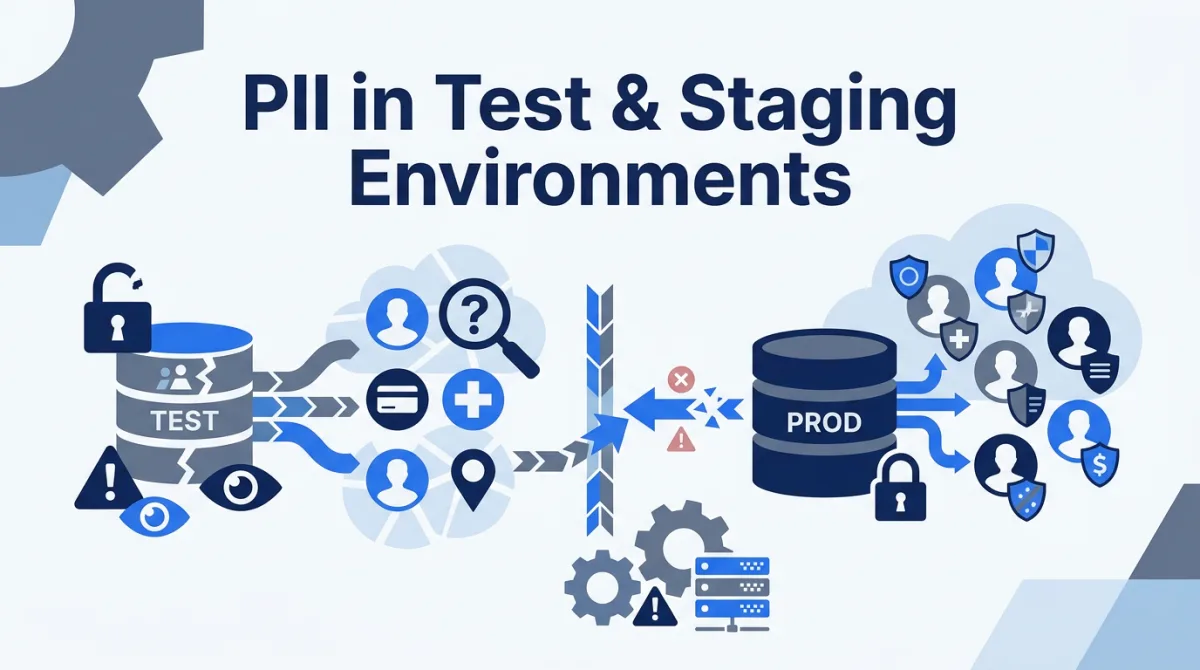
PII in a test or staging environment is exactly the same regulated personal data it was in production; the environment does not change its legal status. Direct identifiers, quasi-identifiers, and sensitive attributes all stay in scope under GDPR, CCPA, HIPAA, and PCI-DSS the moment they land in a lower environment. This guide explains what counts as PII outside production, why holding it there is a real liability, and how to replace it with fictional data.
Most teams encrypt production, enforce least-privilege access, and turn on audit logging, then clone that same database into a staging box that three contractors, a CI runner, and a forgotten analytics sandbox can all read. The records did not become less sensitive in transit. If you lead engineering, run QA, or answer for compliance, the practical fix is the same: replace production copies with synthetic profiles generated from reserved and never-issued ranges that look real to your software but correspond to no living person.
What counts as PII in non-production data?
PII in non-production data falls into three categories: direct identifiers that point to one person alone (name, email, SSN), quasi-identifiers that single someone out only in combination (ZIP, birth date, gender), and sensitive attributes that carry extra legal weight on their own (health, biometric, financial). All three remain regulated in test systems, and the direct-versus-indirect line drives nearly every de-identification call.
GDPR Article 4(1) defines personal data as any information relating to an identified or identifiable natural person, and it explicitly covers indirect identification through factors like an identification number, location data, or one or more factors specific to that person [gdpr-art4]. The phrase "one or more factors" is what pulls quasi-identifiers into scope. Latanya Sweeney's research at Carnegie Mellon demonstrated the stakes: the combination of five-digit ZIP code, full date of birth, and gender uniquely identifies roughly 87 percent of the US population [sweeney-reid]. Three columns most teams consider harmless re-identify almost everyone.
| Category | Identifies a person? | Examples | Handling in non-prod |
|---|---|---|---|
| Direct identifier | Yes, on its own | Full name, email address, phone number, Social Security number, passport number, account login | Remove or replace with fictional values; never copy real ones into test |
| Quasi-identifier (indirect) | Only combined with other fields | ZIP/postal code, date of birth, gender, job title, employer, device ID | Replace or generalise; combinations re-identify even when each field looks harmless |
| Sensitive attribute | Carries extra legal weight regardless | Health condition, biometric template, race, religion, sexual orientation, financial balance, criminal record | Highest priority to remove; many regs treat these as special categories |
Why is pseudonymisation not the same as anonymisation?
Pseudonymisation reduces risk but keeps data regulated; anonymisation removes it from scope entirely. Hashing an email, encrypting a name, or swapping a customer ID for a token feels like de-identification, but if the transformation is reversible or the value can be re-linked, GDPR still treats it as personal data. Anonymisation means re-identification is no longer reasonably possible. Everything short of that bar leaves a masked database capable of leaking a breach-worthy dataset.
What are the risks of copying production into staging?
Copying production into staging multiplies your breach blast radius, widens access far beyond who can touch production, and pulls every lower environment into regulatory audit scope. The single most common shortcut in software delivery, restoring last night's prod backup so QA has realistic data, takes your most sensitive records and stores them under your weakest defences. Three risk dimensions get overlooked most often.
| Risk | What happens | Why non-prod makes it worse |
|---|---|---|
| Breach blast radius | One copy becomes many: staging, QA, dev laptops, CI artifacts, backups | Lower environments rarely have prod-grade encryption, monitoring, or retention limits, so a single record sprawls into dozens of weakly guarded copies |
| Access sprawl | Contractors, vendors, and broad engineering groups get read access for testing | People who could never touch production routinely query staging, widening the human attack surface and the insider-risk pool |
| Regulatory scope creep | Every system holding the data falls under GDPR, CCPA, HIPAA, or PCI-DSS | Each lower environment becomes auditable in-scope infrastructure, multiplying assessment cost and breach-notification obligations |
| Logging and leakage | Real PII ends up in application logs, error traces, and screenshots | Debug verbosity is higher in non-prod, so sensitive values leak into log aggregators and ticket attachments |
| Stale-data liability | Old prod copies linger long after the customer deleted their account | Erasure requests fulfilled in production do not propagate to forgotten staging snapshots, creating silent compliance violations |
The numbers make the exposure concrete. IBM's 2024 Cost of a Data Breach Report puts the global average breach cost at USD 4.88 million, a 10 percent jump over 2023 and the highest figure in the study's history [ibm-breach]. A staging environment full of copied production records holds the same data as production but defends it with far less, which makes it just as attractive a target. A breach there is reported, investigated, and penalised on identical terms. GDPR Article 33 gives you 72 hours to notify regulators whether the leak came from production or a test box.
A test database that contains real customer records is a production database that happens to be poorly defended.
What do GDPR, CCPA, HIPAA, and PCI-DSS require for non-production data?
None of the major frameworks exempt test systems. Personal data is in scope wherever it lives, so GDPR's security and minimisation duties, CCPA's deletion rights, HIPAA's safeguards, and PCI-DSS's storage rules all apply to staging and dev exactly as they apply to production. PCI-DSS goes furthest, outright banning live card numbers from pre-production. The table below maps the headline requirements that bear on lower environments.
| Framework | What it covers | Implication for test/staging |
|---|---|---|
| GDPR (EU) | Art. 4 defines personal data incl. indirect identifiers; Art. 5 demands data minimisation and purpose limitation; Art. 32 requires security of processing | A test environment is processing. Minimisation argues against holding real data at all; if you do, it must be secured to the same standard [gdpr-art4] |
| CCPA / CPRA (California) | Defines personal information broadly, including household and inferred data; grants access, deletion, and opt-out rights | Personal information in staging is subject to deletion requests and counts toward your obligations; copies must be tracked and purgeable [ccpa] |
| HIPAA Safe Harbor (US health) | Lists 18 identifiers that must be removed for de-identification of protected health information | Removing all 18 identifiers takes data out of PHI scope; anything less keeps the test box inside HIPAA's safeguards [hipaa-safeharbor] |
| PCI-DSS (payment cards) | Requirements 3 and 6 restrict storage of cardholder data and forbid live PANs in test/development | Req. 6.4.3 (v3.2.1) and current Req. 6.5.5 (v4.0) prohibit production account data (live PANs) in pre-production; use sandbox test card numbers only [pci-dss] |
How do HIPAA's 18 identifiers work as a redaction checklist?
HIPAA Safe Harbor lists 18 identifier types that must be stripped before health data counts as de-identified, and it doubles as the most concrete redaction checklist any team can borrow, even outside healthcare. The list includes names, all geographic subdivisions smaller than a state, every date element finer than year for dates tied to an individual, phone and fax numbers, email addresses, SSNs, medical record numbers, account numbers, biometric identifiers, and full-face photographs [hipaa-safeharbor]. If your test dataset still holds any of these tied to a real person, it is not de-identified, full stop.
How do you replace PII with fictional test data?
Replace PII with generated synthetic data: records that are structurally valid, pass your validation logic, and exercise the same code paths, yet correspond to no real person because they are drawn from reserved or never-issued ranges. Once you accept that real personal data does not belong in lower environments, the work is mechanical, swap each real field for a fictional equivalent built to be safe by construction.
Our generator at / produces fictional names, addresses, emails, phone numbers, and document-style numbers for this exact purpose. Phone numbers come from ranges reserved for fiction and testing, identifier numbers use never-issued or sandbox patterns, and addresses are plausible without belonging to a specific household. For locale-correct formats, /countries matches the conventions of the markets you operate in, and /privacy explains how the tool itself avoids retaining what you generate.
| Real field type | Why it is risky in test | Generated replacement |
|---|---|---|
| Customer full name | Direct identifier; ties record to a real person | Fictional name from generated name pools, locale-aware |
| Email address | Direct identifier; often reused as login | Synthetic address on example/test domains that bounce safely |
| Phone number | Direct identifier; can ring a real person | Number from reserved fictional ranges (e.g. 555-style / documentation blocks) |
| National ID / SSN-style | Highly sensitive; uniquely identifying | Structurally valid number from never-issued or reserved ranges |
| Payment card PAN | Prohibited in test by PCI-DSS | Published sandbox test card number from the relevant network |
| Date of birth + ZIP | Quasi-identifiers; re-identify in combination | Randomised, internally consistent fictional values |
What is generated data for, and what is it not?
Generated identities exist for software testing, QA, automated test fixtures, form-filling, demos, and protecting your own privacy in low-stakes signups. They exist to stand in for real records, never to deceive anyone. Using a fabricated name, number, or document to open a real bank account, pass a Know Your Customer (KYC) check, claim a benefit, or evade any legally required identity verification is fraud, and it is illegal regardless of how the data was produced. Where a use would break the law, the honest answer is that you cannot do it. The entire value of synthetic data comes from the fact that it represents no one.
What does a practical migration path look like?
- Inventory every non-production environment and identify which ones currently hold copied production data, including backups and CI artifacts.
- Classify the columns using the direct / quasi / sensitive framework above, and map them against the HIPAA 18-identifier list as a redaction checklist.
- Replace direct identifiers and sensitive attributes with generated fictional values, and randomise or generalise quasi-identifiers so combinations cannot re-identify.
- Switch payment flows to published sandbox test card numbers; never restore real PANs.
- Add a pipeline guardrail that fails any refresh attempting to load real production records into a lower environment.
- Document the new data provenance so auditors can see that staging contains synthetic data, shrinking your in-scope footprint.
Done well, this removes whole environments from breach blast radius and audit scope at once. No real person sits behind a generated record, so there is no re-identification risk, no erasure obligation, and no 72-hour notification clock if that data ever leaks. Defending fictional data in staging is a categorically stronger position than defending real data in places it was never meant to live.
References & sources
- GDPR Article 4 — Definitions (personal data, identifiers) — GDPR-Info / Intersoft Consulting
- California Consumer Privacy Act (CCPA) overview — California Office of the Attorney General
- Methods for De-identification of PHI (Safe Harbor, 18 identifiers) — U.S. Department of Health and Human Services
- PCI DSS: Requirements and Security Assessment Procedures — PCI Security Standards Council
- Cost of a Data Breach Report 2024 — IBM Security
- Simple Demographics Often Identify People Uniquely (ZIP, DOB, gender re-identification) — Data Privacy Lab, Carnegie Mellon University (L. Sweeney)
Frequently asked questions
Does PII in a test environment count as a data breach if it leaks?
Yes. Regulators assess breaches by whether personal data was exposed, not by which environment held it. A leaked staging database full of copied production records is a reportable breach under GDPR Article 33 and most US state laws, with the same 72-hour notification clock and penalties as a production leak.
Is a hashed or truncated email address still PII in non-production data?
Often, yes. Hashing is pseudonymisation, not anonymisation, when the original value can still be recovered or re-linked. Under GDPR a pseudonymised value remains personal data. Truncated card PANs stay in PCI-DSS scope depending on how many digits remain. Only irreversible removal or fully synthetic replacement takes data out of scope.
What is the difference between a direct identifier and a quasi-identifier?
A direct identifier points to one person on its own (full name, Social Security number, email). A quasi-identifier (also called an indirect identifier) identifies no one alone but can single someone out when combined with others. Latanya Sweeney showed that ZIP code, birth date, and gender together uniquely identify about 87 percent of the US population.
Can we just mask production data instead of generating synthetic data?
Masking helps, but poorly applied masking leaves quasi-identifiers and referential patterns intact, which can allow re-identification. Generating fictional profiles from never-issued ranges avoids the problem entirely because there is no real person behind the record to re-identify.
Does HIPAA allow real patient data in a test environment?
Only if the test environment is treated as part of the covered system with full safeguards, business associate agreements, and access controls, which is expensive and risky. The HIPAA Safe Harbor method lets you de-identify by removing 18 specified identifiers; data that meets Safe Harbor is no longer protected health information. Synthetic patient records sidestep the question by containing no real PHI.
Is it ever legal to use a generated identity to pass a real verification check?
No. Generated identities are for software testing, QA, form-filling, and privacy. Using a fictional name, number, or document to open a real account, pass KYC, or evade a legally required identity check is fraud and is illegal regardless of the tool used to create the data.
More on privacy law and anonymization
- How to Protect Your Privacy Online With Fictional Details
- Disposable Email vs Fake Email Generator: What & When to Use
- Synthetic Data for GDPR Compliance: Anonymization Done Right
- CCPA vs GDPR for Non-Production Test Data
- Data Anonymization Techniques Compared
- Data Masking vs Tokenization: Differences & Test Data