Test Data Management: 9 Best Practices for Reliable Test Suites
Test data management best practices: lifecycle stages, masking vs synthetic vs prod copies, subsetting, refresh, versioning, and a 9-point checklist.
By Vincent RuanPublished June 25, 2026Last updated July 23, 20269 min read
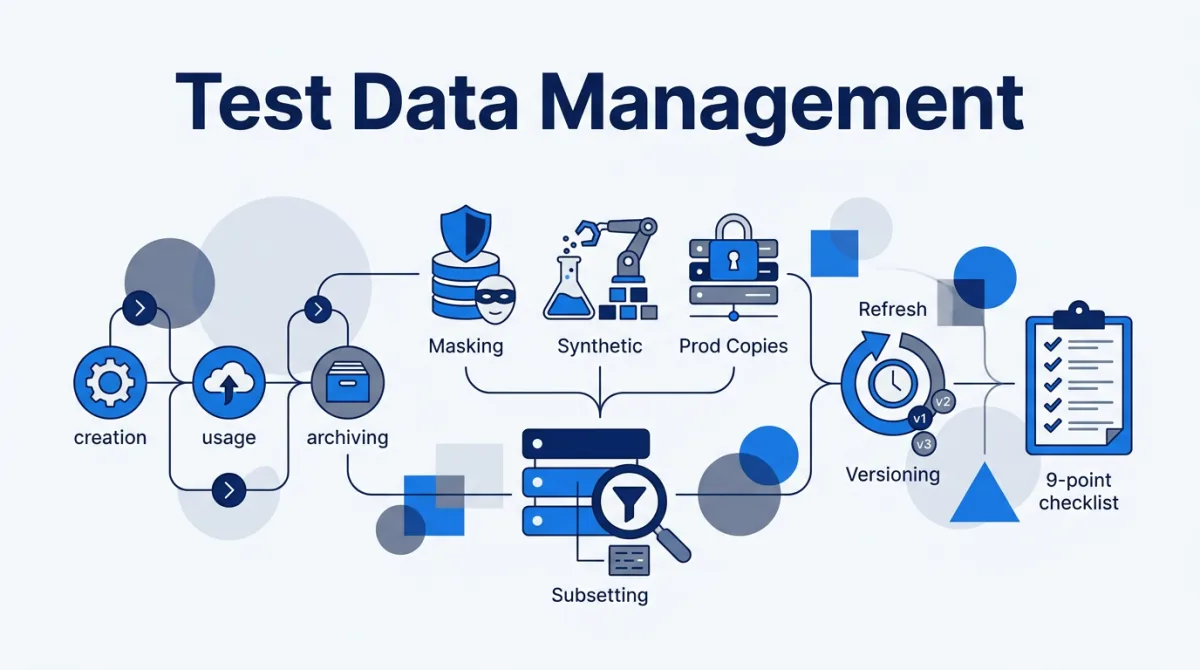
Flaky suites, leaked customer records, and "works on my machine" bugs often trace back to one root cause: nobody owns the test data. Test data management (TDM) turns that data into a governed asset with a defined lifecycle, so QA leads and test engineers can ship reliable suites without copying sensitive production records into every environment. This guide covers the TDM lifecycle, the three sourcing approaches, nine best practices, and the anti-patterns that quietly break test reliability.
What is test data management and why does it matter?
Test data management is the practice of planning, provisioning, masking, subsetting, refreshing, versioning, and disposing of the data used across test environments. It treats test data as a managed asset governed by a lifecycle, not as disposable fixtures. Done well, TDM makes suites deterministic, controls storage cost, and keeps personal data out of non-production systems.
The stakes are concrete. Personal data copied into a staging database is still personal data under GDPR Article 4(1), and a breach there carries the same exposure as production [gdpr-art4]. Meanwhile, full-volume production clones inflate storage and slow every pipeline. A disciplined TDM strategy answers four questions for every suite: where does the data come from, how is it protected, how is it kept current, and when is it destroyed.
What are the stages of the test data lifecycle?
The test data lifecycle has six stages: plan, provision, protect, distribute, refresh, and retire. Each stage has an owner and an exit criterion. Planning defines coverage needs; provisioning sources the data; protection masks or synthesizes it; distribution delivers it to environments; refresh keeps it current; retirement disposes of it on a schedule to limit exposure and cost.
| Stage | Goal | Key activity | Exit criterion |
|---|---|---|---|
| 1. Plan | Define what data the tests need | Map test cases to data requirements and coverage | Documented data requirements per suite |
| 2. Provision | Obtain the raw data | Subset from prod, or generate synthetic | Dataset available in a staging store |
| 3. Protect | Remove personal data risk | Mask, pseudonymize, or fully synthesize | No production PII remains in non-prod |
| 4. Distribute | Deliver data to environments | Seed databases, fixtures, or sandboxes | Each environment provisioned and isolated |
| 5. Refresh | Keep data current with schema | Re-subset or regenerate on a cadence | Data matches current schema and rules |
| 6. Retire | Dispose of stale or sensitive data | Automated cleanup and teardown | Data removed per retention policy |
Should you use production copies, masked subsets, or synthetic data?
Choose the approach by weighing realism against privacy risk and cost. Raw production copies offer maximum realism but carry the highest privacy risk and storage cost. Masked subsets balance realism with reduced risk. Fully synthetic data carries the lowest privacy risk and cost while requiring effort to model realistic edge cases. Most regulated teams blend masked subsets with synthetic generation.
| Approach | Realism | Privacy risk | Storage cost | Best for |
|---|---|---|---|---|
| Raw production copy | Highest | Highest (real PII) | Highest (full volume) | Last-resort prod incident repro only |
| Masked / pseudonymized subset | High | Reduced (PII obscured) | Low (subset) | Integration and UAT environments |
| Synthetic generation | Configurable | Lowest (no real PII) | Lowest | Unit, component, and CI tests |
Masking transforms real values into realistic but non-identifying ones (for example, replacing a name while keeping its format). Pseudonymization, defined in GDPR Article 4(5), replaces identifiers so data can no longer be attributed to a person without separately held information [gdpr-art4]. Synthetic generation invents records from scratch using reserved ranges, so there is no source person to re-identify. NIST SP 800-188 documents how properly applied de-identification reduces privacy risk [nist-800-188]. For generating those records at scale, see the dedicated /blog/test-data-generation-guide, and use the /bulk tool to produce large seeded datasets.
De-identification techniques, when properly applied, can substantially reduce the privacy risk associated with the use, sharing, and storage of personal data.
What are the 9 best practices for test data management?
The nine core TDM best practices are: treat data as a versioned asset, subset instead of cloning, mask at the source, prefer synthetic for sensitive fields, isolate data per test, seed for determinism, automate refresh, automate cleanup, and audit data lineage. Together they keep suites fast, reproducible, and compliant while controlling storage and privacy exposure.
| # | Practice | What it prevents |
|---|---|---|
| 1 | Version test data alongside the code that consumes it | Drift between fixtures and schema |
| 2 | Subset production data instead of full clones | Storage bloat and slow pipelines |
| 3 | Mask or pseudonymize at the source boundary | PII leaking into non-prod systems |
| 4 | Prefer synthetic data for sensitive fields | Re-identification risk on PII columns |
| 5 | Isolate data per test or per run | Cross-test contamination and order dependence |
| 6 | Seed generators with fixed values | Non-deterministic, flaky assertions |
| 7 | Automate refresh on a defined cadence | Stale data that misses schema changes |
| 8 | Automate cleanup and teardown | Accumulating state and exposure windows |
| 9 | Audit data lineage and retention | Untracked PII and compliance gaps |
How do you keep test data deterministic and isolated?
Keep test data deterministic by seeding generators with fixed values, isolating state per test, and tearing down after each run. A fixed seed means the same inputs produce the same records every time, so assertions stay stable. Isolation prevents one test from mutating data another test reads, which is the most common source of order-dependent flakiness.
A worked example: seed a generator with the integer 42 to produce a fixed batch of 1,000 fictional customers. Every CI run rebuilds the identical 1,000 records, so a checkout test that expects customer #500 to have a specific cart total passes deterministically. Change the seed to 43 and you get a different but equally reproducible batch for a parallel shard. The / generator and /bulk export both support seeded output for exactly this pattern.
When should you refresh versus regenerate test data?
Refresh masked subsets on a schedule tied to schema volatility, and regenerate synthetic data on every CI run. Integration environments typically re-subset nightly or weekly so they track production schema changes. Unit and component tests regenerate fresh synthetic fixtures each run because generation is cheap and avoids shared mutable state. Match cadence to how fast your schema and rules change.
- Per CI run: Regenerate synthetic unit and component fixtures from a fixed seed.
- Nightly: Re-subset and re-mask integration data after the daily production schema sync.
- Weekly or per release: Refresh UAT datasets to reflect new business rules and reference data.
- On demand: Snapshot and provision a fresh masked subset to reproduce a specific production defect.
What TDM anti-patterns break test reliability?
The most damaging TDM anti-patterns are sharing one mutable dataset across all tests, copying unmasked production data into staging, hardcoding magic IDs, and never cleaning up. Each one trades short-term convenience for long-term flakiness or compliance exposure. Recognizing them early lets QA leads redirect effort toward versioned, isolated, and disposable data.
| Anti-pattern | Why it hurts | Replace with |
|---|---|---|
| Shared mutable golden database | Tests pollute each other; order matters | Per-test isolation and teardown (#5, #8) |
| Unmasked production copy in staging | Live PII exposure outside prod | Mask at source or synthesize (#3, #4) |
| Hardcoded magic record IDs | Brittle when data is regenerated | Seeded, referenced fixtures (#1, #6) |
| Full-volume clone for every env | Storage bloat, slow refresh | Targeted subsetting (#2) |
| No retention or cleanup policy | Stale data and growing risk surface | Automated retire stage (#8, #9) |
How do you put a TDM strategy into practice?
Start by classifying your data, then automate the lifecycle. Inventory which fields are personal data under GDPR and similar laws, decide masked-versus-synthetic per field, wire provisioning and cleanup into CI, and version every dataset with the code that uses it. A pragmatic TDM strategy reaches reliability faster by synthesizing sensitive fields and subsetting the rest.
- Classify: Tag every column as PII, sensitive, or safe, referencing your privacy program and applicable law such as the CCPA definition of personal information [ccpa-1798140].
- Decide per field: Synthesize PII and sensitive fields; subset and mask the rest to preserve referential integrity.
- Automate provisioning: Generate seeded synthetic data in CI and provision masked subsets to shared environments on a schedule.
- Version and isolate: Store data definitions in source control next to tests; isolate state per run.
- Automate retirement: Tear down ephemeral data after each suite and enforce retention on shared datasets.
For teams measuring the payoff: industry surveys consistently rank test data and environment provisioning among the top constraints on test cycle time, and the ISTQB Foundation syllabus (v4.0, 2023) lists test data preparation as a core part of the fundamental test process [istqb-syllabus]. Treating that preparation as a managed lifecycle, rather than a per-sprint scramble, is what separates reliable suites from flaky ones.
References & sources
- GDPR Article 4 — Definitions (personal data, pseudonymisation) — EU GDPR (gdpr-info.eu)
- NIST SP 800-188: De-Identifying Government Datasets — NIST
- California Civil Code § 1798.140 — CCPA definitions of personal information — California Legislative Information / OAG
- RFC 5737 — IPv4 Address Blocks Reserved for Documentation — IETF
- RFC 2606 — Reserved Top Level DNS Names (example.com, .test) — IETF
- ISTQB Certified Tester Foundation Level Syllabus v4.0 (2023) — ISTQB
Frequently asked questions
What is test data management (TDM)?
Test data management is the practice of planning, creating, provisioning, masking, subsetting, refreshing, versioning, and disposing of the data used across testing environments. It treats test data as a governed asset with a defined lifecycle rather than ad-hoc fixtures, so test suites stay deterministic, compliant, and cheap to maintain.
Is TDM the same as test data generation?
No. Generation produces records (names, addresses, card-shaped numbers). Management is the broader strategy that decides which data to use, how to mask production data, how to subset it, when to refresh, how to version it with code, and how to clean it up. Generation is one tool inside a TDM program.
Should I copy production data into test environments?
Full production copies are the easiest to obtain but carry the highest privacy risk and storage cost. Most regulated teams use masked subsets or synthetic data instead. If you must use production-derived data, mask or pseudonymize it before it leaves the production boundary, per GDPR Article 4(5) and NIST guidance.
How do I keep test data deterministic?
Seed generators with fixed values, version test data alongside the code that consumes it, isolate data per test or per run, and tear down state after each suite. Avoid relying on shared mutable fixtures or live production snapshots that drift between runs.
What card and ID numbers are safe to use in test data?
Use reserved and sandbox ranges only: documentation IP blocks (RFC 5737), example domains (RFC 2606), card-network test numbers, and never-issued identifier ranges. These are designed for testing and cannot map to a real person or account, keeping fictional data strictly for QA and privacy work.
How often should test data be refreshed?
Refresh cadence depends on schema volatility and data sensitivity. A common pattern is refreshing masked subsets nightly or weekly for integration environments and regenerating synthetic data on every CI run for unit and component tests, balancing freshness against the cost and risk of re-masking.
More on test data practice
- What Is Synthetic Test Data? A Developer's Guide
- Test Data Generation Guide: Schemas, Rows & Edge Cases
- Mock Data vs. Real Data: Why Teams Test With Fake Profiles
- Deterministic Test Data Seeding: Faker Examples
- Synthetic Data for ML: Evaluation and Common Mistakes
- Email Validation Test Cases — CSV, JSON & 8 Validators