What Is a ZIP Code? Format, Structure & How They Work
How a US ZIP code is built: the 5-digit national-area, SCF, and delivery structure, ZIP+4, first-digit region map, and why ZIP-to-state consistency matters.
By Vincent RuanPublished June 27, 2026Last updated August 23, 20269 min read
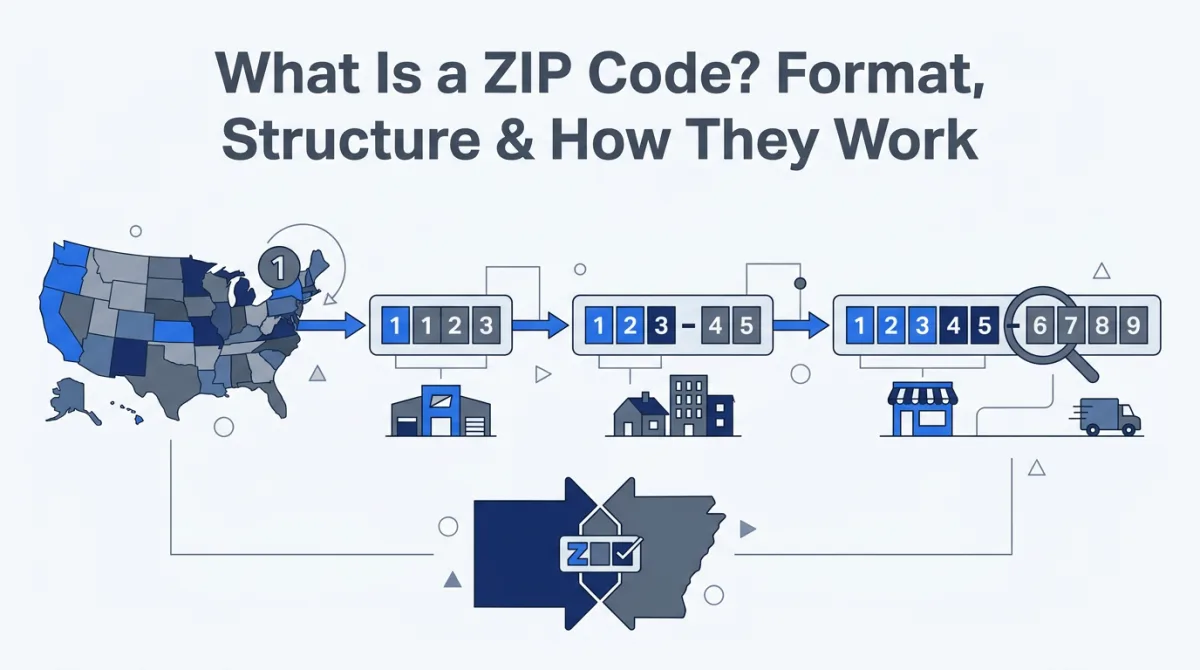
A ZIP code is the 5-digit number the US Postal Service uses to route mail to a delivery area. It is read left to right as a hierarchy: the first digit picks a national region, the next two point to a regional sorting hub, and the last two land on a specific post office or delivery zone. This guide breaks down each segment, explains the optional ZIP+4 add-on, maps the first digit to its region, and shows why ZIP-to-state consistency is the rule that makes or breaks address validation.
What is a ZIP code?
ZIP stands for Zone Improvement Plan. The Post Office Department introduced the 5-digit ZIP code on July 1, 1963 to handle a surge in mail volume that local clerks could no longer sort from memory [usps-history]. Instead of every clerk knowing every town, a ZIP code lets automated equipment route a letter through a chain of regional facilities to the correct local post office. The system was promoted by a cartoon mascot, Mr. ZIP, and adoption became near-universal after the Postal Service began encouraging ZIP codes on all classes of mail.
A ZIP code describes a path through the mail network, not a place on a map with hard borders. That distinction matters for software: a ZIP code reliably tells you which region and post office serve an address, but it does not draw a city or county line. To produce records that respect this structure, you can generate a valid random ZIP paired with its real state for testing instead of typing five arbitrary digits that may not correspond to any real region.
How is a 5-digit ZIP code structured?
The five digits form three nested zones. The first digit identifies one of 10 national areas, a group of states. The second and third digits identify a sectional center facility (SCF), the regional processing hub that serves a cluster of post offices. The fourth and fifth digits identify the specific post office or delivery area within that SCF region [usps-history]. Reading the code is like zooming in: country region, then sorting hub, then local destination.
Take 20500, the ZIP code for the White House. The leading 2 places it in the Mid-Atlantic national area. The 05 identifies the SCF that processes mail for Washington, DC. The final 00 narrows it to a specific delivery station. The same logic applies to every 5-digit code in the country.
| Segment | Digits in example | Scope | What it identifies |
|---|---|---|---|
| 1st digit | 2 | National area | One of 10 multi-state regions (here, the Mid-Atlantic) |
| 2nd-3rd digits | 05 | Sectional center facility (SCF) | The regional sorting hub serving a group of post offices |
| 4th-5th digits | 00 | Delivery area | A specific post office, station, or local delivery zone |
The first three digits together, called the ZIP-3 or SCF prefix, are the workhorse of mail routing. Sorting equipment can move a piece most of the way to its destination using just those three digits, which is why bulk mailers and shipping systems index so heavily on the ZIP-3.
What do the first digits of a ZIP code mean by region?
The first digit was assigned geographically, climbing roughly from the Northeast (0) toward the West Coast (9). This is why a Massachusetts ZIP starts with 0 and a California ZIP starts with 9. The mapping is not perfectly contiguous, but it gives a fast way to sanity-check which part of the country a ZIP belongs to [usps-history] — you can see it in action on the New York and California address pages, where every generated ZIP stays inside the local prefix range. The table below lists each first-digit national area with example states.
| First digit | National area | Example states |
|---|---|---|
| 0 | Northeast | CT, MA, ME, NH, NJ, RI, VT (plus PR, VI) |
| 1 | Northeast / Mid-Atlantic | Delaware, New York, Pennsylvania |
| 2 | Mid-Atlantic / Southeast | DC, Maryland, North Carolina, Virginia |
| 3 | Southeast | Alabama, Florida, Georgia, Tennessee |
| 4 | Midwest (Great Lakes) | Indiana, Kentucky, Michigan, Ohio |
| 5 | Midwest (Upper) | Iowa, Minnesota, Montana, Wisconsin |
| 6 | Central | Illinois, Kansas, Missouri, Nebraska |
| 7 | South Central | Arkansas, Louisiana, Oklahoma, Texas |
| 8 | Mountain West | Arizona, Colorado, Nevada, New Mexico, Utah |
| 9 | West | Alaska, California, Hawaii, Oregon, Washington |
What is ZIP+4 and when do you need it?
ZIP+4 is the 5-digit ZIP code followed by a hyphen and four more digits, introduced in 1983 to support automated sorting [usps-history]. The first two add-on digits identify a delivery sector (a few blocks, a group of streets, or a large building), and the last two identify a delivery segment (one side of a street, a single floor, a bank of PO boxes, or a specific high-volume receiver). The White House full code, for example, is written 20500-0005.
ZIP+4 is optional for ordinary senders, but it lets the Postal Service sort mail down to the carrier-route or even building level, which is why bulk mailers use it to earn automation postage discounts. Most consumer forms only collect the 5-digit ZIP and let the USPS look up the +4 automatically during processing.
| Form | Example | Resolves to | Typical use |
|---|---|---|---|
| 5-digit ZIP | 20500 | A post office / local delivery area | Most online forms, shipping rate lookups |
| ZIP+4 | 20500-0005 | A block, building, or PO box group | Bulk mail, automation discounts, precise routing |
| Full address | 1600 Pennsylvania Ave NW, Washington, DC 20500 | A specific deliverable address | Actual mail delivery, address verification |
Is a ZIP code the same as a city or state?
No, and conflating them is the most common ZIP code mistake in software. A ZIP code is a delivery route served by a post office, so a single city such as New York can contain dozens of ZIP codes, while a single ZIP code can straddle two cities or counties. The 'city' the USPS ties to a ZIP code is the name of the serving post office, which sometimes differs from the city a resident would write on a letter [census-zcta].
Because the relationship is many-to-many, you cannot derive a city from a ZIP code with a simple formula. You need a lookup table that maps each ZIP to its acceptable city and state values. When you build sample data for a New York scenario, pull a real local ZIP from a dataset, as our random address generator and New York address samples do, so the city, state, and ZIP form a combination the Postal Service would actually recognize.
ZIP codes versus Census ZCTAs
Because a ZIP code has no official boundary, the US Census Bureau cannot map it directly to land. Instead it publishes ZIP Code Tabulation Areas (ZCTAs): generalized polygons that approximate the area covered by the addresses in a ZIP code, built so the Bureau can report population and housing statistics by ZIP-like geography [census-zcta]. A ZCTA usually shares its 5-digit label with the matching ZIP code, but the two are not identical, and not every ZIP code (especially point ZIPs assigned to a single large mailer) gets a ZCTA.
ZIP Code Tabulation Areas (ZCTAs) are generalized areal representations of United States Postal Service (USPS) ZIP Code service areas.
Why ZIP-to-state consistency matters for form validation
Because the first three digits are tied to a real region, a ZIP code only validates if it agrees with the rest of the address. Set the ZIP to 90210 (Beverly Hills, California) while the state field says New York, and any serious address-validation or shipping API will flag the mismatch and reject or correct the record [usps-zip-lookup]. Frontend forms increasingly run the same check, auto-filling city and state from the ZIP and refusing combinations that do not match.
This is the single biggest reason naive test data fails. A ZIP made of five random digits will frequently land on a region that contradicts the state you also generated, and your checkout, signup, or shipping flow will throw an error that has nothing to do with the bug you were trying to test. Coherent ZIP-state-city tuples keep the test focused on your code, not on a self-inflicted validation failure.
- ZIP-state mismatch: the leading digits point to a different region than the state field (most common failure).
- Nonexistent ZIP-3: the first three digits map to no assigned SCF, so the lookup returns nothing.
- Wrong city for the ZIP: the city name does not match any city the USPS associates with that ZIP code.
- Wrong format: fewer or more than 5 digits, letters, or a malformed ZIP+4 (missing or misplaced hyphen).
Common ZIP code myths
A few misconceptions cause real bugs. The biggest is treating a ZIP code as a geographic boundary you can draw on a map. It is a routing label for a set of delivery points, and the USPS reassigns, splits, and retires ZIP codes as mail volume shifts.
- Myth: a ZIP code is a city boundary. Reality: it is a mail-delivery route; cities hold many ZIPs and a ZIP can cross city lines.
- Myth: a ZIP code is permanent. Reality: the USPS adds, splits, and retires ZIP codes over time as routes change.
- Myth: you can always derive the city from the ZIP. Reality: a ZIP can have several acceptable city names, including the post office name and alternates.
- Myth: ZIP+4 is required. Reality: the four-digit add-on is optional for senders; the USPS can append it during processing.
- Myth: a Census ZCTA equals a ZIP code. Reality: a ZCTA is a generalized approximation built for statistics, not the routing code itself.
Generating valid ZIP codes for tests
For sample data, the goal is a ZIP that exercises your validation exactly as a real one would. Start from a real region so the first digit and ZIP-3 are legitimate, then attach the city and state that belong to that ZIP. This keeps the record valid against USPS-derived lookups while describing no actual household [usps-zip-lookup]. Avoid inventing five random digits, which tend to land on unassigned ZIP-3 prefixes or contradict the state you generated alongside them.
A quick ZIP validation checklist
- Confirm the value is exactly 5 digits (or 5+4 with a single hyphen for ZIP+4).
- Check the first three digits map to a real, assigned SCF prefix.
- Confirm the first digit's national area is consistent with the state field.
- Verify the city is one the USPS accepts for that ZIP code.
- Reject any mismatch with a clear, field-specific error message rather than silently passing it.
If you want the national picture behind these rules — how many codes exist, which prefixes cross state lines, why 00501 is real but 00000 never will be — every figure is computed from the GeoNames postal dataset [geonames] and collected in our US ZIP code statistics, with the per-state detail charted on the state pages.
Build these checks once and reuse them everywhere. When you need realistic inputs to drive them, the ZIP code generator and the full random address generator produce coherent ZIP, city, and state tuples, so your validators see well-formed data and your tests fail only when there is a real bug to find.
References & sources
Frequently asked questions
What does ZIP in ZIP code stand for?
ZIP stands for Zone Improvement Plan. The US Postal Service launched it on July 1, 1963 to route mail through regional sorting hubs instead of relying on local clerks to know every destination. The name is meant to suggest that mail with a ZIP code travels more efficiently.
How many digits is a ZIP code?
A basic ZIP code is 5 digits. The extended ZIP+4 format adds a hyphen and 4 more digits (for example 20500-0005) to identify a more specific delivery point such as a city block, an individual building, or a cluster of PO boxes. Both forms are valid; the 4-digit add-on is optional for senders.
What does the first digit of a ZIP code mean?
The first digit identifies one of 10 broad national areas. The numbering runs roughly west across the country: 0 covers the Northeast (Connecticut, Massachusetts, New Jersey), the digits climb through the South and Midwest, and 9 covers the far West (California, Washington, Alaska, Hawaii). The next two digits then narrow it to a sectional center facility.
Is a ZIP code the same as a city?
No. A ZIP code marks a mail-delivery route served by a post office, not a municipal boundary. One city can contain dozens of ZIP codes, and a single ZIP code can cross city or even county lines. The 'city' the USPS associates with a ZIP code is the name of the serving post office, which does not always match a resident's mailing-address city.
What is the difference between a ZIP code and ZIP+4?
The 5-digit ZIP code routes mail to a post office or local delivery area. The ZIP+4 add-on narrows that down to a specific segment such as one side of a street, a floor of a building, a high-volume receiver, or a group of PO boxes. ZIP+4 lets automated equipment sort to the carrier-route level and can lower postage on bulk mail.
Why does a generated ZIP code need to match the right state?
Because ZIP codes are geographically structured, the first three digits are tied to a real region. If a form sets the ZIP to 90210 but the state to New York, address-validation and shipping APIs will reject it. Test data should pair each ZIP with the state and city it actually belongs to so the record passes the same checks a real address would.
Are ZIP codes and Census ZCTAs the same thing?
No, though they are related. The US Census Bureau cannot map mail routes to land areas directly, so it builds ZIP Code Tabulation Areas (ZCTAs): generalized polygons that approximate the area covered by a USPS ZIP code. ZCTAs are used for demographic statistics, while the underlying ZIP code remains a routing path that has no official boundary.