Data Anonymization Techniques: K-Anonymity, Generalization & More
Data anonymization techniques compared: suppression, generalization, pseudonymization, k-anonymity, l-diversity, t-closeness, and differential privacy.
By Vincent RuanPublished June 25, 2026Last updated July 23, 20269 min read
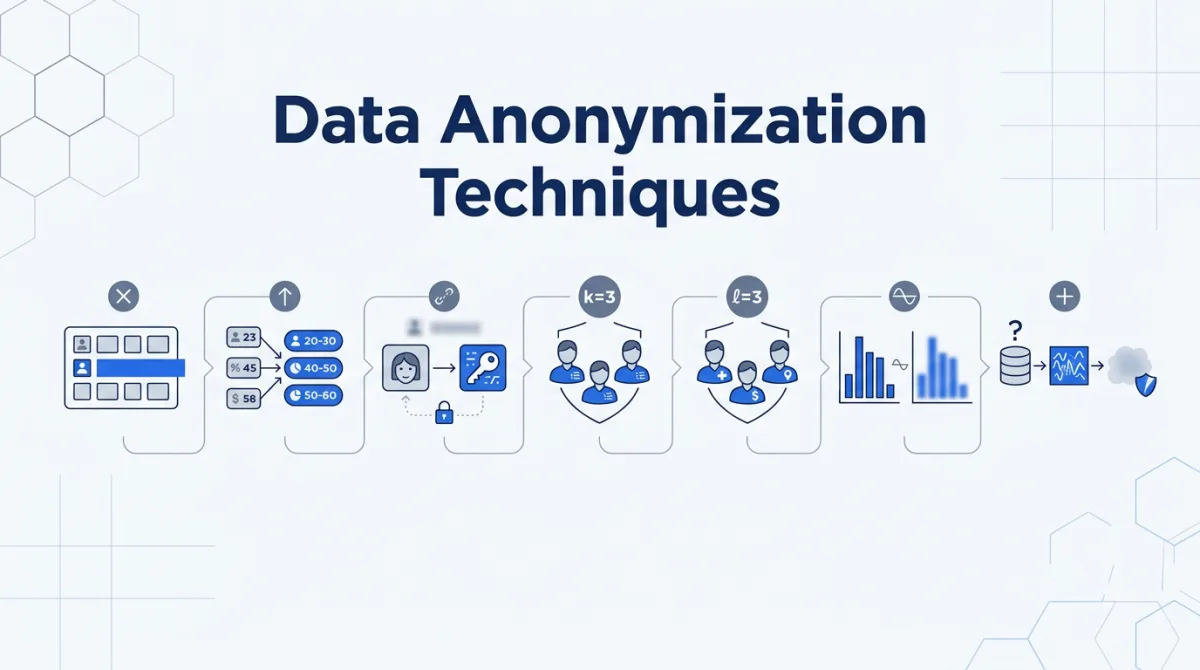
Privacy engineers have to balance two goals. The data should be hard to re-identify, but still useful for analysis, testing, or release. This guide explains the core data anonymization techniques, shows worked examples, and compares each method on protection and utility. It also explains why fully synthetic data from reserved sandbox ranges avoids the re-identification problem entirely.
What are the main data anonymization techniques?
The main data anonymization techniques are suppression, generalization, pseudonymization, k-anonymity, l-diversity, t-closeness, and differential privacy. Suppression, generalization, and pseudonymization transform fields. K-anonymity, l-diversity, and t-closeness protect groups of records. Differential privacy protects query results by adding calibrated noise.
NIST SP 800-188 places these methods under de-identification and statistical disclosure limitation [nist-800-188]. It also makes a practical point: no single technique fits every release. The table below defines each method with a concrete example from a fictional patient table.
| Technique | Definition | Example (fictional record) |
|---|---|---|
| Suppression | Remove or blank a value entirely so it cannot contribute to identification. | ZIP 02139 → * (cell removed) |
| Generalization | Replace a precise value with a broader category or range. | Age 37 → [30-39]; ZIP 02139 → 021** |
| Pseudonymization | Replace a direct identifier with a reversible token, keeping a separate mapping key. | Name 'Jane Doe' → token P-4471 (key stored elsewhere) |
| K-anonymity | Guarantee each record's quasi-identifiers match at least k-1 others. | Every {021**, [30-39], F} group has ≥ k rows |
| L-diversity | Require at least l 'well-represented' sensitive values per k-anonymous group. | Each group holds ≥ 3 distinct diagnoses |
| T-closeness | Keep each group's sensitive-value distribution within t of the whole-table distribution. | Group diagnosis spread ≈ overall spread |
| Differential privacy | Add calibrated noise so one person's presence barely changes any output, bounded by epsilon. | Count 142 → 145 via Laplace noise, ε = 1.0 |
Why pseudonymization is not true anonymization
Pseudonymization swaps a direct identifier for a token. The problem is that a re-identification key still exists somewhere. GDPR Recital 26 treats pseudonymized data as personal data because re-identification remains reasonably possible [gdpr-recital-26]. Pseudonymization reduces exposure and helps contain breaches. It does not remove data from privacy-law scope the way true anonymization can.
The principles of data protection should... not apply to anonymous information, namely information which does not relate to an identified or identifiable natural person or to personal data rendered anonymous in such a manner that the data subject is not or no longer identifiable.
How does k-anonymity work and where does it fail?
K-anonymity was introduced by Latanya Sweeney in 2002. It requires every record to look the same as at least k-1 other records when you compare quasi-identifiers. Quasi-identifiers are fields like ZIP, birth date, and sex. They are not unique on their own, but they can identify people when linked to outside data. In practice, teams reach k-anonymity by using generalization and suppression until each group has at least k records [sweeney-k-anonymity].
Sweeney's research showed the stakes: roughly 87% of the US population could be uniquely identified by the combination of 5-digit ZIP code, gender, and date of birth alone [sweeney-uniqueness]. K-anonymity directly attacks that linkage by collapsing those quasi-identifiers into shared buckets.
A worked k-anonymity example
Suppose a fictional table has rows with {ZIP 02139, Age 37, F} and {ZIP 02141, Age 34, F}. Generalizing ZIP to 021 and age to [30-39] turns both into {021, [30-39], F}. If at least three more fictional rows share that exact tuple, the group satisfies k=5: no one in it can be singled out by ZIP, age band, and sex.
L-diversity, proposed by Machanavajjhala and colleagues, adds a second rule. Each k-anonymous group must contain at least l well-represented sensitive values [l-diversity]. T-closeness, from Li, Li, and Venkatasubramanian, goes further. It requires the sensitive-value distribution inside each group to stay close to the distribution in the whole table. This limits what an attacker can learn from skew [t-closeness].
What is differential privacy in basic terms?
Differential privacy is a formal guarantee. It says a computation should return almost the same result whether one specific person is included or excluded. The bound is set by a privacy budget called epsilon. A smaller epsilon means more noise, stronger privacy, and lower accuracy. This model can defend against attackers with broad background knowledge.
K-anonymity protects records in a released table. Differential privacy protects the query mechanism. It usually works by adding Laplace or Gaussian noise that matches the sensitivity of the query. NIST SP 800-226 gives federal guidance on evaluating differential-privacy guarantees and choosing epsilon for real deployments [nist-800-226]. The US Census Bureau applied differential privacy to the 2020 Census redistricting data, the largest production use to date [census-dp].
How do anonymization techniques compare on protection, utility, and complexity?
These techniques sit on a spectrum. Pseudonymization keeps the most utility but gives the least protection. Differential privacy gives the strongest formal guarantee, but costs accuracy and implementation effort. The comparison below rates each method on re-identification protection, retained utility, and engineering complexity for a typical tabular release.
| Technique | Re-identification protection | Data utility retained | Implementation complexity |
|---|---|---|---|
| Suppression | Medium | Low-Medium | Low |
| Generalization | Medium | Medium | Low |
| Pseudonymization | Low (reversible) | High | Low |
| K-anonymity | Medium-High | Medium | Medium |
| L-diversity | High | Medium-Low | Medium-High |
| T-closeness | High | Low-Medium | High |
| Differential privacy | Very High (formal) | Variable (depends on ε) | High |
| Fully synthetic data | Very High | High | Medium-High |
No technique is best in every case. A low-risk internal analytics export may need only generalization. A public microdata release with sensitive health records may need t-closeness or differential privacy. The next table maps each technique to the situations where it tends to fit best.
| Use case | Recommended technique(s) | Why it fits |
|---|---|---|
| Internal dashboards from production data | Pseudonymization + generalization | Keeps utility high; access stays controlled internally |
| Public release of microdata | K-anonymity + l-diversity / t-closeness | Protects against linkage and homogeneity attacks |
| Aggregate statistics, official statistics | Differential privacy | Formal guarantee survives repeated and adversarial querying |
| Sensitive health or demographic data | T-closeness or differential privacy | Limits attribute disclosure from distribution skew |
| Test, QA, and demo environments | Fully synthetic data | No real subject exists; eliminates re-identification by construction |
| Software development and CI pipelines | Fully synthetic data | Sandbox-range values are safe to commit and share |
Why does fully synthetic data sidestep re-identification?
Fully synthetic data is generated, not transformed. Each record comes from a model or from reserved numbering ranges. It carries no one-to-one link to a real individual. Singling-out, linkage, and inference attacks all need a real person behind a row. In fully synthetic output, that person does not exist.
Classic anonymization starts from real records and tries to hide them. That leaves residual risk. It is the risk behind Sweeney's 87% uniqueness finding and the Netflix Prize de-anonymization, where researchers linked "anonymized" ratings to public IMDb data [narayanan-netflix]. Fully synthetic data avoids that class of attack because there is no source row to recover. Our generator draws from never-issued and sandbox ranges. Our guide on data masking versus synthetic data compares masking real data against generating it fresh.
How should a privacy engineer choose a technique?
Start with the threat model and the release context. Who receives the data? What could they link it to? How much accuracy does the use case need? Match those answers against the protection-versus-utility table. Then validate the result with a re-identification risk assessment, as NIST SP 800-188 recommends before release [nist-800-188].
Regulation also constrains the choice. GDPR draws a hard line between pseudonymization and true anonymization. Pseudonymized data is still personal data; truly anonymous data can leave GDPR scope [gdpr-recital-26]. HIPAA's de-identification standard at 45 CFR §164.514(b) offers two paths. Safe Harbor removes 18 specified identifier types. Expert Determination uses a statistical method that maps well to k-anonymity and differential privacy [hipaa-deid]. The table below maps each technique to how the major regimes treat it.
| Technique | GDPR (EU) | HIPAA (US health data) | NIST guidance |
|---|---|---|---|
| Pseudonymization | Personal data; recognized safeguard (Art. 4(5), Recital 26) | Insufficient alone; not a de-identification method | Covered as reversible de-identification in SP 800-188 |
| Suppression / generalization | Contributes toward anonymization if irreversible | Core operations of the Safe Harbor 18-identifier method | Primary disclosure-limitation tools in SP 800-188 |
| K-anonymity (with l-diversity / t-closeness) | Can support anonymity if re-identification is not reasonably likely | Acceptable under Expert Determination (45 CFR §164.514(b)(1)) | Recommended statistical method in SP 800-188 |
| Differential privacy | Strong path to anonymization via formal guarantee | Acceptable under Expert Determination | Evaluated in SP 800-226 |
| Fully synthetic data | Outside scope when no link to a data subject exists | Not PHI when generated without real-patient mapping | Noted as emerging approach in SP 800-188 |
- Classify each field as direct identifier, quasi-identifier, or sensitive attribute.
- Decide whether the consumer is internal, contractual, or public, since public releases need the strongest controls.
- Apply field-level methods (suppression, generalization) first, then group-level guarantees (k-anonymity and its extensions).
- For aggregate or repeatedly queried outputs, prefer differential privacy with a documented epsilon budget.
- For test, demo, and development environments, generate fully synthetic data instead of anonymizing production records.
- Measure residual re-identification risk and document the decision for audit.
The key idea is simple: anonymization is risk management, not a one-time switch. Pick the lightest technique that meets the threat model. That preserves utility. Reserve differential privacy and synthetic generation for cases that truly need a formal or structural guarantee.
References & sources
- NIST SP 800-188, De-Identifying Government Data Sets (2023) — National Institute of Standards and Technology
- NIST SP 800-226, Guidelines for Evaluating Differential Privacy Guarantees (2025) — National Institute of Standards and Technology
- Sweeney, L. — k-anonymity: A Model for Protecting Privacy (2002) — International Journal on Uncertainty, Fuzziness and Knowledge-Based Systems
- Sweeney, L. — Simple Demographics Often Identify People Uniquely (2000) — Carnegie Mellon University, Data Privacy Lab
- Machanavajjhala et al. — l-Diversity: Privacy Beyond k-Anonymity (2007) — ACM Transactions on Knowledge Discovery from Data
- Li, Li, Venkatasubramanian — t-Closeness: Privacy Beyond k-Anonymity and l-Diversity (2007) — IEEE International Conference on Data Engineering
- Narayanan & Shmatikov — Robust De-anonymization of Large Sparse Datasets (2008) — IEEE Symposium on Security and Privacy
- Disclosure Avoidance for the 2020 Census: An Introduction — US Census Bureau
- Guidance Regarding Methods for De-identification of PHI per the HIPAA Privacy Rule (45 CFR §164.514) — US Department of Health and Human Services
- GDPR Recital 26 — Not Applicable to Anonymous Data — gdpr-info.eu
Frequently asked questions
Is pseudonymization the same as anonymization?
No. Pseudonymization replaces identifiers with reversible tokens while a mapping key still exists, so it remains personal data under GDPR Recital 26. True anonymization is irreversible, and once data is genuinely anonymized GDPR no longer applies to it.
What is k-anonymity in simple terms?
K-anonymity, defined by Latanya Sweeney in 2002, requires that every record share its quasi-identifier values with at least k-1 other records. With k=5, any combination of attributes like ZIP, age, and sex matches at least five people, so no single person can be singled out by those fields.
Why is differential privacy considered stronger than k-anonymity?
Differential privacy gives a mathematical guarantee bounded by a privacy budget epsilon: adding or removing one person barely changes any query result. K-anonymity protects against linkage but can leak sensitive attributes through homogeneity and background-knowledge attacks, which differential privacy resists by design.
Does k-anonymity protect sensitive attributes?
Not fully. K-anonymity hides identity within a group but, if every member shares the same sensitive value, the value is exposed regardless of group size. L-diversity and t-closeness extend k-anonymity to require diversity and distributional similarity in the sensitive column.
How does fully synthetic data avoid re-identification?
Fully synthetic records are generated from a model or from never-issued sandbox ranges and contain no row-level mapping to any real individual. With no one-to-one correspondence to a source record, linkage and singling-out attacks have no real person to point to.
Which standard should I follow for de-identification?
NIST SP 800-188, De-Identifying Government Data Sets, gives a practical framework covering technique selection, re-identification risk assessment, and governance. For statistical disclosure limitation and differential privacy, it is the most cited US federal reference for engineers.
More on privacy law and anonymization
- Disposable Email vs Fake Email Generator: What & When to Use
- Synthetic Data for GDPR Compliance: Anonymization Done Right
- PII in Test Environments: Risks & Replacements
- CCPA vs GDPR for Non-Production Test Data
- Data Masking vs Tokenization: Differences & Test Data
- How to Protect Your Privacy Online With Fictional Details