EIN vs SSN vs ITIN: US Taxpayer ID Numbers Compared
EIN, SSN and ITIN are all nine digits, but different agencies issue them for different jobs. Compare formats, eligibility, and how to tell them apart.
By VincentPublished July 13, 2026Last updated July 23, 20269 min read
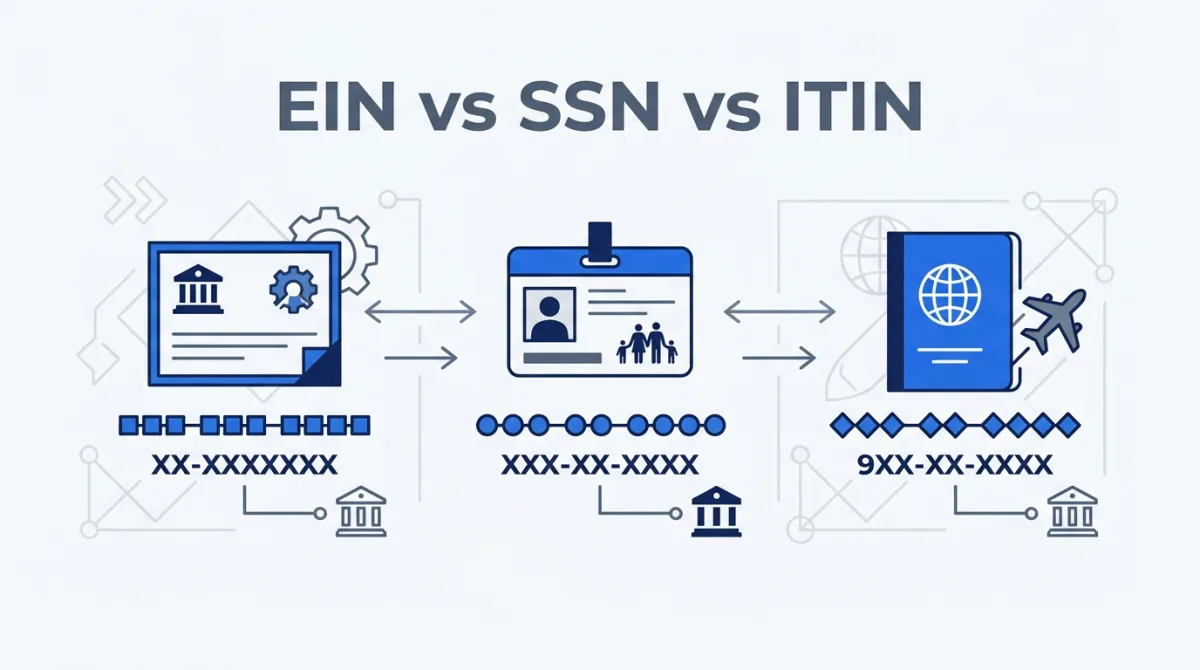
The United States runs on nine-digit taxpayer numbers, and three of them dominate every form you will ever see: the SSN, the EIN and the ITIN. They are the same length, they all show up in the same database columns, and they are constantly confused with each other — by form designers, by validation code, and by test data that puts the wrong shape in the wrong field. This guide compares who issues each number, who needs it, what the digits mean, and how to tell them apart from format alone.
One umbrella: taxpayer identification numbers
The IRS groups all of these under one term: TIN, or taxpayer identification number — any number the agency accepts as identifying a taxpayer on a return or statement [irs-tin]. Two of the five TIN types cover almost everyone: the SSN for individuals and the EIN for entities. The ITIN fills the main gap — individuals who must file US taxes but cannot get an SSN — while two narrower types cover pending adoptions (ATIN) and paid tax preparers (PTIN).
| Type | Full name | Issued by | Identifies |
|---|---|---|---|
| SSN | Social Security number | Social Security Administration | A person (citizen or authorized resident) |
| EIN | Employer identification number | IRS | A business, estate, trust or other entity |
| ITIN | Individual taxpayer identification number | IRS | A person not eligible for an SSN [irs-tin] |
| ATIN | Adoption taxpayer identification number | IRS | A child in a pending US adoption |
| PTIN | Preparer tax identification number | IRS | A paid tax-return preparer |
SSN: the personal number everything else leans on
The Social Security number is the oldest and most consequential of the three — created in 1936 for tracking earnings, and long since turned into a de facto national identifier for credit, banking and employment. It is written XXX-XX-XXXX: historically an area number tied to the issuing state, a two-digit group number, and a four-digit serial. That geography is gone: since June 25, 2011 the SSA assigns SSNs by randomization, drawing from previously unassigned ranges and eliminating any meaning in the first three digits [ssa-randomization].
Structure still rules out plenty of values. A valid SSN never has an area of 000 or 666, a group of 00, or a serial of 0000 — and crucially for this comparison, the SSA never issues areas 900–999. That reserved 9XX space is exactly where ITINs live, and it is also why a well-built generator can emit masked, never-issuable placeholders that cannot collide with a real person. The full digit-by-digit story is in our US SSN format guide.
EIN: the same nine digits, regrouped for entities
An employer identification number is the business world's SSN — required to hire employees, open business bank accounts, file entity returns, and issue 1099s. It is free, issued directly by the IRS in minutes online [irs-ein], and formatted XX-XXXXXXX: a two-digit prefix, a hyphen, then seven digits. That 2+7 grouping is the fastest visual tell that a number is an EIN rather than an SSN or ITIN.
The prefix once encoded which IRS campus assigned the number. Campus assignment ended as a geographic signal in 2001, and applications now flow mostly through the online system, which draws from its own prefix pool — but the IRS still publishes the full table of valid prefixes per assignment channel, which validators can use to reject impossible EINs [irs-ein-prefixes].
| Assignment source | Example prefixes |
|---|---|
| Online application | 20, 26, 27, 45, 46, 47 [irs-ein-prefixes] |
| Andover campus | 10, 12 |
| Atlanta campus | 60, 67 |
| Austin campus | 50, 53 |
| Kansas City campus | 40, 44 |
| Ogden campus | 80, 90 |
ITIN: for taxpayers outside the SSN system
The individual taxpayer identification number exists for one purpose: letting people who are not eligible for an SSN — nonresident aliens with US filing obligations, their spouses and dependents, certain visa holders — file and pay federal taxes [irs-itin]. It borrows the SSN's 3+2+4 shape (9XX-XX-XXXX) but is instantly recognizable: an ITIN always begins with 9, and its fourth and fifth digits fall within the ranges 50–65, 70–88, 90–92 or 94–99 [irs-itin].
Two properties set ITINs apart from the other two numbers. First, they confer nothing beyond tax processing — no work authorization, no Social Security credits, no immigration status. Second, they lapse: an ITIN unused on a federal return for three consecutive tax years expires and must be renewed with Form W-7 [irs-itin]. If the holder later becomes eligible for an SSN, the SSN takes over and the ITIN is retired.
Side by side: the three numbers compared
| SSN | EIN | ITIN | |
|---|---|---|---|
| Written format | XXX-XX-XXXX | XX-XXXXXXX | 9XX-XX-XXXX |
| Issued by | Social Security Administration | IRS | IRS |
| Identifies | A person | An entity | A person ineligible for an SSN |
| First digit | Never 9 | Any valid prefix [irs-ein-prefixes] | Always 9 |
| Authorizes work? | Yes (with status) | n/a — not a personal ID | No [irs-itin] |
| Expires? | No | No | After 3 unused tax years |
| Cost to obtain | Free | Free [irs-ein] | Free (Form W-7) |
Telling them apart at a glance
Given a bare nine-digit number on a form or in a database, three checks identify it the way a format validator would:
- Check the grouping. 2+7 with the hyphen after the second digit is an EIN. 3+2+4 means a personal number — continue.
- Check the first digit. A 9 up front means it cannot be a real SSN; it is ITIN-shaped (or a deliberately fake placeholder).
- Check the ITIN middle pair. Fourth and fifth digits in 50–65, 70–88, 90–92 or 94–99 confirm the ITIN pattern [irs-itin]; outside those ranges, the number is not a valid ITIN either.
That principle — format-valid but guaranteed-fictional — is the same one behind reserved 555 phone numbers and sandbox credit card ranges. If you need full test profiles around these numbers, the fake identity generator produces internally consistent people, and the PII in test environments guide covers the compliance reasoning. For how other countries structure their equivalents of the SSN, see national ID number formats explained.
Classifying a taxpayer number at a glance
SSN, EIN and ITIN are three answers to one question — who is this taxpayer? — split by what kind of taxpayer it is. The SSA numbers people; the IRS numbers entities and the people the SSA cannot. Their formats were designed to coexist: the 2+7 grouping walls EINs off visually, and the reserved 9XX space keeps ITINs from ever colliding with an SSN. Learn those two facts and you can classify any US taxpayer number — real or test data — at a glance.
References & sources
- Taxpayer identification numbers (TIN) — U.S. Internal Revenue Service
- Employer identification number — U.S. Internal Revenue Service
- How EINs are assigned and valid EIN prefixes — U.S. Internal Revenue Service
- Individual taxpayer identification number (ITIN) — U.S. Internal Revenue Service
- Social Security Number Randomization — U.S. Social Security Administration
Frequently asked questions
Can the same person have both an SSN and an EIN?+
Yes, and it is common. A sole proprietor or single-member LLC owner keeps a personal SSN and can also request an EIN for the business — to open a business bank account, hire employees, or simply avoid putting a personal SSN on W-9 forms. The two numbers identify different tax entities: the person and the business.
How can I tell whether a nine-digit number is an SSN, ITIN or EIN?+
Look at the grouping and the first digit. An EIN is written 2+7 (XX-XXXXXXX). SSNs and ITINs are both written 3+2+4, but an ITIN always begins with 9 and its fourth and fifth digits fall in IRS-defined ranges (50–65, 70–88, 90–92, 94–99). A 3+2+4 number that does not start with 9 is SSN-shaped.
Do ITINs expire?+
Yes. An ITIN that is not used on a federal tax return for three consecutive tax years expires on December 31 of that third year, and the holder must renew it with Form W-7 before filing again. SSNs and EINs, by contrast, are issued once and do not expire — an EIN stays attached to its entity even if the business closes.
Is an EIN sensitive information like an SSN?+
Less so, but it is still an identifier worth handling carefully. EINs of public companies and nonprofits are openly published in SEC and Form 990 filings, and businesses share them routinely on invoices and W-9s. Unlike an SSN, an EIN alone rarely enables identity theft against a person — but it can be abused for business-identity fraud, so it is not something to scatter needlessly.
Does an ITIN authorize someone to work in the US?+
No. An ITIN exists only so the IRS can process taxes for people who are not eligible for an SSN. It does not grant work authorization, Social Security benefits, or immigration status — and it should never be used in place of an SSN on employment eligibility paperwork.