What Is Synthetic Test Data? A Developer's Guide
Synthetic test data is artificially generated data that mimics production structure and statistics without real PII. How it works and how to generate it.
By Vincent RuanPublished June 27, 2026Last updated June 27, 20269 min read
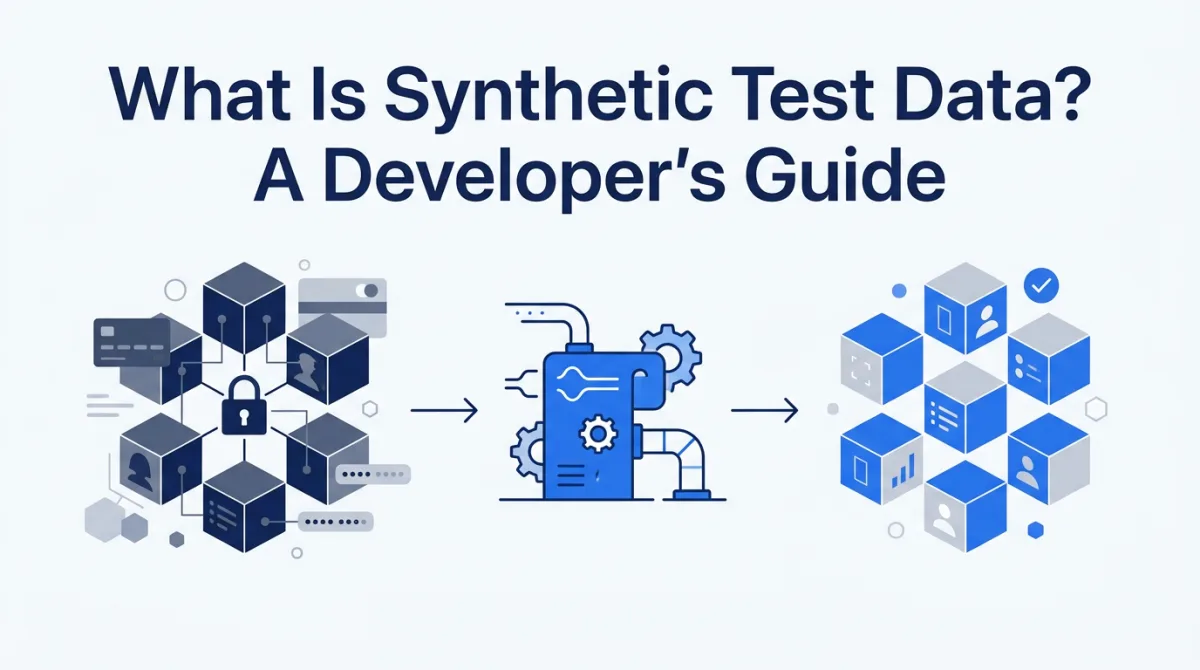
Synthetic test data is data that is artificially generated by a program rather than collected from real events or real people, but is engineered to be structurally and statistically realistic. A synthetic user record can have a plausible name, a well-formed email, an address that passes validation, and a clearly labeled test-ID placeholder, yet it maps to no real human. That property, realistic shape without copied production subjects, is what makes it the safest default for development, testing, and staging.
What is synthetic data for testing?
In a testing context, synthetic data is generated input that exercises your code the way real data would, without being real data. It satisfies your schema, your field formats, your foreign-key relationships, and your volume requirements, so your application behaves as it would in production. The difference is provenance: every value was produced by a generator or a model, not extracted from a real customer, patient, or transaction.
This distinguishes it from the alternative most teams reach for first, which is copying production and scrubbing it. We compare those approaches head-to-head in /blog/data-masking-vs-synthetic-data, but the short version is that synthesis starts from nothing and builds up, while masking starts from real records and tries to hide the sensitive parts.
Why do teams use synthetic test data?
Three pressures push engineering teams toward synthetic data, and they compound as the company grows.
1. Keep production PII out of non-production
Every copy of production in a lower environment multiplies your exposure. Under the GDPR, personal data in a test database is still personal data: it is in scope for access requests, breach notification, retention limits, and lawful-basis requirements. The CCPA imposes parallel obligations in California. Synthetic records sidestep this because they relate to no identifiable person, and GDPR Recital 26 makes clear that the principles of data protection do not apply to anonymous information [gdpr-recital-26]. Fewer copies of real PII also means a smaller blast radius when a non-prod environment is misconfigured or leaked.
2. Reproduce edge cases on demand
Real datasets are shaped by whatever happened to occur. They rarely contain the leap-year birthday, the 40-character surname, the address with no postal code, or the account with a negative balance, exactly the cases that break software. Synthetic generators let you manufacture those conditions deliberately and repeatedly, so a flaky bug becomes a deterministic fixture instead of a hunt through production for a matching record.
3. Share data freely
Fully synthetic fixtures can be committed to a repository, attached to a ticket, handed to a contractor, or shipped in a public demo after you confirm they contain no copied production values. That removes much of the legal review, data-processing overhead, and access control burden that real data drags along, and it lets teams collaborate without a privacy bottleneck.
Synthetic vs masked vs anonymized data
These three terms are often blurred, but they sit at different points on the re-identification spectrum. Masked and anonymized data both begin with real records, which means a real row always existed and could, in principle, be linked back. Fully synthetic data has no original row to re-identify. The Article 29 Working Party's Opinion 05/2014 frames anonymization around three residual risks, singling out, linkability, and inference, and notes that techniques applied to real data rarely eliminate all three [wp216].
| Property | Fully synthetic | Masked (real, obscured) | Anonymized (real, de-identified) |
|---|---|---|---|
| Source | Generated from scratch | Real production records | Real production records |
| A real row exists behind each record | No | Yes | Yes |
| Re-identification risk | No source row to re-identify | Residual (mapping may leak) | Residual (singling out, linkage, inference) [wp216] |
| Realism / referential integrity | Depends on generator quality | High (real values kept where safe) | High but degraded by generalization |
| GDPR scope when done well | Out of scope [gdpr-recital-26] | Often still in scope | Out of scope only if truly non-identifiable |
| Can be shared publicly | Yes | Risky | With caution |
We go deeper on where each one lands under EU law, and why "anonymized" is a high bar, in /blog/synthetic-data-gdpr-anonymization.
What are the types of synthetic data?
Synthetic data is not one thing. The privacy and realism trade-off depends on how much real data, if any, survives into the output.
| Type | What it contains | Re-identification risk | Best for |
|---|---|---|---|
| Fully synthetic | No source records; every value generated | No source-row risk | Dev/test fixtures, demos, public sharing |
| Partially synthetic | Real records with only sensitive fields replaced | Low to moderate (real rows remain) | High-fidelity staging where some real structure is needed |
| Hybrid | Mix of real and generated, or a model sampled from real data | Varies with method and tuning | Analytics and model training that need real-world shape |
For pure functional and integration testing, fully synthetic data is almost always the right default: there is no original production row to recover, and your code usually cannot tell the difference when the formats and relationships are correct. Model-based synthetic data still needs privacy and fidelity checks, especially when it was trained on sensitive real records.
How is synthetic data generated?
There are two broad families of generators, and most real-world pipelines mix them.
Rule-based (Faker-style) generation
Rule-based generators produce values from curated lists and format rules: pick a first name from a locale-aware list, assemble a syntactically valid email, build a phone number that matches a country's numbering plan, or add a checksum when the field supports one. Libraries like Faker popularized this approach, and it is the backbone of most test-data tooling because it is fast, deterministic when seeded, and needs no access to real data at all. The trade-off is that the fields are individually realistic but not jointly correlated; a rule-based record will not reflect that older customers in a region tend to have certain plan types, for example.
Statistical and ML model generation
Model-based generators fit a statistical model or a neural network (such as a GAN or a variational autoencoder) to a real dataset, then sample new records from it. Done well, the output preserves the joint distribution: correlations between columns, conditional frequencies, and overall shape. NIST has invested in evaluating exactly this, running a Differential Privacy Synthetic Data Challenge to push the state of the art [nist-dp-challenge], and publishing SDNist, a tool that scores a synthetic dataset on both utility (how well it preserves the real data's characteristics) and privacy (how well it protects the originals) [nist-sdnist]. The cost is complexity and a residual privacy concern: a model trained on real data can memorize and reproduce rare individuals unless it is constrained.
NIST's SDNist tool reflects the same trade-off: it evaluates a synthetic dataset on both utility and privacy metrics, rather than treating synthetic data as automatically safe or automatically useful [nist-sdnist].
Benefits and limits of synthetic test data
The benefits follow directly from the definition: no real PII to govern, edge cases on demand, freely shareable data, and reproducible fixtures. The limits are just as important to understand before you rely on synthetic data for anything beyond format testing.
- It can miss rare real-world correlations. Simple generators preserve individual distributions and pairwise correlations but often fail to capture higher-order dependencies between columns.
- It under-represents outliers. The unusual records that drive real bugs and real risk are exactly the ones models smooth away, and privacy-preserving methods deliberately downweight them to avoid memorizing real individuals.
- Quality depends entirely on the generator. A rule-based record that passes your schema can still be statistically unrealistic, which is fine for functional tests and misleading for analytics.
- Partially synthetic and model-based data are not automatically out of scope. If real records or memorized individuals survive into the output, privacy law can still apply.
How to generate synthetic identities for testing
For most testing, you do not need a trained model, you need realistic identities with correct formats, generated on demand and clearly labeled as fake. Here is the quickest path.
- Pick the locale or country whose formats you need, so names, addresses, phone numbers, and regional labels match the right market.
- Choose the fields your schema requires (name, email, address, phone, date of birth, test-ID placeholder) and nothing you do not need.
- Generate the volume you want, from a handful of fixtures to thousands of rows for load testing.
- Seed the generator if you need deterministic fixtures, so the same input always yields the same records in CI.
- Label the output clearly as synthetic and keep it out of any path that could be mistaken for real customer data.
Our identity generator produces complete fake identities without copying real personal data, and generate by country gives you locale-correct names, addresses, phone dial codes, and country-labeled test ID placeholders. Both are rule-based, so each record is realistic in shape and not tied to a production customer, which is exactly what you want for fully synthetic test fixtures.
References & sources
- Recital 26 — Not applicable to anonymous data — GDPR (gdpr-info.eu)
- Opinion 05/2014 on Anonymisation Techniques (WP216) — Article 29 Data Protection Working Party
- SDNist: Synthetic Data Report Tool — NIST
- 2018 Differential Privacy Synthetic Data Challenge — NIST
Frequently asked questions
What is synthetic test data?
Synthetic test data is data that is artificially generated by a program rather than collected from real events or real people, but is built to be structurally and statistically realistic. A synthetic customer record has a valid-looking name, email, address, and test-ID placeholder that satisfy your schema and validation rules, yet correspond to no actual person. It exists so engineers can develop and test against realistic data without copying production records that contain personal information.
Is synthetic test data GDPR-compliant?
When data is truly synthetic and contains no information relating to an identified or identifiable real person, it falls outside the GDPR's scope entirely. GDPR Recital 26 states that the principles of data protection do not apply to anonymous information. The caveat is that data must be genuinely non-identifiable: partially synthetic data that still carries real records, or model-generated data that memorizes and reproduces rare real individuals, can fail that test and remain in scope.
What is the difference between synthetic data and masked data?
Masked (or anonymized) data starts from real production records and obscures or perturbs the sensitive fields, so the underlying rows still correspond to real people and carry residual re-identification risk. Fully synthetic data is generated from scratch and contains no real records at all, so there is no original row to re-identify. Masking preserves a one-to-one link to real subjects; synthesis breaks that link by construction.
Is synthetic data realistic enough for testing?
For format, schema, and volume testing it is usually more than enough, and rule-based generators produce valid records on demand. The limitation is statistical fidelity: synthetic datasets can preserve simple distributions and pairwise correlations but often miss higher-order dependencies, rare events, and outliers found in real data. For functional and integration testing this rarely matters; for analytics or model training, validate the specific correlations your use case depends on.
How do I generate synthetic identities for testing?
The fastest path is a rule-based generator. Pick the locale or country you need, choose the fields (name, address, email, phone, country-labeled test ID placeholder), generate as many records as you want, and label them clearly as synthetic. For deterministic test fixtures, seed the generator so the same input always produces the same data. Our identity generator and per-country generators create fictional records without copying real personal data.
What are the types of synthetic data?
There are three common types. Fully synthetic data contains no source records, so there is no original row to re-identify, though generator quality still matters. Partially synthetic data replaces only the sensitive fields of real records while keeping the rest, trading some privacy for higher realism. Hybrid synthetic data combines real and generated records, or fits a model to real data and samples new rows from it, balancing fidelity against disclosure risk.
More on test data practice
- Synthetic Data for ML: Evaluation and Common Mistakes
- Email Validation Test Cases — CSV, JSON & 8 Validators
- Test Data Generation Guide: Schemas, Rows & Edge Cases
- Mock Data vs. Real Data: Why Teams Test With Fake Profiles
- Deterministic Test Data Seeding: Faker Examples
- Test Data Management: 9 Best Practices