When Is It OK to Use a Fake Address Online? Sign-Ups & Testing
When you can use a fake address online: use-case tables marking sign-ups, QA testing, and KYC as OK, risky, or illegal, plus the privacy law behind it.
By Vincent RuanPublished June 25, 2026Last updated June 25, 20268 min read
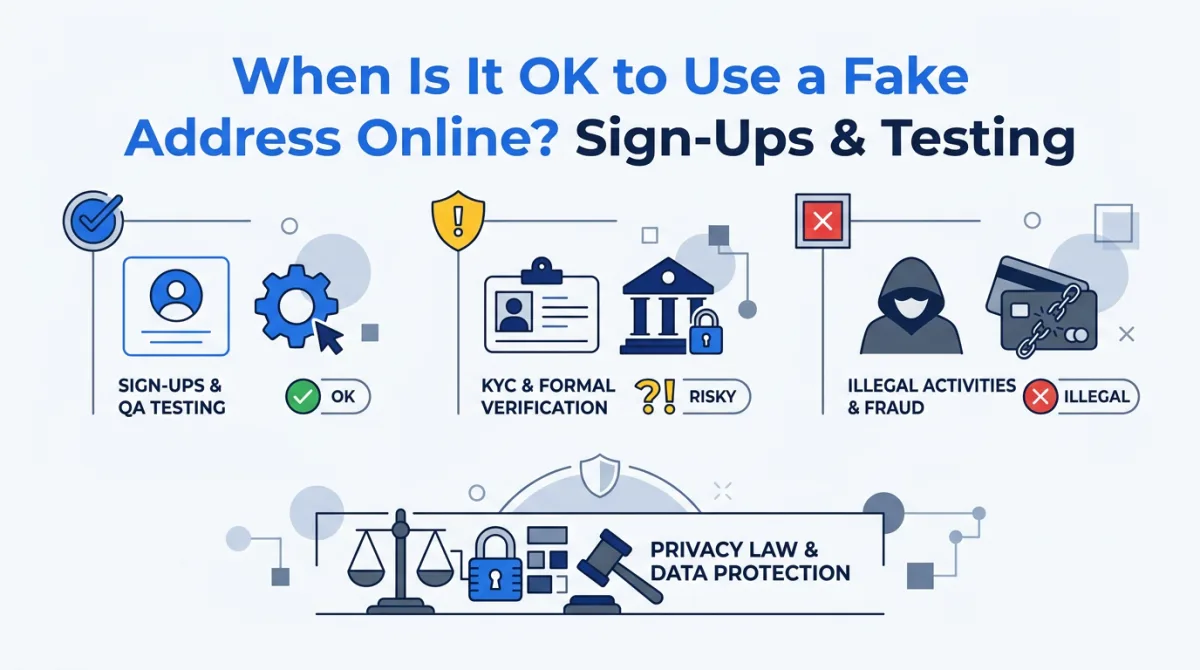
Using a fake address online is legal in itself, and it is a sound privacy choice whenever a form has no legitimate reason to know where you live. It crosses into fraud only when the address feeds a payment, a shipment, or a legally required identity check. The deciding factor is intent, not the act of typing a made-up street.
Plenty of forms demand a home address they will never use: a weather newsletter, a PDF download gate, a trial for software that runs entirely in your browser. Withholding your real street here is data minimization, a principle written directly into privacy law, not paranoia, and part of the broader playbook in our guide on protecting your privacy with fake details. This guide marks every common scenario as OK, risky, or illegal, with tables you can screenshot. Our random address generator and state address pages exist for the OK column only.
What does 'fake address' actually mean?
A fake address means one of two very different things, and conflating them is where trouble starts. The safe kind is a fictional but well-formed address: a real city, a real state, and a ZIP code genuinely valid for that city, with a randomized house number and street so the result belongs to no real household. The dangerous kind is someone else's real address or a made-up one attached to a financial or legal transaction.
A well-formed fictional address passes the two checks most forms run, format validation and ZIP-to-city consistency, without ever resolving to a deliverable home. The USPS manages roughly 41,000 ZIP codes, each mapped to a specific delivery area [usps-zip], so a generator that respects that mapping produces data that looks correct to validators while staying synthetic. If you only need the postal part, the random ZIP code generator returns a valid 5-digit ZIP paired with its real state.
| Property | Real address | Well-formed fictional address | Garbage input (123 Fake St) |
|---|---|---|---|
| Passes format validation | Yes | Yes | Often yes |
| ZIP valid for the city | Yes | Yes | Usually no |
| Resolves to a real home | Yes | No | No |
| Safe to use for privacy | Exposes you | Yes | Yes, but fails better validators |
| Deliverable by mail | Yes | No | No |
Which uses are OK, risky, or illegal?
A fake address is OK whenever the recipient collected your location by habit rather than need (newsletters, free trials, QA, demo accounts), risky where a contract may penalize you (loyalty programs), and illegal where the address is load-bearing for a payment, a shipment, or a mandated identity check (banking, billing, KYC, government forms). One question sorts almost every case: does the other party have a legitimate reason to know where you live?
| Scenario | Verdict | Why |
|---|---|---|
| Newsletter or content sign-up | OK | No legal need for your location; classic over-collection. |
| Free trial with no physical shipment | OK | Nothing is delivered; address is dead-weight data. |
| QA / form / API testing | OK | Synthetic data is best practice; avoids touching real people. |
| Demo or staging account | OK | Test environments should never hold real personal data. |
| Loyalty or rewards program | Risky | Check terms; a mismatch can void rewards or close the account. |
| Shipping a real package to yourself | Illegal/Impossible | It simply won't arrive; carriers need a real deliverable address. |
| Receiving goods under a false identity | Illegal | This is a core element of mail and wire fraud. |
| Banking, loans, or KYC | Illegal | Identity verification is legally mandated; falsifying it is fraud. |
| Credit card billing address | Illegal | Must match issuer records; a mismatch to force a charge is fraud. |
| Government services or taxes | Illegal | False statements to the government carry their own penalties. |
The pattern is consistent. Every OK row shares one trait: the address is data the recipient collected by habit, not by need. Every illegal row shares the opposite: the address supports a payment, a delivery, or a legally required check. A fake address for sign ups sits squarely in the first group, which makes it the most common and most defensible use.
Is it illegal to use a fake address online?
No, not by itself. No US law bans entering '482 Maple Avenue' when you live elsewhere. The federal mail and wire fraud statutes (18 U.S.C. §§ 1341 and 1343) punish a false statement only when it is part of a scheme to obtain money or property by deception [doj-wire-fraud] [cornell-mail-fraud]. A fake address on a weather newsletter takes nothing from anyone, so no statute reaches it.
Two categories flip a harmless field into a legal problem. First, legally mandated verification: financial institutions must run a Customer Identification Program under BSA/AML rules that collects and verifies your address [ffiec-cip]. Feeding that process a fictional address defeats a legal control and is treated as fraud. Second, contract: most terms of use require accurate registration data, and breaking that can void your account or support a claim against you.
The crime is not the false statement in isolation; it is the false statement deployed to obtain money or property by deception.
| What you do | Legal status | What pushes it over the line |
|---|---|---|
| Fictional address on a newsletter | Legal | Nothing; no deception of legal consequence. |
| Fictional address in a test database | Legal | Nothing; this is recommended practice. |
| Fake address to skip bank verification | Illegal | Defeats a legally required KYC control. |
| Fake billing address to push a charge | Illegal | Payment obtained by deception = fraud. |
| Fake address to receive ordered goods | Illegal | Goods obtained under a false identity = fraud. |
| Fake address violating a site's ToS | Civil risk | Account termination; possible breach-of-contract claim. |
Why does privacy law favor minimization?
Privacy law tells companies to collect only what they need, so withholding an address a service has no use for aligns with the rules rather than breaking them. GDPR Article 5(1)(c), in force since May 25, 2018, requires personal data to be 'adequate, relevant and limited to what is necessary' for the stated purpose [gdpr-art5]. A newsletter demanding a street address it will never use collects beyond necessity; a fictional address enforces the limit it skipped.
Security frameworks say the same. The NIST Privacy Framework lists data minimization among its core controls, urging organizations to limit collection and retention to what is needed [nist-privacy]. The stakes are concrete: IBM put the global average cost of a data breach at $4.88 million in 2024, a 10% jump over the prior year [ibm-breach]. An address you never disclosed cannot appear in the dump.
| Principle / source | What it says | What it means for you |
|---|---|---|
| GDPR Art. 5(1)(c) | Collect only data necessary for the purpose | Forms shouldn't demand your address 'just because' |
| NIST Privacy Framework | Minimize collection and retention | Less stored data = smaller blast radius |
| Data-breach reality | Stored personal data leaks regularly | What you withhold can't be exposed |
| Purpose limitation | Use data only for stated reasons | A newsletter has no shipping purpose |
This is the principled core of our /privacy stance: generated data is for reducing the personal information you scatter across the web, never for taking something you have not earned.
Why use fake addresses for testing software?
Use fake addresses in test data because real ones are a liability: they belong to real people and end up in commit history, log files, ticket screenshots, and seed scripts copied between environments. If a staging job accidentally fires real mail, a genuine address means a genuine stranger receives your test output. A fake address for testing removes that risk while exercising the identical code paths.
What should good test addresses cover?
Strong test data is not one happy-path record; it is a spread of cases that stress your validators. A random US address for testing generator should hand you valid combinations plus deliberately tricky ones: ZIP+4 formats, unit numbers, the longest city names, and territories like Puerto Rico that trip up naive US-only logic. The matrix below is what a realistic suite covers.
| Test case | Example shape | What it checks |
|---|---|---|
| Standard 5-digit ZIP | Austin, TX 78701 | Baseline ZIP-to-city validation |
| ZIP+4 format | Denver, CO 80202-1234 | Extended ZIP parsing [usps-zip] |
| Unit / apartment line | Apt 4B, secondary line | Multi-line address handling |
| Long city name | Rancho Santa Margarita, CA | Field length and truncation |
| US territory | San Juan, PR 00901 | Non-state handling in 'US' logic |
| Edge ZIP boundaries | 00501 / 99950 | Lowest and highest valid US ZIPs |
A quick decision checklist
Run a generated address through these five questions in order before you submit it anywhere. The first 'yes' tells you what to do, and the gray areas mostly vanish.
- Will real money move based on this address (billing, payment, KYC)? If yes, use your real address. Stop.
- Will physical goods be shipped or received? If yes, use your real address. A fictional one won't arrive, and using it to take goods is fraud.
- Is this a legally required identity or government check? If yes, use your real address. Stop.
- Does a contract or terms-of-service require accurate info, with real consequences for you? If yes, weigh the account risk before proceeding.
- Is this a low-stakes form that has no real need for your location? If yes, a fictional address from / or /us is an appropriate privacy choice.
The same fictional address is responsible privacy on a newsletter and reckless fraud on a loan application; only the context changes. Keep generated data in the lane it was built for, sign-ups, testing, and privacy, and you stay firmly on the right side of the line.
References & sources
- ZIP Code: The Basics — United States Postal Service
- Elements of Wire Fraud (Criminal Resource Manual) — U.S. Department of Justice
- 18 U.S. Code § 1341 - Frauds and swindles — Cornell Law School, Legal Information Institute
- Customer Identification Program (BSA/AML Manual) — FFIEC
- Art. 5 GDPR - Principles relating to processing of personal data — GDPR-Info.eu
- NIST Privacy Framework — National Institute of Standards and Technology
- Cost of a Data Breach Report — IBM
Frequently asked questions
Is it illegal to use a fake address online?
Entering a fictional address on a form is not a crime by itself. It becomes illegal when the address is used to commit fraud, evade a legally required identity check (like banking KYC), receive goods or services under a false identity, or violate a contract you agreed to. Context and intent decide legality, not the act of typing a made-up street.
When should I use a fake address for sign-ups?
Use one for low-stakes accounts that have no legitimate need for your real location: newsletters, content paywalls, free trials that won't ship anything, and demo accounts. A real city plus a valid ZIP keeps the form happy without exposing where you actually live.
Can I use a fake address for testing software?
Yes. Synthetic addresses are a recommended practice in QA. Using a real US address for testing risks contacting a real person or leaking their data into logs and screenshots. A generated address with a real city and valid ZIP exercises the same validation logic without that risk.
What makes an address 'real-looking but fake'?
It pairs a genuine city and state with a ZIP code that is valid for that city, then randomizes the house number and street so the combination does not resolve to anyone's home. It passes format and ZIP-to-city checks but is not a deliverable, occupied address.
Is using a fake billing address for a credit card illegal?
Yes, when a payment is involved. A billing address must match what your card issuer has on file, and submitting a mismatched one to push a charge through is payment fraud. Never use a generated address for billing, banking, or any financial verification.
Where can I get a random US address for testing or sign-ups?
Our generators produce fictional but well-formed US addresses. Use /us for state-specific addresses with valid ZIP codes, or / for a full random identity. All output is synthetic and intended for testing, form-filling, and privacy only.
More on addresses and postal formats
- Hong Kong ZIP Code: What to Enter (000000, HKG or 999077)
- New Zealand Address Format: Postcodes, Examples & Rules
- US ZIP Code Statistics — State Counts & CSV
- US Address Format Explained: USPS Rules & Examples
- US ZIP Code Ranges by State — Table & Exceptions
- Postal Code Formats by Country: UK, Canada, Germany & More