Why Fake Phone Numbers Start With 555
Why do movies and test data use 555 phone numbers? The history of the fictional 555-0100 to 555-0199 range, KLondike 5, and how to use it safely.
By Vincent RuanPublished July 2, 2026Last updated July 23, 20267 min read
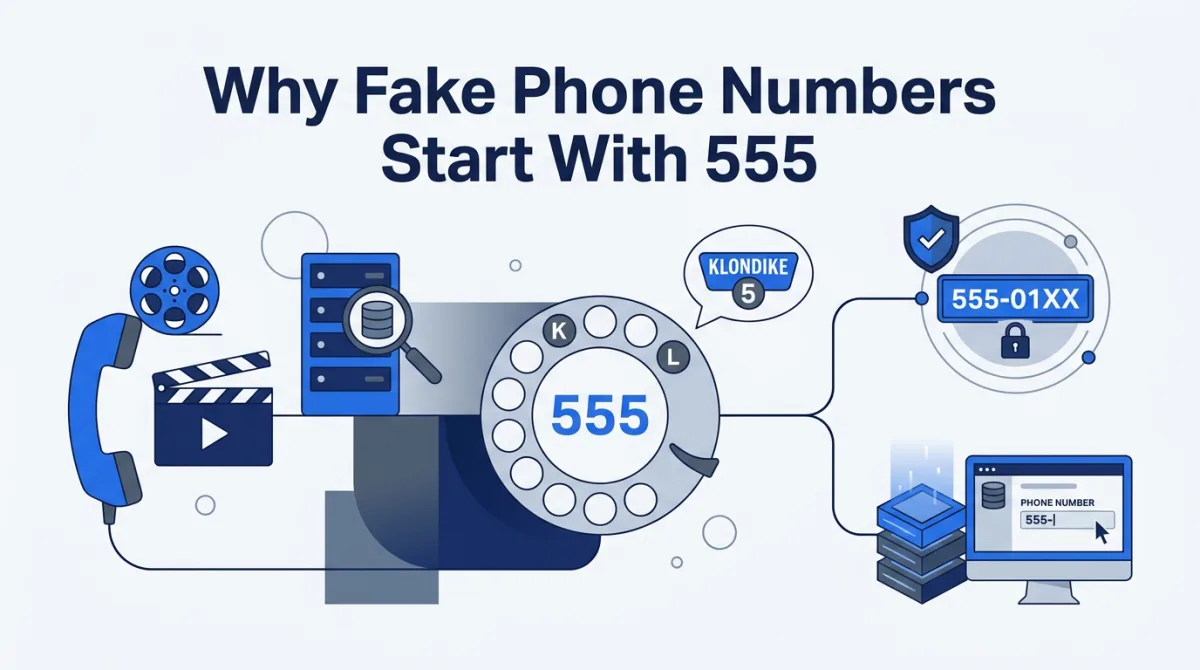
Watch enough film and television and you will notice every phone number a character rattles off starts the same way: 555. It is one of the most consistent conventions in fiction, and it exists for a very practical reason — a phone number spoken on screen gets dialed by thousands of curious viewers, and those calls have to land somewhere harmless. This article explains where the 555 convention came from, what part of the 555 range is actually reserved for fiction, and why the same range is the right choice for fake phone numbers in test data.
The problem: audiences dial numbers they hear
Whenever a real-looking phone number appears in a movie, a song or an ad, some fraction of the audience will call it. The most famous cautionary tale is Tommy Tutone's 1981 hit “867-5309/Jenny”: the song reached No. 4 on the Billboard Hot 100, and owners of 867-5309 in area code after area code were flooded with prank calls for decades — some numbers were changed, others were auctioned or turned into marketing lines [jenny-wiki]. Studios learned early that using a plausible number was a liability — what they needed was a number that looked completely real but could never belong to a person.
Why 555 specifically
In the North American Numbering Plan (NANP) — the shared numbering system covering the US, Canada and much of the Caribbean since 1947 — a phone number breaks into a three-digit area code, a three-digit central-office (exchange) code, and a four-digit line number [nanp-wiki]. The 555 exchange was historically set aside for special telephone-company services rather than ordinary subscribers. Directory assistance, reachable at 555-1212, is the best-known example [555-wiki].
Because no regular household could hold a 555 number, scriptwriters could hand one to a character without risking a real family's phone ringing at midnight. The convention predates all-digit dialing: in the era of named exchanges, films used “KLondike 5” — the letters K and L sit on the 5 key, so KL5 dials 555 [555-wiki].
The official fictional range: 555-0100 to 555-0199
For decades, fiction treated the whole 555 exchange as fair game. That changed in the 1990s, when the numbering administration began releasing 555 line numbers for real assignments and carved out an explicit block for creative use: 555-0100 through 555-0199 are designated for fictional and advertising purposes across the NANP [555-wiki] [nanpa]. Everything outside that hundred-number block should be treated as potentially real.
| Range / number | Status | Safe for fiction & test data? |
|---|---|---|
| 555-0100 – 555-0199 | Reserved for fictional use NANP-wide | Yes — the only officially safe block |
| 555-1212 | Directory assistance | No — connects to a real service |
| Other 555-XXXX | Assignable to real applicants | No — may be or become real |
| Any non-555 number | Ordinary subscriber numbers | No — can ring a real person |
555 numbers you have already heard
Once you know the convention, you will hear it everywhere. Some well-known fictional numbers include the Ghostbusters' hotline, Bruce Almighty's pager (which famously used a non-555 number in the theatrical cut and caused real-world misdials before being changed for home release), and virtually every business card, billboard and answering-machine message in modern television [555-wiki]. The Bruce Almighty incident is the counterexample that proves the rule: the one high-profile film that skipped 555 generated complaints from real number-holders across multiple area codes.
What about other countries?
The 555 convention is North American. Other numbering authorities publish their own reserved ranges for drama and testing — the UK's Ofcom, for example, maintains per-city blocks that broadcasters can use safely, such as the London 020 7946 0xxx range [fictitious-wiki]. If you need locale-correct fictional numbers outside the NANP, use a generator that understands each country's format: our country identity generators format phone numbers with the right dial code and national pattern for 36 countries.
| Region | Reserved fictional range | Administered by |
|---|---|---|
| US / Canada / NANP | XXX-555-0100 – XXX-555-0199 (any real area code) | NANPA |
| United Kingdom (London) | 020 7946 0000 – 020 7946 0999 | Ofcom drama number blocks |
| United Kingdom (mobile) | 07700 900000 – 07700 900999 | Ofcom drama number blocks |
| Other countries | National regulators publish equivalent drama/testing blocks | Varies [fictitious-wiki] |
Using 555 numbers in test data
The same property that protects filmmakers protects developers. Seeding a database, demoing a CRM, or screenshotting a contact form with real-looking numbers risks embarrassing (or legally messy) accidental contact if the data leaks into a live system — a marketing automation that texts your staging database is a classic incident. Numbers from the fictional block are inert by design.
- Forms and validation — (415) 555-0132 passes length and format checks like any real number.
- Demos and screenshots — safe to publish; no viewer can dial your test user.
- Staging databases — if an automation misfires and messages every contact, nothing happens.
- Documentation — examples stay valid forever because the block will never be assigned.
Need one now? The random phone number generator produces fiction-range US numbers instantly, and the full identity generator pairs one with a matching name, address and email so your test profiles stay internally consistent. For the story behind the address side of that profile, see what is a ZIP code.
A deliberate hole in the numbering plan
555 numbers work because of a deliberate hole in the numbering plan: a block that looks like every other phone number but is guaranteed never to ring. Hollywood uses it so fiction cannot collide with reality; good test data uses it for exactly the same reason. When you need a fake number, do not improvise one — draw it from the block that was built for the job.
References & sources
- 555 (telephone number) — Wikipedia
- North American Numbering Plan — Wikipedia
- North American Numbering Plan Administrator — numbering resources — NANPA
- 867-5309/Jenny — Wikipedia
- Fictitious telephone number — Wikipedia
Frequently asked questions
Are all 555 numbers fake?
No. Only 555-0100 through 555-0199 are reserved for fictional use. Other 555 line numbers have real assignments — most famously 555-1212, which has long been used for directory assistance. That is why careful test data sticks to the 0100–0199 block instead of inventing any random 555 number.
Can I call a 555 number?
If you dial a number in the fictional 555-0100–0199 block, the call will not reach a person — the numbers are not assigned to subscribers. Numbers outside that block may connect to real services such as directory assistance, so dialing arbitrary 555 numbers is not a reliable way to reach 'nothing'.
Why do fake data generators use 555 numbers?
Because the fictional block is the only officially safe choice for a US-format phone number. A generated number like (212) 555-0147 passes format validation in forms and looks realistic in demos and screenshots, yet can never ring a real person's phone — the same property Hollywood relies on.
What did KLondike 5 mean in old movies?
Before all-digit dialing, US numbers began with exchange names — you dialed the first two letters plus a digit. 'KLondike 5' translates to the digits 55-5, so a character saying 'KLondike 5-3226' was already using the 555 exchange. It is the same fictional convention, one naming era earlier.