John Doe: The History of Placeholder Names
Who is John Doe? How a medieval English legal fiction became the standard name for unknown people — and what other countries call their John Does.
By Vincent RuanPublished July 2, 2026Last updated October 1, 20267 min read
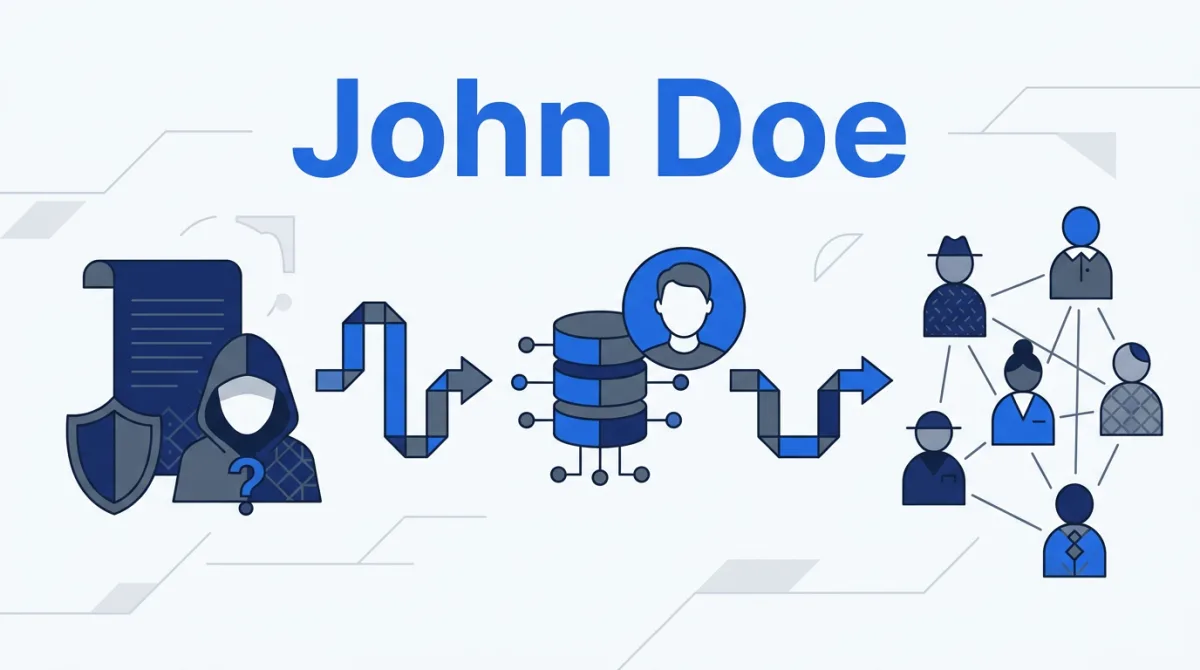
An unidentified patient arrives at a US emergency room and is admitted as John Doe. A lawsuit is filed against someone not yet identified: John Doe. A sample driver's license in a government brochure: John Doe again. He is the most famous man who never existed. His story starts in medieval English courtrooms, centuries before anyone needed a fake name generator.
A medieval legal fiction
English property law had a procedure called the action of ejectment for disputes over land. To fit a real dispute into its rigid formula, the court papers told a small fiction: a hypothetical tenant had leased the land and been thrown off it. That tenant needed a name. By convention lawyers wrote John Doe, and a second stock character, Richard Roe, played the other side [wiki-doe] [lii-doe]. The practice may date back to the reign of Edward III, from 1327 to 1377.
The names were deliberately generic: a doe and a roe, two kinds of deer, attached to everyday first names. England abolished the ejectment fiction in 1852, and British usage moved on to other placeholders. American law had already absorbed the convention and kept it [wiki-doe].
John Doe in American law today
In the modern United States the name does real procedural work. Courts accept Doe pleadings when a party's identity is unknown or protected. A plaintiff can sue “John Doe 1–10” before knowing who the defendants are, then substitute real names later. Anonymous parties in sensitive cases proceed as John or Jane Doe, as in Roe v. Wade and Doe v. Bolton [lii-doe].
Police use John Doe warrants that identify a suspect by DNA profile or description when no name is known. Coroners and hospitals log unidentified people as John, Jane or Baby Doe [wiki-doe].
| Name | Role | Still in use? |
|---|---|---|
| John Doe | Unknown or hypothetical man; first party | Yes — courts, police, hospitals |
| Jane Doe | Unknown or hypothetical woman | Yes — same contexts |
| Baby Doe | Unidentified infant | Yes — medical and child-welfare records |
| Richard Roe | Second unknown party (opposite John Doe) | Yes — multi-party suits (Doe v. Roe) |
| John Stiles / Richard Miles | Third and fourth parties in old English pleading | Historical [wiki-doe] |
| John Q. Public / Joe Public | The average citizen (rhetorical, not legal) | Informal usage [wiki-doe] |
The system is not a museum piece. It carries a real caseload. In a 2004 census, US medical examiner and coroner offices reported handling about 4,400 unidentified bodies in a typical year, and about 1,000 were still unidentified a year later [bjs-mec]. NamUs, the national database for these cases, exists to match them with missing persons [namus]. Those files open under a Doe name.
Every country has its own John Doe
The problem John Doe solves is universal, so nearly every naming culture has an equivalent, often printed on official sample documents. Germany's sample ID cards famously carry Erika Mustermann, the female counterpart of Max Mustermann [wiki-placeholder].
| Country / language | Placeholder name | Notes |
|---|---|---|
| United States | John Doe / Jane Doe | Courts, police, hospitals; Richard Roe as the second party |
| United Kingdom | Joe Bloggs, John Smith | Doe survives in some legal contexts (e.g. Doe injunctions) |
| Germany | Max / Erika Mustermann | 'Muster' literally means 'specimen' — used on sample ID cards |
| Spanish-speaking countries | Fulano (de Tal), Juan Pérez | Fulano, Mengano, Zutano for a series of unknowns |
| Italy | Mario Rossi | Statistically flavored: a very common name pairing |
| France | Monsieur / Madame Tout-le-monde | 'Mr or Mrs Everyone'; Pierre, Paul ou Jacques for 'anyone' |
| Chinese | Zhang San / Li Si (张三 / 李四) | Two common surnames plus the numbers three and four |
| Sweden | Medelsvensson | 'Average Svensson' — the statistical everyman |
| Russia | Ivan Ivanovich Ivanov | Maximum-generic patronymic stack |
| Japan | Yamada Tarō / Hanako | Used on specimen forms and sample cards |
The pattern is always the same. Take an unremarkable surname, attach a common first name, and the result reads as anyone and no one. Need this for one locale, such as a believable German, Japanese or Spanish everyman for a demo? The country generators build names from each locale's name lists, in the right order. The name directory covers the meaning and origin of hundreds of individual names.
From John Doe to generated test data
John Doe is, in effect, the world's oldest piece of fake test data: a name-shaped value with no real person behind it, standardized so systems and people know what it means. But one placeholder breaks down in modern software. Fill a staging database with ten thousand John Does, and you cannot test search, sorting, deduplication, other languages or realistic layouts. Every record collides.
- Variety: real systems need varied names to exercise indexes, search and deduplication.
- Locale coverage: 'John Doe' tells you nothing about how your UI handles 'Nguyễn Thị Minh Khai' or 'Björn Ægir'.
- Realistic shapes: layout and truncation bugs only show up with real-world name lengths.
- Consistency: a believable test person needs a name that matches the address, phone and email around it.
That is the gap generated identities fill. The fake person generator produces thousands of distinct, consistent John Does. Each has a matching address, a fiction-range phone number and a profile, and none describes a real person, as the medieval lawyers intended. For where the legal lines sit, read is using a fake name generator legal.
A seven-century-old solution, still in use
Placeholder names are a seven-century-old answer to a problem software still has: sometimes you need a person-shaped record without a person. John Doe standardized the answer for courts and coroners. Locale-aware generated names are the same idea, scaled for databases and demos. Both work for one reason: everyone can tell at a glance that no real person is behind the name.
References & sources
- John Doe — Wikipedia
- John Doe — Wex legal dictionary — Cornell Law School, Legal Information Institute
- Placeholder names by language — Wikipedia
- Medical Examiners and Coroners' Offices, 2004 — US Bureau of Justice Statistics
- National Missing and Unidentified Persons System (NamUs) — US Department of Justice, National Institute of Justice
Frequently asked questions
What does John Doe actually mean?
John Doe is a placeholder name for a man whose real identity is unknown, withheld or hypothetical. Jane Doe is the female version, and Baby Doe is used for children. In US legal practice the name appears in lawsuits against unknown parties, in warrants for unidentified suspects, and in hospital or coroner records for unidentified people.
Where did the name John Doe come from?
It comes from English legal fictions used in property disputes. In the old action of ejectment, the court papers named made-up parties: by convention, John Doe as the hypothetical tenant and Richard Roe as his opponent. That let the real dispute be heard under a fixed procedure. The convention outlived the procedure, which England abolished in 1852.
Do other countries use John Doe?
The name itself is Anglo-American, but the idea is universal. Germany uses Max Mustermann, and the UK often uses Joe Bloggs. Spanish speakers say Fulano, Italians Mario Rossi, and Swedes Medelsvensson. Sample documents in many countries, such as specimen ID cards, carry these placeholder identities.
Is it legal to use a placeholder or fake name?
Using a fictional name for examples, test data, demos or low-stakes privacy is legal. That is what placeholder names exist for. It becomes illegal when used to defraud, dodge a legal duty or impersonate a real person. For the full picture, see our guide on whether fake name generators are legal.
Update history
- Re-checked every name and figure. Replaced the Hong Kong, French and 'Joe Sixpack' entries our sources did not support, corrected the source of the unidentified-remains figure, and rewrote the prose in shorter sentences.
- Retitled for the question people search, 'who is John Doe'.
- Replaced an invented author persona in the byline with the site's real author.
- Published, then expanded the same day with the roster of legal placeholder names and the NamUs figures.
More on names and name data
- Is Using a Fake Name Generator Legal? Lawful Uses vs Fraud
- Name Validation Test Cases — Free CSV & JSON
- Why Random Name Generators Repeat: The Birthday Paradox
- randomuser.me Alternative: Photos & Address Fixtures
- Faker.js vs Online Generator — Which to Use
- Is FakeNameGenerator Safe? Review & Alternatives