US Address Format Explained: USPS Addressing Rules
How a US mailing address is structured: street line, unit, city, state, ZIP+4 — with USPS Publication 28 standards, abbreviations and worked examples.
By Vincent RuanPublished July 2, 2026Last updated August 23, 20268 min read
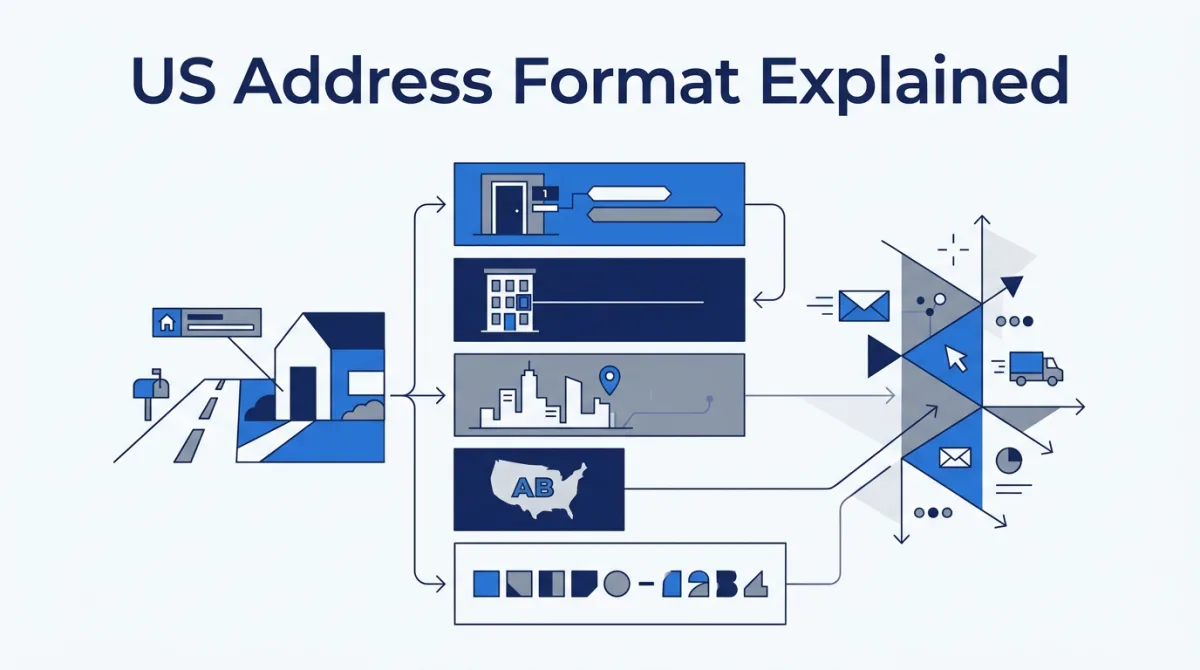
Every US mailing address follows the same compact grammar, and once you can read it, form design, address validation and test-data generation all get easier. The authoritative rulebook is USPS Publication 28, which defines how addresses should be standardized for mail processing [pub28]. This guide walks the format part by part, with the standard abbreviations and worked examples — and shows what a structurally correct but fictional test address looks like.
The scale involved explains why the format is so strict: USPS serves more than 165 million delivery points across the country [usps-facts], organized under roughly 41,000 active ZIP codes [zip-wiki]. At that volume, addresses are machine-read and machine-sorted — a predictable structure is not bureaucratic pedantry, it is what makes next-day sorting physically possible.
The two lines that matter
Strip away recipient names and company lines and a domestic address reduces to two functional lines. The delivery address line locates the point: primary number, street name, suffix and any secondary unit. The last line routes it: city, two-letter state abbreviation, and ZIP code [pub28].
| Part | Example | Rules |
|---|---|---|
| Primary number | 4821 | The house/building number; no ordinal words |
| Predirectional | N, SW | Optional compass point before the street name |
| Street name | MAPLE | The name proper, uppercase in standardized form |
| Suffix | AVE, ST, BLVD | Standard abbreviation from the Pub 28 suffix table |
| Postdirectional | NE | Optional compass point after the suffix |
| Secondary unit | APT 3B, STE 200 | Standard designators: APT, STE, UNIT, FL, RM |
| City | AUSTIN | The USPS-recognized place name for the ZIP |
| State | TX | Two-letter USPS abbreviation, always |
| ZIP / ZIP+4 | 78701-4425 | 5 digits route to an area; +4 narrows to a block face |
Standard abbreviations: why AVENUE becomes AVE
Publication 28 defines a canonical abbreviation for every street suffix and unit designator — over 200 suffix variants map onto a much smaller standard set: AVENUE, AVENU and AV all standardize to AVE; BOULEVARD to BLVD; APARTMENT to APT [pub28]. Address-validation APIs (and the CASS-certified software behind shipping labels) rewrite input into this canonical form, which is why the address you typed in a checkout often comes back subtly different.
- Common suffixes — ST (Street), AVE (Avenue), BLVD (Boulevard), DR (Drive), LN (Lane), RD (Road), CT (Court), PL (Place), PKWY (Parkway), CIR (Circle).
- Directionals — N, S, E, W, NE, NW, SE, SW, before or after the street name: 100 N MAIN ST, 200 OAK AVE SW.
- Unit designators — APT, STE (Suite), UNIT, FL (Floor), RM (Room), BLDG (Building); '#' is discouraged in standardized form.
- States — always the two-letter code: TX, CA, NY. Old-style abbreviations like Calif. or Tex. are not valid in the last line.
| Designator | Meaning | Followed by a number? |
|---|---|---|
| APT | Apartment | Yes — APT 3B |
| STE | Suite | Yes — STE 200 |
| UNIT | Unit | Yes — UNIT 12 |
| FL | Floor | Yes — FL 4 |
| RM | Room | Yes — RM 118 |
| BLDG | Building | Yes — BLDG 7 |
| DEPT | Department | Yes — DEPT 450 |
| BSMT / FRNT / REAR / LBBY | Basement / Front / Rear / Lobby | No — stand alone [pub28] |
How the ZIP code ties it together
The last line's ZIP code is what actually routes the piece: the first digit places the address in one of ten national zones, the first three digits identify a sectional center facility, and the full five digits a delivery area [pub28]. The optional +4 narrows further to a block face or building. Crucially, ZIP prefixes are geographically consistent — 787 is central Texas, 100 is Manhattan — so an address whose city, state and ZIP disagree fails validation instantly. We cover the system in depth in what is a ZIP code.
Worked examples
| As people write it | Standardized form |
|---|---|
| 4821 Maple Avenue, Apt. 3B, Austin, Texas 78701 | 4821 MAPLE AVE APT 3B / AUSTIN TX 78701 |
| 100 north Main Street Suite 200, Columbus OH | 100 N MAIN ST STE 200 / COLUMBUS OH 43215 |
| 752 W. 8th Ave #12, Dallas, TX | 752 W 8TH AVE UNIT 12 / DALLAS TX 75208 |
Note what standardization did: spelled-out words became canonical abbreviations, punctuation disappeared, '#' became a designator, and every last line gained a correct ZIP. If your form or fixture data round-trips through a validation API unchanged, it was already well-formed.
Generating structurally correct test addresses
For developers, the payoff of understanding the format is better fixtures: addresses that pass real validators without pointing at real homes. The random address generator applies the rules above — real city/state pairs, state-consistent ZIP prefixes, randomized street and number — and the state pages and city pages pin results to a specific place when your test needs, say, a Texas address. For a full profile around the address (name, 555-range phone, email), use the complete identity generator.
A small, strict grammar worth learning once
A US address is a small, strict format: delivery line plus last line, canonical abbreviations, and a ZIP that must agree with its city and state. The abbreviations are not conventions but a published standard: Publication 28's appendix defines the canonical suffix forms — ST, AVE, BLVD and the rest [pub28-abbr] — and its secondary-unit table defines which designators (APT, STE, UNIT) require a number and which, like BSMT or FRNT, must stand alone [pub28-units]. Learn the grammar once and you can design better address forms, debug validation failures faster, and recognize immediately why good generated test addresses look the way they do.
References & sources
- Publication 28, Appendix C1 — Street suffix abbreviations — USPS
- Publication 28, §213 — Secondary address unit designators — USPS
- Publication 28 — Postal Addressing Standards — United States Postal Service
- USPS facts — size and scope — United States Postal Service
- ZIP Code — Wikipedia
Frequently asked questions
What goes in address line 1 vs address line 2?
Line 1 is the delivery line: house number, street name and suffix — 4821 MAPLE AVE. Line 2, when used, carries the secondary unit: apartment, suite or unit number — APT 3B. USPS actually prefers the unit on the same line as the street when it fits; a separate line 2 is a web-form convention, not a postal requirement.
What is the difference between ZIP and ZIP+4?
The 5-digit ZIP code identifies a delivery area — a set of routes around a post office. ZIP+4 appends four digits that narrow it to a specific block face, building or high-volume recipient. The +4 is optional for senders; sorting equipment derives it automatically from a correct street address.
Do US addresses need to be in uppercase?
Mail in any casing gets delivered, but the USPS standardized format is all uppercase with no punctuation — 4821 MAPLE AVE STE 200 — because that is what optical character recognition equipment reads most reliably. Address validation services normalize to this form, which is why your checkout sometimes rewrites what you typed.
How do I get a realistic US address for testing?
Use a generator that keeps the parts consistent: a real city and state, a ZIP whose prefix is valid for that state, and a randomized street and house number so the address resolves to no real residence. Structurally valid but fictional is the safe combination for demos, fixtures and screenshots.