US Area Codes Explained: How Numbers Are Assigned
How the North American Numbering Plan works: area code structure, N11 codes, overlays vs splits, toll-free ranges, and which numbers can never be real.
By Vincent RuanPublished July 2, 2026Last updated August 23, 20268 min read
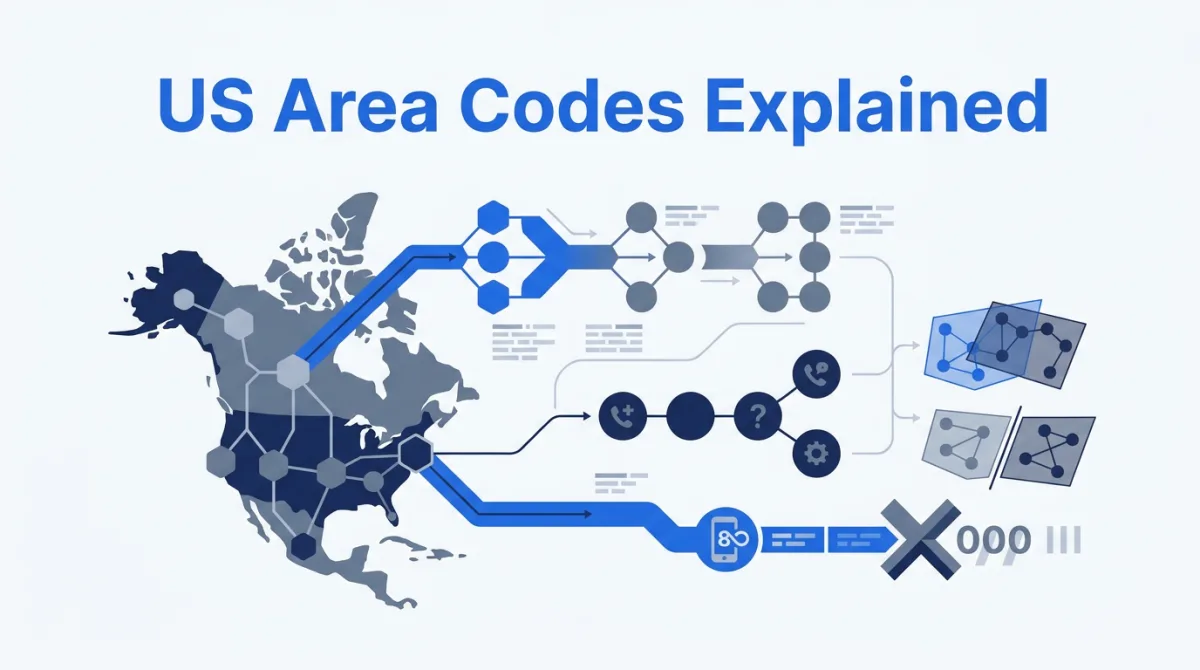
Area codes look arbitrary until you learn the system behind them — and then every phone number becomes readable. The rules decide which numbers can exist, which cities share codes, and why certain digits never appear where you expect them. This guide covers the North American Numbering Plan from its 1947 origins to modern overlays, and ends where fake data begins: the numbers the plan guarantees will never ring, which power every good phone number generator.
One plan, twenty-plus countries
The North American Numbering Plan (NANP) was designed by AT&T and Bell Laboratories in 1947 to replace a patchwork of local numbering schemes and enable direct long-distance dialing without operators. The original plan carved the continent into 86 numbering areas; today more than 400 area codes are in service across some 20 countries and territories under a single country code, +1, administered by the North American Numbering Plan Administrator [nanp-wiki] [npa-list] [nanpa]. Every number in the plan is ten digits in the same shape: NPA-NXX-XXXX.
| Part | Name | Example: (212) 555-0147 | Constraints |
|---|---|---|---|
| NPA | Numbering plan area (area code) | 212 | First digit 2–9; N11 reserved |
| NXX | Central office / exchange code | 555 | First digit 2–9; N11 reserved |
| XXXX | Line number | 0147 | Any four digits |
The digit rules that make numbers parseable
The plan's constraints exist so switching equipment (and now software) can parse a dialed sequence without ambiguity. Area codes and exchange codes both must start with 2–9, because a leading 1 signals long-distance and a leading 0 the operator [nanp-wiki]. Three-digit N11 codes are carved out for services: 911 for emergency, 411 for directory assistance, 311, 511, 711 and 811 for civic and utility services. In the original 1947 scheme the middle digit of an area code had to be 0 or 1 — which is why the oldest codes look like 212, 213, 312 and 305 — a restriction lifted in 1995 when those combinations ran out.
- Geographic codes — most codes map to a territory: 212 Manhattan, 213 Los Angeles, 312 Chicago, 305 Miami.
- Toll-free — 800, 833, 844, 855, 866, 877, 888 are non-geographic; the called party pays.
- Premium — 900 numbers bill the caller; largely obsolete but still reserved.
- Special-purpose — 710 (US federal government) and other easily recognizable codes have dedicated roles [nanpa].
| Area code | Territory (1947) | Today |
|---|---|---|
| 212 | New York City | Manhattan core; overlaid by 646, 332 |
| 213 | Los Angeles | Downtown LA; overlaid by 323 |
| 312 | Chicago | The Loop; overlaid by 872 |
| 202 | Washington, DC | Still the district's only geographic code |
| 305 | All of Florida | Now just Miami-Dade & the Keys; Florida has 10+ codes |
| 415 | Northern California | San Francisco; overlaid by 628 [npa-list] |
Splits and overlays: what happens when numbers run out
A single area code holds roughly 7.9 million usable numbers, and dense regions exhaust that. For decades the fix was a split: the map was cut and one side re-numbered — painful for everyone reprinting stationery. Since the late 1990s the standard fix is an overlay: a new code is layered over the same territory, existing numbers keep their code, and ten-digit dialing becomes mandatory because a local seven-digit number is no longer unambiguous [nanp-wiki]. Manhattan's 212 now shares streets with 646 and 332; Los Angeles's 213 with 323.
Reading a number like a validator
Put the rules together and you can sanity-check any US number at a glance, the way format validators do:
- Ten digits after +1? Anything else is not a NANP subscriber number.
- Area code starts 2–9 and is assigned? 112-xxx-xxxx is impossible; 999 is unassigned.
- Exchange starts 2–9? A 0 or 1 there breaks parsing; 911 as an exchange is reserved.
- Line number 0100–0199 under exchange 555? Then it is officially fictional — by design.
That last check is the bridge between real numbering and test data. The plan deliberately reserves 555-0100 through 555-0199 for fictional use — the full story is in why fake phone numbers start with 555 — so a generator can emit numbers that pass every structural check above yet can never reach a person [wiki-555].
Generating valid-but-fictional US numbers
When you need phone numbers for a demo, fixture or screenshot, the correct recipe is: a real geographic area code (so the number looks plausible for the profile's city and state), a 555 exchange, and a line number in the fictional block. Our random phone number generator does exactly this, and the full identity generator matches the area code to the generated address — a Texas profile gets a Texas-plausible number, consistent with its correctly structured street address. For state-pinned data, start from the US state pages.
A 75-year-old scheme that still parses cleanly
The NANP is a 75-year-old addressing scheme that still parses cleanly: three digits of where, three of which switch, four of who. Once you know the digit rules, N11 reservations and the overlay era's quirks, you can validate numbers structurally, design better phone fields — and recognize that the only truly safe fake numbers are the hundred the plan set aside on purpose.
References & sources
- 555 (telephone number) — the reserved fictional block — Wikipedia
- North American Numbering Plan — Wikipedia
- North American Numbering Plan Administrator — NANPA
- List of North American Numbering Plan area codes — Wikipedia
Frequently asked questions
What do the parts of a US phone number mean?
In (212) 555-0147, 212 is the area code (NPA) identifying a geographic numbering area, 555 is the central-office or exchange code (NXX) historically identifying a switch, and 0147 is the line number identifying the individual subscriber on that exchange. The same 10-digit structure covers the US, Canada and much of the Caribbean.
Why do some cities have multiple area codes?
When a numbering area approaches exhaustion, administrators either split it geographically (part of the map keeps the old code, part gets a new one) or overlay a new code on the same territory. Overlays are now standard because nobody has to change their existing number — the tradeoff is mandatory 10-digit dialing, since 212 and 646 numbers coexist on the same streets.
Can an area code start with 0 or 1?
No. The first digit of an area code (and of an exchange code) must be 2–9. A leading 1 is the country code / long-distance prefix and a leading 0 historically reached the operator, so numbers like (087) or (112) plus seven digits are structurally impossible in the North American plan — an instant tell for fake data.
Which phone numbers are guaranteed not to be real?
The only officially reserved fictional block is 555-0100 through 555-0199, usable under any real area code. A generated number like (305) 555-0163 is format-valid — real area code, legal exchange, correct length — but can never connect, which is why test data generators use exactly this range.