Street vs. Road vs. Avenue: What US Street Suffixes Mean
Street, road, avenue, boulevard, drive, lane, court, circle, place: what each US street suffix means by county rule, its USPS abbreviation, how common it is.
By Vincent RuanPublished November 8, 2026Last updated November 8, 202612 min read
Nobody in the federal government decides whether your street is a Street or a Road. The Postal Service standardises the abbreviation, not the meaning: its Publication 28 lists 208 primary suffixes with 504 accepted spellings and asks for one standard form of each [pub28-c1]. The meanings are set by the county or city that names the street, usually in a 9-1-1 addressing ordinance. Those documents agree far more than the magazine explainers suggest. This page quotes four of them.
It then adds something none of them has: how often each suffix is actually used. We counted that on the 8,467,069 named streets in the 2025 Census files behind our most common street names post. If you only need a sample address to test a form with, the random address generator produces one. It comes with a street name, a suffix, a city and a matching ZIP code.
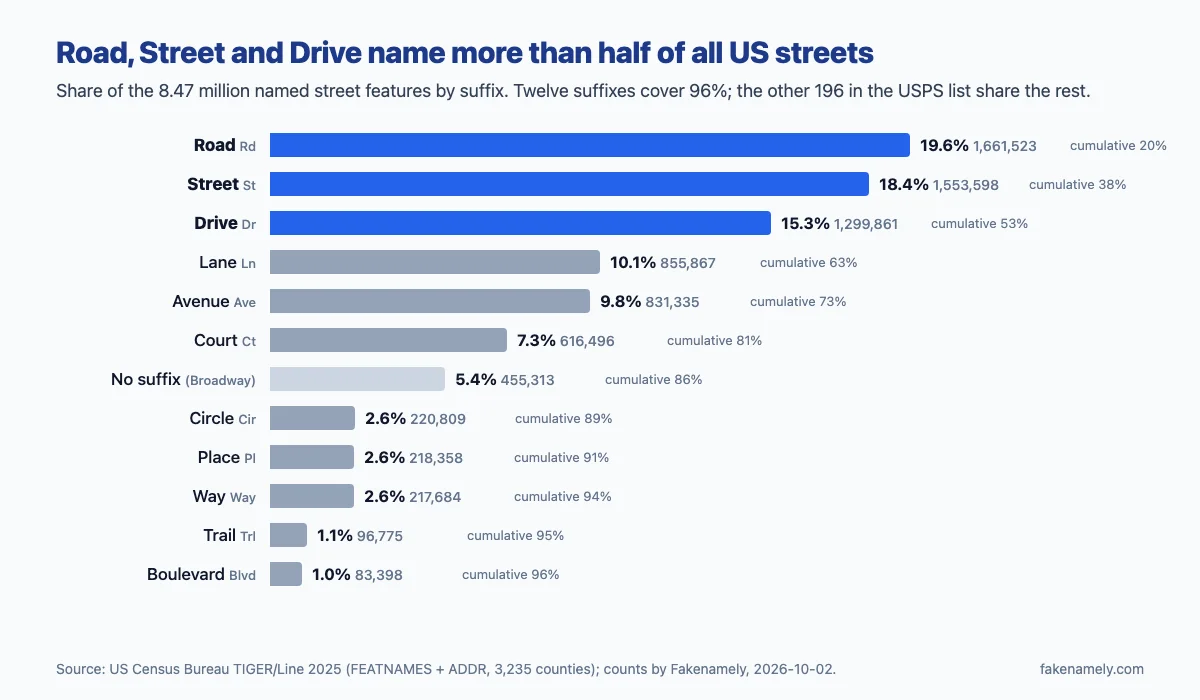
| Suffix | USPS | What it usually means (county standards) | Share of US streets |
|---|---|---|---|
| Road | Rd | A way that connects towns or settlements; may run through open country | 19.6% |
| Street | St | A public way in a town or city, paved, with buildings along it | 18.4% |
| Drive | Dr | A scenic or curving way of local extent; a road through a park | 15.3% |
| Lane | Ln | A narrow or informal street | 10.1% |
| Avenue | Ave | A broad street, often tree-lined, often running across the streets | 9.8% |
| Court | Ct | A short dead-end street; a cul-de-sac | 7.3% |
| (no suffix) | — | Broadway, Avenue A, El Camino Real and other names that stand alone | 5.4% |
| Circle | Cir | A street that curves back to its start, or a dead-end extension of a street | 2.6% |
| Place | Pl | A short street or court, often a U-shape back to the same street | 2.6% |
| Way | Way | A minor street or access road between two streets | 2.6% |
| Trail | Trl | A way following a historical or rural route | 1.1% |
| Boulevard | Blvd | A broad formal way with a median, often 100 feet or more wide | 1.0% |
Street vs. road vs. avenue: the definitions counties actually use
The most precise definitions appear in the documents that assign the names. Jefferson County, West Virginia, has a one-page list from its 9-1-1 addressing office [jefferson]. The Los Angeles County Department of Regional Planning maintains a three-page glossary of prefixes and suffixes, with a table of street widths [lacounty]. Wichita and Sedgwick County, Kansas, explain their conventions in a 40-page address manual [sedgwick], while Douglas County, Colorado, sums everything up in ten rules about direction and shape [douglas]. The table puts their wording side by side.
| Suffix | Jefferson County, WV | Los Angeles County, CA | Wichita / Sedgwick County, KS |
|---|---|---|---|
| Street | A public roadway in a town, city or urban area, especially a paved thoroughfare with footpaths and buildings along one or both sides. | A public way forty or more feet wide, used to give pedestrian and vehicular traffic access to the various parcels of land making up a community. A public way with a direction contrary to that of the avenues of the community. | Historically in Wichita, Streets have been used for east-west thoroughfares and Avenues for north-south thoroughfares. |
| Road | A roadway or thoroughfare running generally in and connecting urban areas. | A public way or highway connecting two or more settlements or towns generally bearing the name or names of the settlements connected. | The street type Road, as used in Wichita, is assigned only to arterial streets with heavy traffic volume such as Ridge Road and Rock Road. Smaller cities often use it the same as the common type of Street. |
| Avenue | A broad roadway usually planted on each side with trees. A public way named for its objectives or after the thing approached. | A broad public street. A street handsomely laid out with trees. A public way named avenue rather than street to denote its peculiar direction. (Avenues north and south, streets east and west). | Therefore, the street type Avenue is not often used and should be reserved for collector streets. |
Three ideas recur. A Street belongs in a built-up place and has buildings along it. A Road goes somewhere else: it connects settlements. In older naming it carried the name of the place it led to. That is why so many Roads are called after a town, a river or a mill. An Avenue is wider and planted with trees, and in grid cities it is the set of streets that run the other way. Los Angeles County says it outright: avenues north and south, streets east and west.
That direction rule is older than any county ordinance. The Commissioners' Plan that laid out Manhattan in 1811 had 'twelve primary 100 feet wide north–south avenues' crossed by numbered streets 60 feet wide running east to west [plan1811]. Wichita adopted the same split and later reversed it in practice. Douglas County, Colorado, writes the opposite into its rules: Avenue or Drive for streets running east to west, Street for north to south [douglas]. So the direction tells you nothing until you know the city.
| Place | Streets run | Avenues run | Source |
|---|---|---|---|
| Manhattan, NY (1811 plan) | East–west, 60 ft wide | North–south, 100 ft wide | Commissioners' Plan of 1811 |
| Wichita, KS (historical rule) | East–west | North–south (now reserved for collectors) | Wichita/Sedgwick County Address Guidelines |
| Los Angeles County, CA | Contrary to the avenues | North–south | LA County Regional Planning definitions |
| Douglas County, CO | North–south | East–west (Avenue or Drive) | Douglas County Suffix Rules 7.3.a–b |
Boulevard vs. avenue vs. parkway: width and the median
A Boulevard is the formal one. Jefferson County calls it 'a broad, formally laid out paved public roadway, typically with a median, usually ornamented with trees, decorated and illuminated' [jefferson]. Los Angeles County adds a number: 'a broad formally laid out paved public way, 100 feet or more wide' [lacounty]. A Parkway is the same idea with planting strips, and sometimes separate drives and bridle paths. Wichita treats the two as 'essentially the same type of street', both 'major thoroughfares usually with a median in the center'. Each must connect at least two major streets [sedgwick].
The LA County glossary finishes with a chart that classifies suffixes by the width of the right of way. It is the most concise answer to the boulevard, avenue and street question that we found in any public document.
| Right-of-way width | Suffixes |
|---|---|
| 100 feet and up | Avenida, Boulevard, Highway, Parkway, Via |
| 80 feet | Avenue, Calle, Camino, Carrera, Highway, Parkway, Road, Street |
| 50 to 70 feet | Byway, Canal, Circle, Court, Cove, Drive, Loop, Paseo, Place, Row, Terrace, Way |
| 5 to 30 feet | Alley, Loop, Motorway, Paseo, Trail, Walk |
Usage follows the hierarchy. Boulevard names 83,398 streets, 1.0% of the total, and Parkway 25,734, or 0.3%. Avenue, the ordinary broad street, names 831,335. Industrial is the name most often paired with Boulevard among the 300 most common street names (14% of Industrial streets are Boulevards), followed by University and Grand.
Drive, lane, way and trail: the suburban set
Drive is the third most common suffix in the country, on 1,299,861 streets, and it is almost entirely a post-war word. The county definitions agree it is a scenic or curving way: 'a recreational or scenic way of local extent. A road through a park' in Los Angeles County; 'a thoroughfare allowing steady flow of traffic' in Jefferson County. Wichita adds a local twist. It uses Drive for a street that runs beside an arterial and shares its name. Elsewhere in the county the word is looser: 'in other cities in Sedgwick County, a Drive is also used for gently curving collector streets' [sedgwick].
Lane is the narrow one, 'a narrow or informal street or passageway' in both Jefferson and Los Angeles County wording, and it names 855,867 streets. Way is defined as a minor connector, 'an access roadway between two streets' or 'a narrow road or highway. A lane' [lacounty], although in practice Way is used for anything a developer wants to sound modern. Trail, per Los Angeles County, is 'a pedestrian way through mountainous territory. A rough path in wild country. A public way following an historical route'; Douglas County simply allows Road, Lane or Trail for any through street [douglas].
| Suffix | Definition (county quoted) | Streets | Share | Names it pairs with most |
|---|---|---|---|---|
| Drive (Dr) | A recreational or scenic way of local extent. A road through a park. (LA County) | 1,299,861 | 15.3% | Circle (77% of Circle streets are Drives), Lakeshore, Skyline, Riverside |
| Lane (Ln) | A narrow or informal street or passageway. (Jefferson County) | 855,867 | 10.1% | Shady (76%), Country, Meadow, Timber |
| Way | An access roadway between two streets. A lane. (Jefferson County) | 217,684 | 2.6% | Aspen, Heritage, Industrial, Village |
| Trail (Trl) | A public way following an historical route. (LA County) | 96,775 | 1.1% | Timber, Cherokee, Pioneer, Arrowhead |
Court, circle, place, loop and terrace: the cul-de-sac family
These five are about shape rather than size, and this is where the ordinances get precise, because emergency dispatch depends on them. A Court is a cul-de-sac: Jefferson County defines it as 'a short enclosed roadway not having any other road intersection along its entire length. A dead-end roadway. A cul-de-sac' [jefferson]. Wichita uses Court 'when a cul-de-sac originates from a street at a near right angle'. It keeps Circle for a dead end that is 'a logical extension or continuation of a street' [sedgwick]. Elsewhere Circle means what it says, 'a roadway that forms a circle or part of a circle'.
Place is the short one. Los Angeles County: 'a short street or court'. Wichita is more specific: 'a short looping or U-shaped street' that begins and ends on the same thoroughfare. It adds a rule that loops containing a cul-de-sac may not be called a Place [sedgwick]. Loop is the Los Angeles County word for 'a street or way which returns into itself'. Terrace is either 'a short hillside street; a street on a terraced hill' (Los Angeles) or, in newer subdivisions, a street 'typically accessing town homes' (Jefferson County). Douglas County adds a tenth shape word, Point, for a cul-de-sac running in either direction.
| Shape | Jefferson County, WV | Wichita / Sedgwick County, KS | Douglas County, CO |
|---|---|---|---|
| Dead end at a right angle off a street | Court: 'A dead-end roadway. A cul-de-sac.' | Court: 'a street with a single common entrance and exit … when a cul-de-sac originates from a street at a near right angle' | Court or Way if it runs north–south; Place if east–west; Point in either direction |
| Dead end that continues a street | — | Circle: 'a logical extension or continuation of a street … a street that dead-ends' | — |
| Returns to the same street (horseshoe) | Circle: 'A roadway that forms a circle or part of a circle.' | Place: 'A short looping or U-shaped street … begin and end on the same thoroughfare.' | Circle or Loop |
| Short street | Place: 'A short street or court, often narrow.' | — | — |
| Hillside or townhome street | Terrace: 'typically accessing town homes' | — | — |
Court is the sixth most common suffix in the country, on 616,496 streets, and Circle and Place name about 220,000 each. Their names give away their age. Among the 300 most common names, the ones most often paired with Court are Hampton, Cambridge, Windsor, Quail and Heather. That is the vocabulary of subdivisions built after 1970, not of the Main Streets and Church Streets laid out a century earlier.
What Ct, Cir, Pl, Ter and the rest mean on an address line
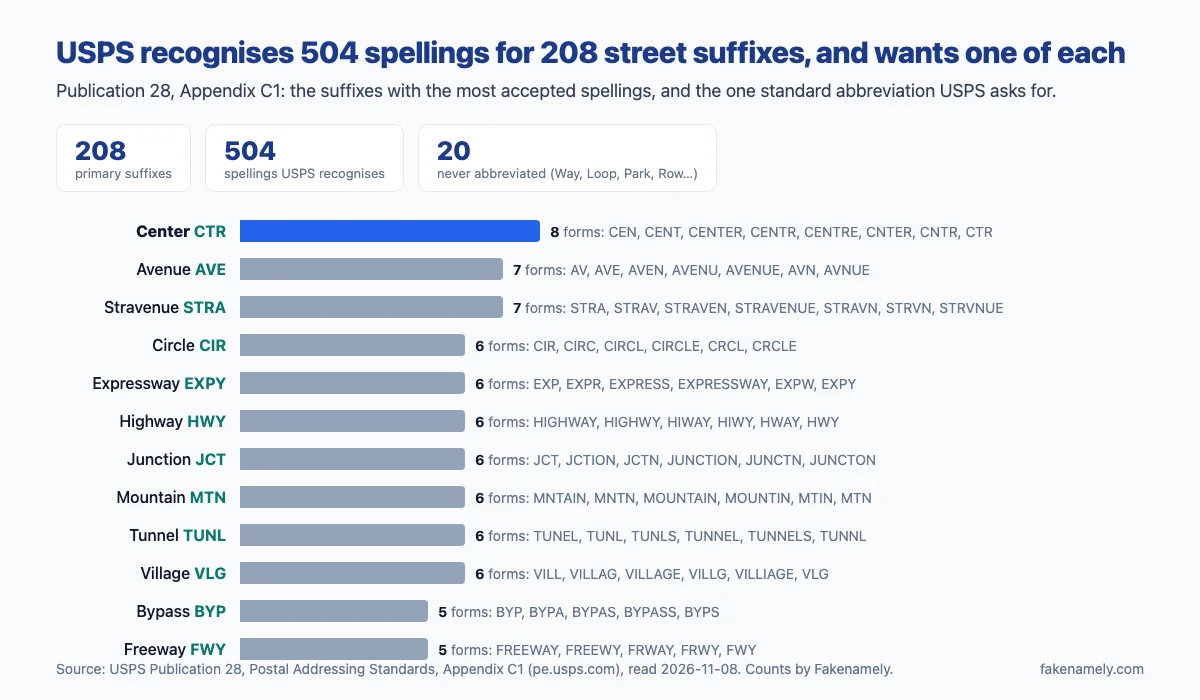
The abbreviations are the one part of this subject with a national standard. Publication 28 Appendix C1 lists every suffix the Postal Service recognises, the spellings people commonly write, and the single abbreviation it wants in the suffix field [pub28-c1]. Section 234.1 of the same publication states the rule: 'The suffix of the address should conform to the standard suffix abbreviations listed in the ZIP+4 file' [pub28-234]. We read the whole table: 208 primary suffixes, 504 accepted spellings, 20 suffixes that are never abbreviated.
| Suffix | USPS standard | Other spellings USPS recognises | Share of streets |
|---|---|---|---|
| Road | RD | ROAD | 19.6% |
| Street | ST | STREET, STRT, STR | 18.4% |
| Drive | DR | DRIVE, DRIV, DRV | 15.3% |
| Lane | LN | LANE | 10.1% |
| Avenue | AVE | AV, AVEN, AVENU, AVENUE, AVN, AVNUE | 9.8% |
| Court | CT | COURT | 7.3% |
| Circle | CIR | CIRC, CIRCL, CIRCLE, CRCL, CRCLE | 2.6% |
| Place | PL | PLACE | 2.6% |
| Way | WAY | WY | 2.6% |
| Trail | TRL | TRAIL | 1.1% |
| Boulevard | BLVD | BOUL, BOULEVARD, BOULV | 1.0% |
| Terrace | TER | TERR, TERRACE | 0.7% |
| Loop | LOOP | LOOPS | 0.35% |
| Cove | CV | COVE | 0.3% |
| Parkway | PKWY | PARKWAY, PARKWY, PKWAY, PKY | 0.3% |
| Highway | HWY | HIGHWAY, HIGHWY, HIWAY, HIWY, HWAY | 0.2% |
| Alley | ALY | ALLEE, ALLEY, ALLY | 0.2% |
| Ridge | RDG | RDGE, RIDGE | 0.1% |
| Point | PT | POINT | 0.1% |
| Path | PATH | PATHS | 0.1% |
Two details catch people out. First, the abbreviation is written without a period: ST, not St., in the USPS standard, although address-matching software accepts both. Second, when two suffix words run together, Publication 28 section 234.2 says to abbreviate only the second. An address on 'Parkway Avenue' has Parkway as part of the name and AVE in the suffix field [pub28-234]. The Spanish words that open a name, Calle, Camino, Via and Paseo, are not suffixes at all. The Census records them as prefix types. Together they open about 1% of US streets, 41,021 of them Calle.
The name decides the suffix: Main is a Street, Shady is a Lane
Counties define suffixes by geometry, but the people who name streets follow habit, and the habit is strong enough to measure. For each of the 300 most common street names we counted which suffix it carries. Main is a Street 92% of the time and Frontage is a Road 96% of the time. A street called Circle is a Drive in 77% of cases (Circle Drive). Shady is a Lane in 76%. Grand and Central are Avenues more often than not. Broadway has no suffix at all 30% of the time, the highest share of any common name.
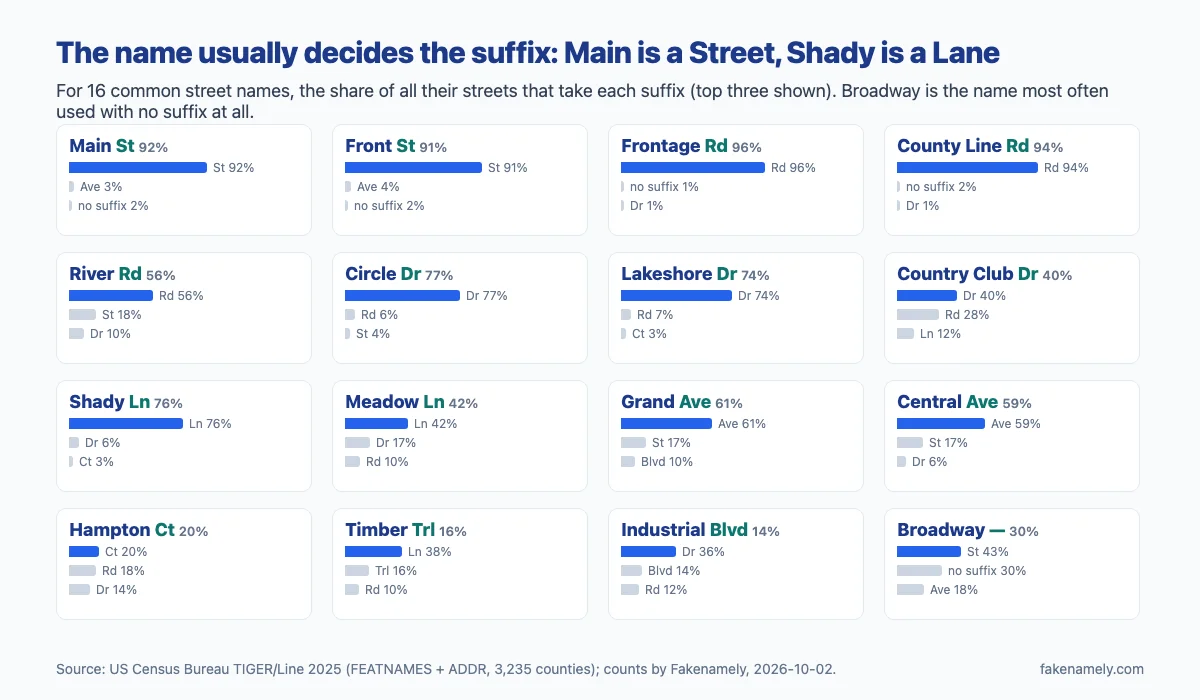
| Name | Streets | Most common suffix | Second | Third |
|---|---|---|---|---|
| Main | 33,516 | St 92% | Ave 3% | no suffix 2% |
| 2nd | 31,582 | St 69% | Ave 24% | no suffix 2% |
| Park | 21,373 | Ave 24% | St 24% | Dr 14% |
| Oak | 18,558 | St 52% | Dr 10% | Ln 10% |
| Maple | 17,008 | St 47% | Ave 18% | Ln 10% |
| Washington | 13,460 | St 57% | Ave 24% | Rd 4% |
| Church | 11,465 | St 72% | Rd 13% | Ave 5% |
| Sunset | 10,359 | Dr 36% | Ln 12% | Ave 9% |
| Lake | 10,258 | Dr 27% | St 23% | Rd 22% |
| River | 9,583 | Rd 56% | St 18% | Dr 10% |
| Ridge | 8,143 | Rd 49% | Dr 13% | St 9% |
| Highland | 8,069 | Ave 33% | Dr 22% | St 12% |
| Meadow | 7,138 | Ln 42% | Dr 17% | Rd 10% |
| Dogwood | 7,066 | Ln 26% | Dr 23% | St 10% |
| Broadway | 6,117 | St 43% | no suffix 30% | Ave 18% |
| Country Club | 4,238 | Dr 40% | Rd 28% | Ln 12% |
| Fairway | 3,657 | Dr 52% | Ln 11% | Ct 9% |
The pattern is historical. Names from the 19th-century town plat (Main, Church, Washington, Walnut, the numbered streets) are Streets, with Avenue as the cross-street alternative. Names that describe landscape (River, Ridge, Lake) are Roads and Drives, because they were rural roads that the suburbs grew out to. Names that sell a mood (Meadow, Dogwood, Sunset, Fairway, Country Club) are Lanes, Drives and Courts, the suffixes of the subdivision. The full breakdown for all 300 names is in the detail file.
Writing the suffix on a form, and generating addresses that follow the rules
For a delivery address, write the name as the sign has it and the suffix in its USPS form: 1600 Pennsylvania Ave NW, 350 Fifth Ave, 233 S Wacker Dr. Do not invent a suffix for a street that has none; Broadway is Broadway. If a form has a separate 'street type' field, pick the standard abbreviation from the table above. Our US address format guide covers the rest of the line: the directional, the unit designator and why the ZIP+4 goes last.
When you need sample addresses rather than a real one, use the random address generator. It writes the suffix out in full (Street, Avenue, Court), which address-matching software accepts. If a form insists on the USPS form, shorten it with the table above. The state pages pair those addresses with real ZIP prefixes for each state, and the ZIP code generator covers the postal half of the line on its own.
| Suffix | Example in USPS form | Note |
|---|---|---|
| Street | 412 N Main St, Springfield, IL 62701 | Directional before the name, suffix abbreviated |
| Avenue | 2210 Grand Ave, Des Moines, IA 50312 | AVE, never AV, in the standard |
| Road | 8807 River Rd, Richmond, VA 23229 | RD is the only abbreviation Pub 28 lists for Road |
| Drive | 1500 Lakeshore Dr, Chicago, IL 60610 | DR; DRIV and DRV are also recognised |
| Court | 9 Hampton Ct, Cary, NC 27513 | Almost always a cul-de-sac |
| Boulevard | 3300 Industrial Blvd, Bethel Park, PA 15102 | BLVD; BOUL and BOULV are also recognised |
| Way | 77 Heritage Way, Marlborough, MA 01752 | Written out; WY is accepted but not standard |
| No suffix | 1681 Broadway, New York, NY 10019 | Leave the suffix field empty |
How we counted, and what the numbers leave out
The usage shares come from the 2025 TIGER/Line FEATNAMES and ADDR files for all 3,235 counties and county equivalents [tiger]. That is 62.8 million name records, reduced to 8,467,069 distinct named street features. Each carries the suffix abbreviation the county recorded, the element the federal address standard calls the street name post type [fgdc]. The count and its rules (route prefixes dropped, spelled ordinals folded, directionals separated from names) are documented in the street names post and reproducible with the published script.
The USPS table was read from Postal Explorer on 2026-11-08 and is published as a CSV. The suffix shares are in the types CSV.
Two limitations are relevant. The Census lists the suffix the way the county submitted it. So an Avenue filed as Ave counts as Ave, and a street filed under a Spanish prefix counts as a prefix. And because County Road 12 and State Highway 9 were removed as route designations rather than names, Road and Highway are under-counted compared with what you would see on signs. No county definition quoted here applies beyond the county that wrote it. The point of quoting four is that they agree on the shapes even when they disagree on the direction.
References & sources
- Publication 28, Postal Addressing Standards, Appendix C1: Street Suffix Abbreviations — US Postal Service
- Publication 28, Postal Addressing Standards, section 234: Suffixes (234.1 Abbreviations, 234.2 Two Suffixes) — US Postal Service
- Jefferson County Street Suffix Definitions (9-1-1 Addressing Office) — Jefferson County Commission, West Virginia
- Street Name Establishment and Changes: Definitions, Street Name Prefixes and Suffixes (September 2024) — County of Los Angeles Department of Regional Planning
- Wichita/Sedgwick County, Kansas Address Guidelines (March 2004, updated December 2018), pp. 17–19 — Sedgwick County, Kansas
- Suffix Rules (Addressing and Street Naming Manual items 7.3.a–7.3.j) — Douglas County, Colorado, Department of Community Development
- Commissioners' Plan of 1811, section 'Streets and avenues' — Wikipedia
- TIGER/Line Shapefiles 2025: FEATNAMES and ADDR relationship files — US Census Bureau
- United States Thoroughfare, Landmark, and Postal Address Data Standard (FGDC-STD-016-2011) — Federal Geographic Data Committee
Frequently asked questions
What is the difference between a street and a road?
In county addressing standards a Street is a public way inside a town or city, usually paved and lined with buildings. A Road is a way that connects towns or settlements and may run through open country. Jefferson County, West Virginia, defines a Road as 'a roadway or thoroughfare running generally in and connecting urban areas'. Los Angeles County calls it a way 'connecting two or more settlements or towns'. On the ground the two overlap heavily: Road is the most common US suffix (19.6% of named streets) and Street is second (18.4%).
What is the difference between a street and an avenue?
An Avenue is traditionally broader than a street and often tree-lined, and in many grid cities it runs at right angles to the streets. Manhattan's 1811 plan made avenues 100 feet wide running north to south, and streets 60 feet wide running east to west. Wichita historically used Streets east to west and Avenues north to south. Douglas County, Colorado, does the reverse: Avenue for east to west streets, Street for north to south. The direction rule is local, so check the city, not the dictionary.
What does Ct, Cir, Pl or Ter mean in an address?
They are the USPS standard abbreviations for Court, Circle, Place and Terrace. A Court is normally a cul-de-sac. A Circle is a street that returns to its own start, or a dead-end extension of a street. A Place is a short street or court. A Terrace is a short hillside street or a street of townhomes. Other common ones: Dr is Drive, Ln is Lane, Blvd is Boulevard, Pkwy is Parkway, Trl is Trail, Hwy is Highway.
What is the difference between a boulevard and an avenue?
Both are broad. A Boulevard is the more formal of the two. County standards describe it as a broad paved way, typically with a landscaped median. Los Angeles County reserves the name for ways 100 feet or more wide. An Avenue is a broad street, often planted with trees, without the median requirement. Boulevards are rare in practice, 1.0% of US streets against 9.8% for Avenue.
What is a cul-de-sac street called?
Usually a Court. Wichita and Sedgwick County, Kansas, define a Court as 'a street with a single common entrance and exit', used when a cul-de-sac leaves a street at a near right angle. Jefferson County, West Virginia, calls it 'a dead-end roadway. A cul-de-sac.' Place, Circle and, in Colorado, Point are also used for cul-de-sacs depending on shape and direction. Court is the sixth most common suffix in the US, on 7.3% of streets.
What is the most common street suffix in the US?
Road. In the 2025 Census TIGER/Line files, 19.6% of the 8.47 million named street features end in Road (Rd), 18.4% in Street (St) and 15.3% in Drive (Dr). Lane, Avenue and Court follow. About 5.4% of streets have no suffix at all, Broadway being the best known example.
Should I write Street or St on a form?
Either is deliverable, but the Postal Service's standard is the abbreviation. Publication 28 says 'the suffix of the address should conform to the standard suffix abbreviations listed in the ZIP+4 file'. So St, Rd, Ave, Blvd, Dr, Ln, Ct, Cir, Pl, Ter, Pkwy, Trl and Hwy, all without periods. Twenty suffixes, including Way, Loop, Park, Row and Walk, have no shorter form and are written out.
Update history
- Published, with the share of US streets carrying each suffix, the USPS suffix table as a CSV, and verbatim definitions from four county addressing standards.