US Phone Number Format: +1, 10 Digits, Examples and Test Numbers
How to write a US phone number: (212) 555-0142, +1 and E.164, why it always has 10 digits, how many numbers exist, and which ones are safe for testing.
By Vincent RuanPublished November 14, 2026Last updated November 19, 202613 min read
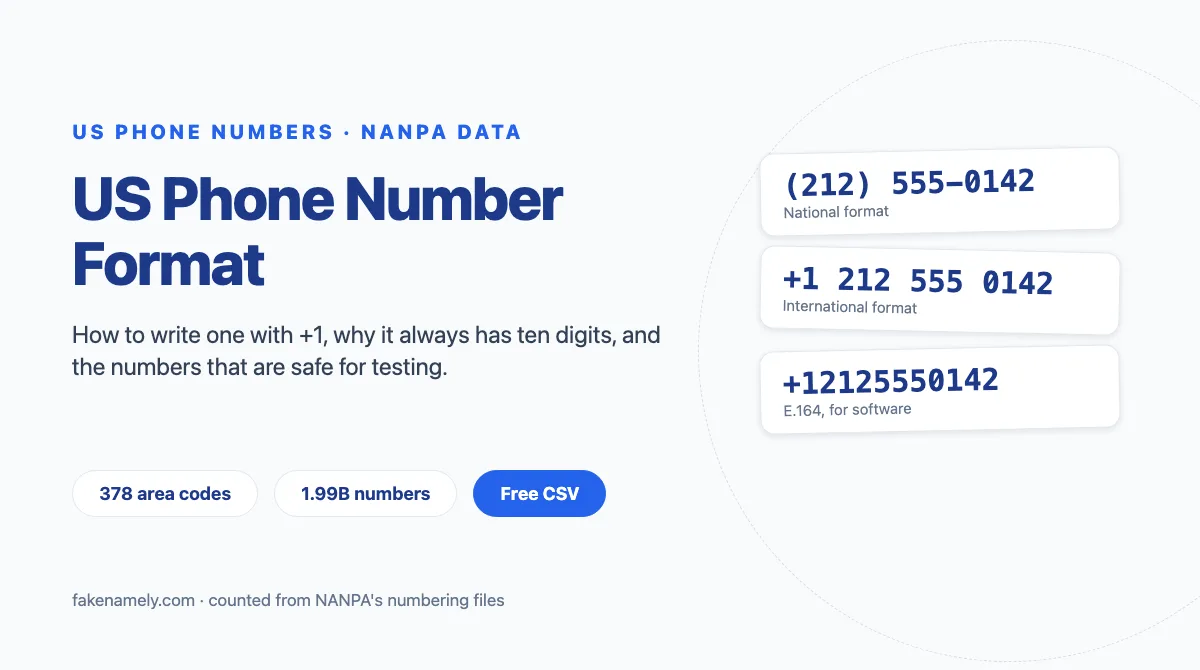
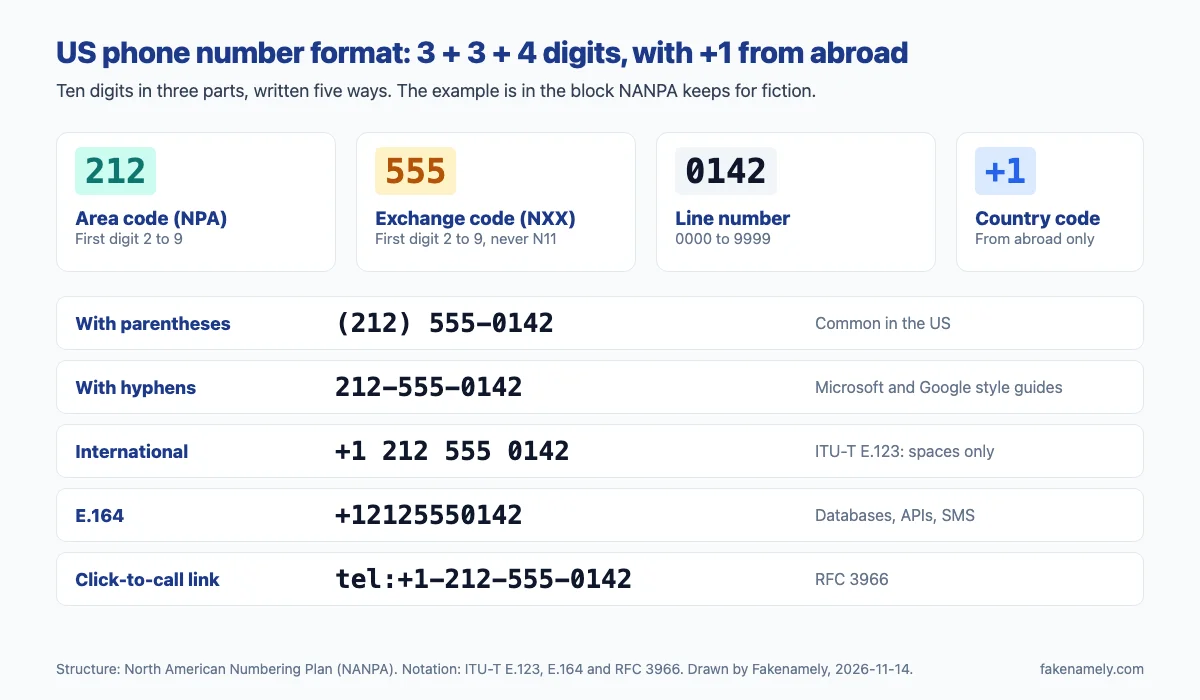
A US phone number has ten digits in three parts. The area code comes first, then a three-digit exchange code, then a four-digit line number. At home you write it as (212) 555-0142 or 212-555-0142. From another country, put the country code +1 in front: +1 212 555 0142.
This guide explains each part from the source. The rules come from the North American Numbering Plan Administrator (NANPA), which runs the plan for the US, Canada and much of the Caribbean [nanpa]. The counts come from NANPA's own files, downloaded on the day we published [npadb] [cocodes]. Every example number we wrote is in the block NANPA keeps for fiction, so none of them can ring a real person. Numbers quoted from style guides and other sources are shown as those sources print them. If you need made-up numbers in bulk, the phone number generator writes them from that same block.
| Form | Example | Use it for |
|---|---|---|
| Parentheses | (212) 555-0142 | Letters, signs and forms read in the US |
| Hyphens | 212-555-0142 | The same, in house styles that avoid parentheses |
| International | +1 212 555 0142 | Email signatures, websites with readers abroad |
| E.164 | +12125550142 | Databases, APIs, SMS services |
| Link | tel:+1-212-555-0142 | The href of a click-to-call link |
| With an extension | 212-555-0142 ext. 25 | Office lines; store the extension separately |
How many digits is a US phone number?
Ten, or eleven if you count the 1 in front. NANPA puts it in one sentence: 'NANP numbers are ten-digit numbers consisting of a three-digit Numbering Plan Area (NPA) code, commonly called an area code, followed by a seven-digit local number' [nanpa]. The seven digits split into a three-digit exchange code and a four-digit line number. NANPA writes the shape as NXX-NXX-XXXX, 'where N is any digit from 2 through 9 and X is any digit from 0 through 9'.
| Part | Example | Rule | How many exist |
|---|---|---|---|
| Area code (NPA) | 212 | NXX: first digit 2 to 9 | 800 possible; 378 in service in the US |
| Exchange code (NXX) | 555 | NXX: first digit 2 to 9, never an N11 code | 800 per area code; 302,400 in US area codes |
| Line number | 0142 | XXXX: any four digits | 10,000 per exchange code |
| Country code | +1 | Shared by the US, Canada and the Caribbean members | 1 |
The length never varies. NANPA's files are built on the rule: each of the 378 US area codes has exactly 800 exchange codes, 200 to 999, which makes 302,400 in all. Each exchange code splits into ten thousands-blocks, each 'beginning with X000 and ending with X999' [cocodepage], so the line number always has four digits. A UK number can have seven, nine or ten digits after the 0, as our UK phone number format guide counts. A US number cannot.
The 1 is not part of the number. The ITU 'assigned country code "1" to the NANP area', which serves 20 countries [nanpa]. Inside the US, many local dialing plans also put a 1 before the area code, which NANPA writes as '1+10 digits' [nanpa988]. That is why some forms ask for 11 digits and others for 10. Store the ten digits and add the 1 when you dial or display it.
Letters are not part of the format either. Vanity numbers such as 1-800-FLOWERS, the FCC's own example [fcctollfree], spell digits using the keypad layout in ITU-T E.161: 2 is ABC, 3 DEF, 4 GHI, 5 JKL, 6 MNO, 7 PQRS, 8 TUV and 9 WXYZ [e161]. Store the digits, not the letters.
Can a US phone number start with 0 or 1?
No. In NANPA's NXX-NXX-XXXX, N is 2 to 9, so area codes and exchange codes both start with a digit from 2 to 9 [nanpa]. NANPA's files bear this out: they list exchange codes 200 to 999 under each area code and nothing below 200. A number such as (012) 555-0142 or (212) 155-0142 cannot exist. A form that accepts it is not checking the format.
Some codes that start with 2 to 9 are held back too. NANPA marks them 'unavailable' in a given area code. Its definitions say these 'include, but are not limited to, test and special use codes (e.g., 958, 959, 555, time), N11 and other unique codes (e.g., 976, 950), codes set aside for pooling, and codes with special dialing arrangements' [cocodes]. We counted where each one is held back. The eight N11 codes, 555 and 950 are unavailable in every one of the 378 area codes. The others are assigned in a few places.
| Exchange code | What NANPA calls it | Unavailable in | Assigned in |
|---|---|---|---|
| 211, 311, 411, 511, 611, 711, 811, 911 | N11 codes | 378 each | 0 |
| 555 | Test and special use | 378 | 0 |
| 950 | Unique code | 378 | 0 |
| 959 | Test and special use | 376 | 2 |
| 700 | Not described in the file | 375 | 3 |
| 976 | Unique code | 369 | 9 |
| 958 | Test and special use | 367 | 11 |
In total, 6,503 exchange codes are unavailable, 2.2% of the 302,400. The other 426 codes on the list account for 1,236 more. Each is held back in at most 56 area codes. The file does not say which of NANPA's reasons applies. The full list is in the unavailable codes file.
Writing a US number with +1: spaces, no parentheses
The international format is a plus sign, the country code 1, then the ten digits. ITU-T E.123, the standard for writing phone numbers, says the plus sign 'serves to remind the subscriber to dial the international prefix which differs from country to country' [e123]. So +1 212 555 0142 works for a reader in London or Tokyo. On a mobile phone you can dial the plus sign itself.
Two habits from the national format should go. First, the parentheses. E.123 uses brackets for digits that 'are not always dialled', and it says they 'should not be used in an international number' [e123]. Second, the hyphens. The same standard says: 'Only spaces should be used in an international number.' That leaves +1 212 555 0142.
Software uses a third form, called E.164 after the ITU recommendation that defines it. It is the plus sign and the digits, with nothing in between: +12125550142. E.164 allows at most 15 digits [e164], and a US number uses 11 of them. Store numbers in this form and format them for display. The ten digits after +1 are the same in every form.
| Form | Example | Rule |
|---|---|---|
| National | (212) 555-0142 or 212-555-0142 | House style decides; see the next section |
| International | +1 212 555 0142 | E.123: plus sign, spaces only, no parentheses |
| E.164 | +12125550142 | Plus sign and digits only; at most 15 digits |
| Link | tel:+1-212-555-0142 | RFC 3966: global number, hyphens allowed, no spaces |
The last row is for web pages. RFC 3966, the standard for phone links, says global numbers are 'identified by the leading "+" character'. It allows hyphens as separators but says links 'MUST NOT use spaces' [rfc3966]. Its own example is a US number: tel:+1-201-555-0123. To call a US number from a landline abroad, replace the plus sign with the local exit code. That is 00 in the UK and most of Europe, so the number becomes 00 1 212 555 0142.
Parentheses, hyphens or dots?
Inside the US there is no single rule, and the published style guides disagree. Microsoft's writing style guide is the firmest: 'Use hyphens—not parentheses, periods, spaces, or anything else—to separate the parts of a phone number' [msstyle]. Google's developer style guide also separates the parts with hyphens, and writes the international form as +1-415-555-0132 [googlestyle]. The US Government Publishing Office's style manual prints its examples with en dashes, such as 202–512–1800 [gpo].
| Source | Example it gives | Separator |
|---|---|---|
| Microsoft Writing Style Guide | 612-555-0175 | Hyphens only; 'not parentheses, periods, spaces' |
| Google developer documentation style guide | 415-555-0132; +1-415-555-0132 | Non-breaking hyphens |
| US GPO Style Manual (2016) | 202–512–1800 | En dashes (the manual's own sales imprint writes (866) 512-1800) |
| ITU-T E.123 | Tel. (0607) 123 4567; Tel. +22 607 123 4567 | Spaces; parentheses only for digits 'not always dialled' |
| Excel's Phone Number format | (555) 555-1234 | Parentheses and a hyphen |
The parentheses have a meaning in the international standard. E.123 uses them for digits that 'are not always dialled' [e123]. In a US number that is the area code, which many local calls used to skip. In more and more places it can no longer be skipped. 988 is now the number of the Suicide and Crisis Lifeline. To make room for it, the FCC counted '82 area codes in 35 states and one U.S. territory' that used 988 as an exchange and still allowed seven-digit dialing [fcc10]. Ten-digit dialing became mandatory there on 24 October 2021 [nanpa988]. There, even a local call needs the area code.
So pick one style and use it everywhere. For readers in the US, 212-555-0142 is the safest choice. Two of the three style guides use it, and it does not suggest the area code is optional. (212) 555-0142 is still common and easy to read. Dots, as in 212.555.0142, appear in none of the guides we checked. For readers abroad, use +1 212 555 0142.
US area codes: 378 in service, 800 possible
An area code is three digits starting 2 to 9, so there are 800 possible codes, 200 to 999. NANPA's database lists all of them. On 14 November 2026, 378 were in service as area codes for the US and its territories. Canada had 55 and the Caribbean and Atlantic members 21. The rest are reserved, set aside for other uses or not yet used.
NANPA's own count of what is left to work with: of the 800 codes, 649 are assignable as area codes once the reserved and special-purpose ones are set aside [nanpexhaust].
| Use | Area codes | Examples |
|---|---|---|
| Geographic, in service in the US and territories | 378 | 212 New York, 213 Los Angeles, 312 Chicago |
| Geographic, in service in Canada | 55 | 416 Toronto, 604 Vancouver |
| Geographic, in service in the Caribbean and Atlantic | 21 | 876 Jamaica, 441 Bermuda |
| Assigned, not yet in service | 6 | US: 451 North Carolina, 565 Georgia, 761 Kentucky |
| Toll-free | 17 (7 in use) | 800, 833, 844, 855, 866, 877, 888 |
| Reserved for expanding the plan | 80 | Every code with 9 in the middle, such as 296 |
| Never assignable | 11 | The eight N11 codes, 555, 950, 988 |
| Other uses, reserved or not yet used | 232 | 500 and other 5XX codes, 900 premium rate, 710 US government |
Toll-free numbers use the same ten-digit format with their own area codes. The FCC lists them: 'Toll free codes – 800, 888, 877, 866, 855, 844 and 833.' It adds that they 'are not interchangeable'. The same seven digits after 1-800 and after 1-888 reach different people [fcctollfree].
The 378 US codes are spread unevenly. California has 41 and Texas 29. Eleven states have only one: Alaska, Delaware, Hawaii, Maine, Montana, North Dakota, New Hampshire, Rhode Island, South Dakota, Vermont and Wyoming. So do American Samoa, Guam, the Northern Mariana Islands and the US Virgin Islands. The full list, with the numbers assigned under each code, is in the area codes file.
| State | Area codes in service | Numbers assigned |
|---|---|---|
| California | 41 | 221,380,000 |
| Texas | 29 | 161,240,000 |
| New York | 23 | 120,660,000 |
| Florida | 23 | 112,160,000 |
| Illinois | 17 | 89,950,000 |
| Pennsylvania | 15 | 82,650,000 |
| Ohio | 15 | 73,060,000 |
| Michigan | 13 | 68,830,000 |
Most of today's codes are young. 'AT&T developed the North American Numbering Plan in 1947' [nanpa], and the original plan 'created 86 geographic areas' across the US and Canada [cnac]. Only 77 of today's US codes carry NANPA's in-service date of 1947. The 1990s added 112, more than any other decade. The newest is 465, added to New York City's 718 area on 18 June 2026. Three more are assigned but not yet live: 565 for Georgia's 912 area from 6 December 2027, 451 for North Carolina's 828 area from 21 September 2028, and 761 for Kentucky's 502 area.
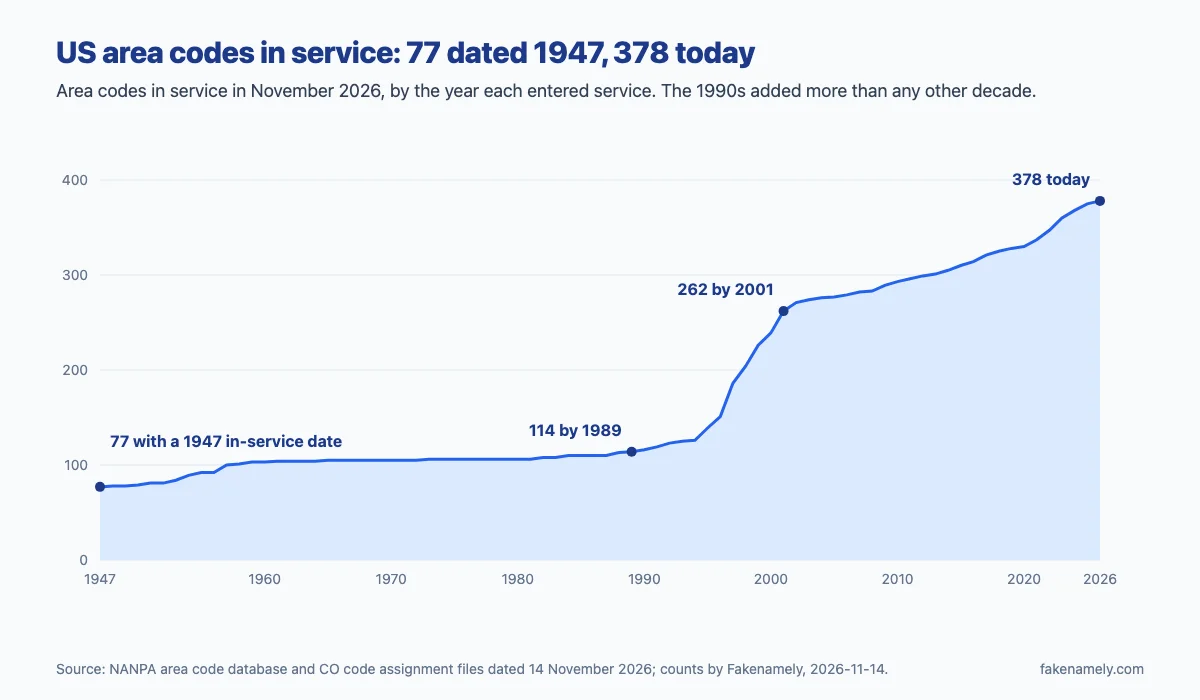
California's regulator gives the rule for new codes: 'A new area code is added to a geographic area when there are no more three-digit prefixes available in the existing area code' [cpuc]. Today the new code arrives as an overlay, laid over the same map, so nobody has to change their number. All 89 US area codes that entered service since 2010 share their map with an older code. In all, 265 of the 378 do. That is why the area code alone tells you little about a caller. Manhattan's 212 shares its area with 646, 332 and 917.
Do US cell phone numbers have a different format?
No. A mobile number has the same ten digits and the same area codes as a landline. Many countries give mobiles their own prefix, such as 07 in the UK. The US does not. Wireless carriers apply for exchange codes from the same pool as every other phone company, so mobile and landline codes sit side by side.
| Exchange | Code holder in NANPA's file |
|---|---|
| 312-200 | MetroPCS, Inc. |
| 312-201 | Illinois Bell Tel Co |
| 312-202 | Illinois Bell Tel Co |
| 312-203 | New Cingular Wireless PCS, LLC - IL |
| 312-204 | Illinois Bell Tel Co |
| 312-205 | MCImetro Access Transmission Services LLC |
| 312-206 | New Cingular Wireless PCS, LLC - IL |
| 312-207 | Illinois Bell Tel Co |
| 312-208 | New Cingular Wireless PCS, LLC - IL |
| 312-209 | Cellco Partnership dba Verizon Wireless - IL |
| 312-210 | Peerless Network of Illinois, LLC - IL |
Five of these eleven codes are held by companies with 'Wireless' or 'PCS' in their names. Nothing in the digits marks them out. NANPA's public files do not even record which codes are wireless. NANPA's exhaust analysis does give the split of new codes by type of company. Wireless carriers took 30% of the codes assigned in 2022, 58% in 2025 and 47% in 2026 up to August [nanpexhaust].
| Year | Codes assigned | Local phone companies (CLEC) | Internet phone services (IPES) | Wireless |
|---|---|---|---|---|
| 2022 | 6,737 | 39% | 30% | 30% |
| 2023 | 5,930 | 41% | 15% | 43% |
| 2024 | 4,689 | 38% | 11% | 51% |
| 2025 | 4,132 | 31% | 11% | 58% |
| 2026 | 2,008 | 34% | 19% | 47% |
CLEC means competitive local exchange carrier, a phone company that competes with the original local one. IPES means an interconnected internet phone service, such as a VoIP provider. Numbers also move between companies, because people keep their number when they switch. So even a carrier lookup only tells you who serves a number today.
How many US phone numbers are there?
Pages that answer this disagree. Some say 10 million per area code, others 7.92 million. The second is the right ceiling. An area code has 800 exchange codes, 200 to 999, because exchange codes cannot start with 0 or 1. Take away the eight N11 codes and 792 remain. Each holds 10,000 line numbers, which gives 7,920,000. The 10 million figure forgets the first-digit rule. In practice the room is a little smaller. US area codes hold back about 17 exchange codes each on average, 6,503 across 378, which leaves about 7.83 million.
| Step | Rule | Numbers |
|---|---|---|
| Any ten digits | 0000000000 to 9999999999 | 10,000,000,000 |
| The plan's shape | 800 area codes × 800 exchange codes × 10,000, before any code is held back | 6,400,000,000 |
| One area code | 792 exchange codes (no N11) × 10,000 | 7,920,000 |
| US area codes in service | 378 × 7,920,000 | 2,993,760,000 |
| In exchange codes assigned to carriers | 198,848 codes × 10,000 | 1,988,480,000 |
| In vacant exchange codes | 97,049 codes × 10,000 | 970,490,000 |
| Reserved for fiction | 555-0100 to 555-0199 × 378 area codes | 37,800 |
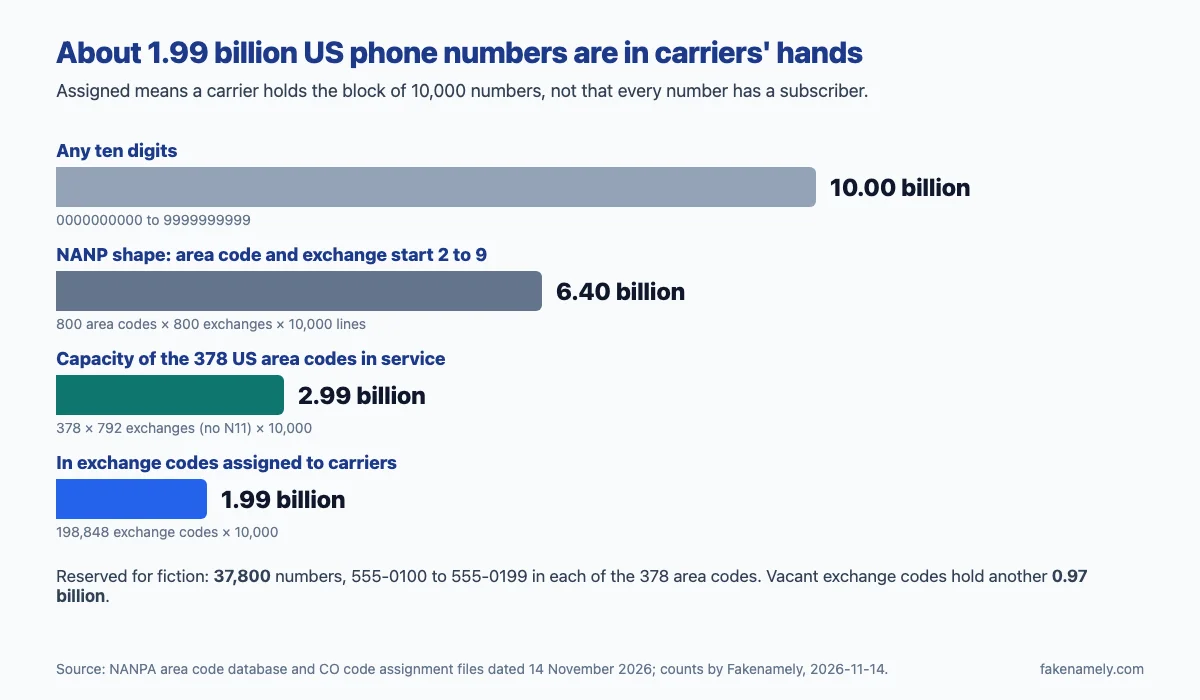
So about 1.99 billion US numbers sit in blocks held by phone companies. That is the supply of numbers, not a count of phones. A carrier holds a whole block of 10,000 whether or not each number has a customer. Many codes are also split further. NANPA defines a thousands-block as 'a range of one thousand telephone numbers (TN) within a CO code (NPA-NXX)' [cocodepage], and in pooled codes these blocks go to different carriers. NANPA's files mark 71.8% of assigned codes as pooled.
Most assigned codes are old. NANPA's file records an assignment date only from January 2001 on. 113,480 assigned codes, 57.1%, have no date, so they were handed out before then. The codes by year file has the rest.
Will the US run out of phone numbers?
Not for a long time. NANPA forecasts when the whole plan will run out of numbers. Its October 2026 analysis says: 'the projected NANP exhaust date is 2064, assuming the quantity of assignable NPA codes remains at 649' [nanpexhaust]. With 6% lower demand the date moves to 2067. The model assumes about 4,060 new exchange codes a year across the plan.
Single area codes run out much sooner, and many already have. In NANPA's files, 100 of the 378 US area codes have no vacant exchange code left. Manhattan's 212 is one of them. Its overlay partner 332 still has 623 free codes, so the area as a whole is not full. NANPA also forecasts a date for each area code [npaexhaust]. These are the ones it expects to run out first.
| Area code | Area | Forecast exhaust | Vacant exchange codes now | New code planned |
|---|---|---|---|---|
| 714 and 657 | Orange County, California | 2nd quarter 2028 | 79 | None yet |
| 912 | Southeast Georgia | 2nd quarter 2028 | 55 | 565, from 6 Dec 2027 |
| 580 | Western Oklahoma | 2nd quarter 2029 | 37 | None yet |
| 828 | Western North Carolina | 2nd quarter 2029 | 51 | 451, from 21 Sep 2028 |
| 956 | South Texas | 2nd quarter 2029 | 47 | None yet |
| 509 | Eastern Washington | 3rd quarter 2029 | 21 | None yet |
| 949 | Orange County, California | 3rd quarter 2029 | 38 | None yet |
| 502 | Louisville, Kentucky | 4th quarter 2029 | 45 | 761, date not set |
US phone numbers for testing: 555-0100 to 555-0199
If you make up a US number, it may well belong to someone. Two-thirds of all exchange codes in US area codes are assigned, and 100 area codes have no vacant code left. A test that calls or texts an invented number can reach a real phone. The safe choice is a number that can never be given to anyone.
NANPA keeps such a block. Its page on 555 numbers says: 'The fictitious, non-working numbers, 555-0100 through 555-0199, will remain reserved for entertainment/advertising' [nanpa555]. The block works with any area code. Its files back this up: the 555 exchange is marked unavailable in all 378 US area codes. That gives 100 safe numbers per area code, 37,800 in all.
One source goes further. Google's developer style guide tells writers to use 'a US number in the range 800-555-0100 through 800-555-0199' and calls it 'reserved for use in examples and in fiction' [googlestyle]. NANPA's page names only the 555-01XX block and says nothing about toll-free codes, so our examples stay with geographic area codes.
| State | City | Example number | International format |
|---|---|---|---|
| New York | New York City | (212) 555-0147 | +1 212 555 0147 |
| California | Los Angeles | (213) 555-0142 | +1 213 555 0142 |
| Texas | Austin | (512) 555-0118 | +1 512 555 0118 |
| Florida | Miami | (305) 555-0163 | +1 305 555 0163 |
| Illinois | Chicago | (312) 555-0175 | +1 312 555 0175 |
| Washington | Seattle | (206) 555-0129 | +1 206 555 0129 |
NANPA's page also explains the rest of 555. The other 555 line numbers were offered for information services from 1994, but 'these numbers were not placed into service', and all of them 'have been returned to the inventory of NANPA resources' [nanpa555]. Two are still in use: 555-1212 for directory assistance and 555-4334. So '555 numbers are fake' is only safe for 0100 to 0199.
People also search for 'unused US phone numbers'. The vacant exchange codes hold 970 million numbers that no carrier has today. But NANPA can assign any of them tomorrow, so they are unused, not safe. Only the 555-01XX block is kept out of service for good.
Why 555? KLondike 5 and Jenny's number
The story of 555 starts before all-digit phone numbers. In 1956, AT&T's plan for long-distance dialing was an exchange name and five digits. You dialed the first two letters of the name, then the digits [att1956]. K and L both sit on the 5 key, so 'KLondike 5' dials as 555. AT&T's 1956 list of suggested exchange names offered none for 55. It marked the series 'Reserved for Radiotelephone' [att1956].
The industry plan that later opened 555 to information services also set aside 0100 to 0199 'for use by the entertainment and advertising industries' [atis555]. A reserved block matters because people dial the numbers they hear.
Tommy Tutone's song '867-5309/Jenny' peaked at No. 4 on the Billboard Hot 100 in May 1982 [billboardjenny]. In 2009, 27 years later, a New Jersey DJ who held that number told CNN he got about 40 calls a day [cnnjenny]. Test data works the same way. A real-looking number that leaks into a live system can ring a stranger.
We tested Faker's US numbers against NANPA's files
Faker is a popular open-source library for making test data. We generated 10,000 numbers with its US setting, en_US, and looked up each one. None used the 555-01XX block. 30.8% fell in an exchange code assigned to a carrier, so they may ring a real person. Another 39.4% used an area code that is not in service anywhere, such as 899 or 396.
| Where the number falls | Faker en_US | Fakenamely US generator |
|---|---|---|
| Exchange code assigned to a carrier | 30.8% | 0% |
| Exchange code vacant today | 15.4% | 0% |
| Exchange code marked unavailable there | 1.0% | 0% |
| Area code in Canada or the Caribbean | 9.5% | 0% |
| Toll-free or other non-geographic area code | 4.0% | 0% |
| Area code not in service anywhere | 39.4% | 0% |
| 555-0100 to 555-0199 under a US area code | 0% | 100% |
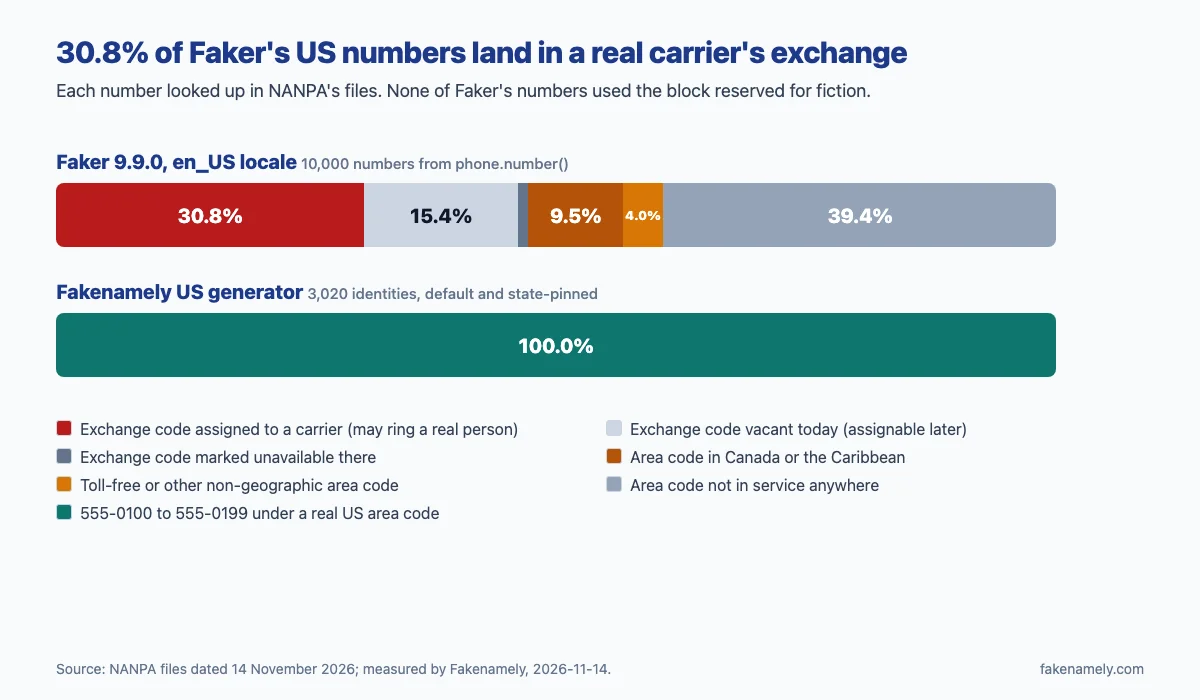
Faker's output has two other habits worth knowing. Three in four of its numbers, 74.2%, end in an extension such as x3262. About a quarter start with '1-'. Neither is wrong, but a test that expects ten digits will fail on them for reasons that have nothing to do with your code.
Our own generator gives every US profile a 555-01XX number. The area code matches the address: a Seattle profile gets 206 and an Austin profile gets 512 or 737. In 3,020 profiles, 2,000 with a random city and 20 for each state page, every number was in the reserved block and every area code belonged to the address's state. You can try it on the phone number generator, the United States page or the New York address generator.
One limit applies to every reserved number. It is safe because nothing answers it. To test that a text really arrives, use a number you own or your SMS provider's test numbers.
Checking a US number in code, with extensions and in Excel
A pattern can check the shape of a US number. Remove any extension first, then spaces, hyphens, dots and parentheses, and test what is left with this pattern: ^(\+?1)?[2-9](?!11)\d{2}[2-9](?!11)\d{2}\d{4}$. It accepts an optional +1 or 1, then an area code and an exchange code that start with 2 to 9 and are not N11 codes, then four digits.
Shape is not existence. With extensions removed, the same pattern accepted 98.1% of Faker's numbers, including 3,794 whose area codes are not in service anywhere. Skip the first step and the extensions make it reject three in four. To check an area code, look it up in the area codes file. For anything more exact, use Google's libphonenumber library. Even that has a limit, which its authors state plainly: 'Do not rely on libphonenumber to determine whether numbers are currently assigned to a specific user and reachable' [libphonenumber].
Extensions belong in their own field. Write them after the number, as in 212-555-0142 ext. 25 or 212-555-0142 x25, and keep them out of the E.164 value. In a click-to-call link, RFC 3966 puts the extension after ';ext=': tel:+1-212-555-0142;ext=25 [rfc3966]. Our post on phone numbers that break software lists more traps, with test cases.
Excel has a built-in format for US numbers. Select the cells and open the Format Cells dialog. Then, in Microsoft's words, 'In the Category box, click Special' and 'In the Type list, click Phone Number' [excel]. Microsoft's example turns 5555551234 into (555) 555-1234. The code behind it is [<=9999999]###-####;(###) ###-####. It shows a seven-digit number as 555-1234 and a longer one with the area code in parentheses.
Type the ten digits without the 1. Excel fills the format from the right, so an extra leading digit lands inside the parentheses: 12125550142 shows as (1212) 555-0142. For hyphens instead of parentheses, use the custom format 000-000-0000. US numbers never start with 0, so the dropped-zero problem that affects UK numbers in Excel does not arise.
How we counted, and what the numbers leave out
NANPA publishes its files for phone companies, and each carries the date it was last updated. Ours were dated 14 November 2026, the day we downloaded them. The area code database lists all 800 possible area codes with their status. The exchange code files list every code in US area codes: the utilized file gives the assigned and unavailable codes, and eight regional files give the vacant ones. Together they cover all 302,400 codes in the 378 area codes, with none missing and none listed twice.
The script, the files it writes and the rules it applies are all published: the script, area codes, area codes by state, unavailable exchange codes, codes by year and the 800 area codes by use.
Three limits apply. Assigned means a carrier holds the block, not that each number is in use, so 1.99 billion is the supply of numbers, not a count of phones. The code holder is the company NANPA gave the code to; with pooling and number porting, other companies may serve the numbers today. And the counts cover the US and its territories only, not Canada or the Caribbean.
References & sources
- About NANPA — North American Numbering Plan Administrator
- NPA Reports: area code database (npa_report.csv, file dated 14 November 2026) — North American Numbering Plan Administrator
- Central Office Code Assignment Records, with field definitions (files dated 14 November 2026) — North American Numbering Plan Administrator
- North American Numbering Plan (NANP) Exhaust Analysis, October 2026 — North American Numbering Plan Administrator
- 2026-2 NPA Exhaust Analysis: NPA exhaust forecasts, October 2026 — North American Numbering Plan Administrator
- 555 Line Numbers — North American Numbering Plan Administrator
- ATIS-0300115: 555 NXX Line Number Reference Document (10 January 2017), section 2.0 — Alliance for Telecommunications Industry Solutions
- Notes on Distance Dialing (1956), Section II, paragraph 2.03, Figure 2 and Appendix B: List of Suitable Central Office Names (scanned copy) — American Telephone and Telegraph Company
- Tommy Tutone chart history, Billboard Hot 100: '867-5309/Jenny', peak position 4, peak date 22 May 1982 — Billboard
- '867-5309' number for sale on eBay (2 February 2009) — CNN
- CO Codes/Thousands-Blocks — North American Numbering Plan Administrator
- 988 and 10-digit dialing: Frequently Asked Questions (updated January 8, 2021) — North American Numbering Plan Administrator
- North American Numbering Plan — Canadian Numbering Administrator
- Area Codes and Numbering — California Public Utilities Commission
- Ten-Digit Dialing (printable consumer guide, last reviewed 15 July 2022) — Federal Communications Commission
- What Is a Toll-Free Number and How Does it Work? (consumer guide) — Federal Communications Commission
- Microsoft Writing Style Guide: phone, phone number; Names and contact information — Microsoft
- Google developer documentation style guide: Format phone numbers in text (last updated 2025-04-17) — Google
- Style Manual, 2016 edition, rules 8.58, 8.76 and 12.7 (telephone numbers) — U.S. Government Publishing Office
- Recommendation ITU-T E.123 (02/2001): Notation for national and international telephone numbers, e-mail addresses and web addresses, clauses 7.1 and 7.2 — International Telecommunication Union
- Recommendation ITU-T E.164 (02/2026): The international public telecommunication numbering plan — International Telecommunication Union
- RFC 3966: The tel URI for Telephone Numbers — Internet Engineering Task Force
- Recommendation ITU-T E.161 (02/2001): Arrangement of digits, letters and symbols on telephones, clause 2.2 — International Telecommunication Union
- Display numbers as phone numbers — Microsoft Support
- libphonenumber FAQ: What does it mean for a phone number to be valid? — Google
Frequently asked questions
How many digits is a US phone number?
Ten: a three-digit area code, a three-digit exchange code and a four-digit line number, as in 212-555-0142. With the country code 1 in front it is eleven. Unlike the UK, the length never varies: every exchange code covers the line numbers 0000 to 9999, and NANPA's files list 302,400 exchange codes in the 378 US area codes.
How do I write a US phone number with the +1 country code?
Put +1 in front of the ten digits and separate the parts with spaces: +1 212 555 0142. Drop the parentheses around the area code. ITU-T E.123, the international standard for writing numbers, says brackets 'should not be used in an international number'. For databases and APIs, use the E.164 form with no spaces: +12125550142.
Can a US phone number start with 0 or 1?
No. Area codes and exchange codes both start with a digit from 2 to 9. In NANPA's files, not one of the 302,400 US exchange codes starts with 0 or 1. A 1 at the front of a dialled number is the country code or long-distance prefix, not part of the number.
Do US cell phone numbers have a different format?
No. Mobile and landline numbers use the same ten digits and the same area codes, and you cannot tell them apart by the number. Wireless carriers get exchange codes from the same pool as everyone else. In NANPA's figures, wireless carriers took between 30% and 58% of the new exchange codes assigned each year from 2022 to 2026.
How many possible phone numbers are there in the US?
The shape of the plan allows 6.4 billion numbers across all 800 possible area codes. Each area code can hold at most 7.92 million, not 10 million, because exchange codes cannot start with 0 or 1 and the eight N11 codes are never used. The 378 US area codes in service could hold 2.99 billion. NANPA's files show 1.99 billion in blocks assigned to phone companies on 14 November 2026.
Will the US run out of phone numbers?
Not for decades. NANPA's October 2026 forecast puts the exhaust of the whole plan in 2064, or 2067 with lower demand. Single area codes run out much sooner. When one does, a new area code is added over the same map. NANPA expects Orange County's 714/657 and Georgia's 912 to run out first, in the second quarter of 2028.
What US phone number can I use for testing?
Use 555-0100 to 555-0199 with any real area code, such as (212) 555-0142. NANPA says these 'fictitious, non-working numbers' 'will remain reserved for entertainment/advertising', so they cannot be given to a customer. That makes 100 safe numbers in each of the 378 US area codes, 37,800 in all. They cannot receive calls or texts.
Why do fake phone numbers start with 555?
Phone companies used the 555 exchange mainly for directory assistance, such as 555-1212. In the days of named exchanges, 555 could be written 'KLondike 5', because K and L sit on the 5 key. Today only 555-0100 to 555-0199 is reserved for fiction. NANPA keeps those 100 numbers out of service, so a number in that block cannot ring anyone.
How should I write a US phone number with an extension?
Write the number, then the extension after 'ext.' or 'x': 212-555-0142 ext. 25. Keep the extension out of the E.164 field, because it is not part of the number. In a click-to-call link it goes after ';ext=', as in tel:+1-212-555-0142;ext=25, the syntax set by RFC 3966.
Update history
- Added a short history of 555 to the testing section: the KLondike 5 exchange name, the block the industry set aside for fiction, and the 867-5309 song. Added one question on why fake numbers start with 555. No counts or tables changed.
- Published, with counts from NANPA's area code and exchange code files of the same day, NANPA's October 2026 exhaust forecast, and a test of 10,000 Faker numbers against those files.
More on phone numbers, texting and numbering plans
- Phone Number Validation Test Cases — CSV & JSON
- UK Phone Number Format: +44, Length, Examples, Test Numbers
- ZIP Code vs Postal Code: Formats by Country Explained
- When to Use a Fake Address Online
- Synthetic Data for GDPR Compliance: Anonymization Done Right
- Data Masking vs Tokenization: Differences & Test Data