UK Phone Number Format: +44, Digits, Area Codes and Test Numbers
How to write a UK phone number: +44 and the leading 0, how many digits, area codes, 07 mobile ranges, and the Ofcom numbers that are safe to use for testing.
By Vincent RuanPublished November 11, 2026Last updated November 11, 202612 min read
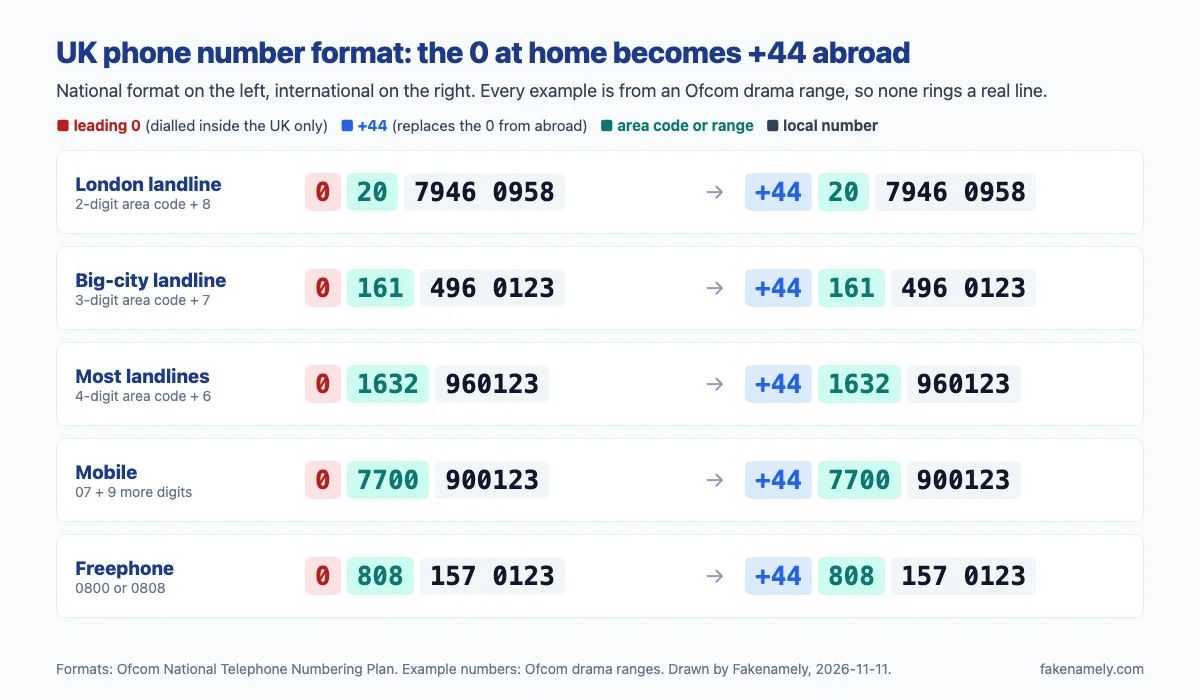
A UK phone number is written in one of two ways. Inside the country it starts with a 0: 020 7946 0958. From anywhere else the 0 is dropped and the country code +44 takes its place: +44 20 7946 0958. Everything else about the format follows from two questions. How long is the area code, and what kind of number is it?
This guide answers both from the source. The rules come from Ofcom, the UK regulator, which publishes the numbering plan [plan]. The counts come from the files Ofcom gives phone companies, which list every block of numbers and who holds it [data]. Every example below is from a range Ofcom keeps out of service for television, so none of them can ring a real person. If you need a whole made-up UK profile, the UK generator writes one with a phone number from the same ranges.
| Number type | Starts with | Written in the UK | International format | Digits after the 0 |
|---|---|---|---|---|
| London landline | 020 | 020 7946 0958 | +44 20 7946 0958 | 10 (2 + 8) |
| Big-city landline | 011x or 01x1 | 0161 496 0123 | +44 161 496 0123 | 10 (3 + 7) |
| Most landlines | 01 + three digits | 01632 960123 | +44 1632 960123 | 10 (4 + 6) |
| Mobile | 071 to 075, 077 to 079 | 07700 900123 | +44 7700 900123 | 10 |
| UK-wide | 03 | 0306 999 0123 | +44 306 999 0123 | 10 |
| Freephone | 0800 or 0808 | 0808 157 0123 | +44 808 157 0123 | 10 (some 0800 numbers have 9) |
| Premium rate | 09 | 0909 879 0123 | +44 909 879 0123 | 10 |
How many digits is a UK phone number?
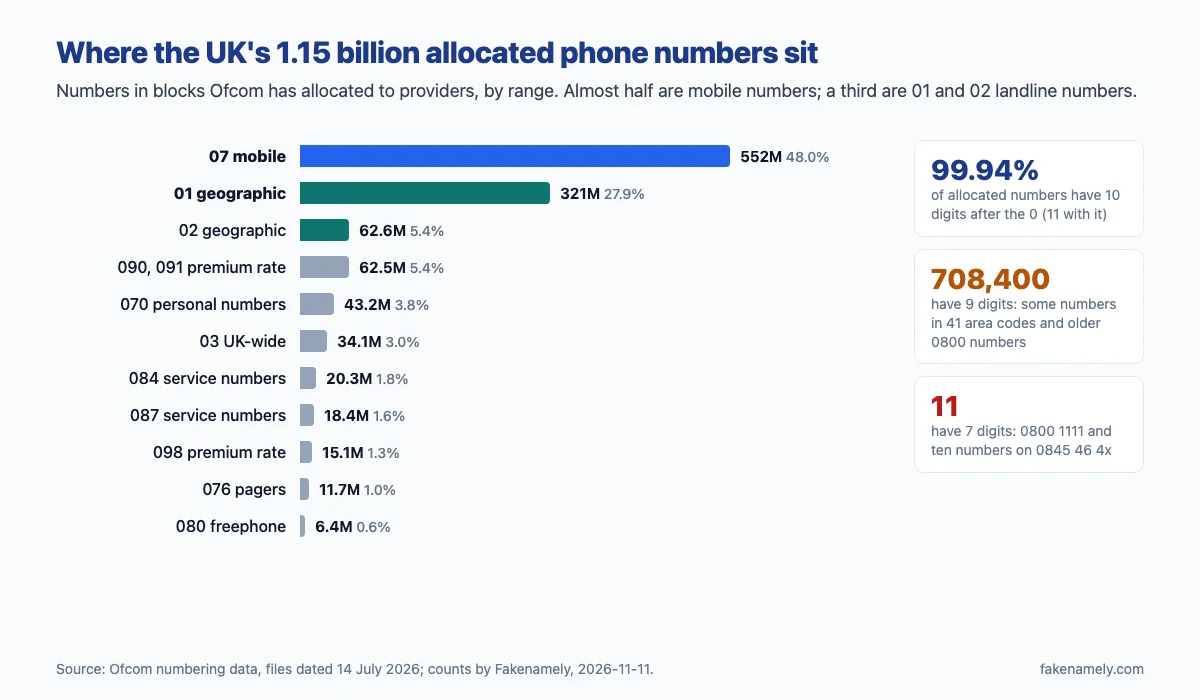
Ten after the 0, so eleven as you dial it at home. Ofcom's plan sets the rule in one sentence. Numbers 'shall comprise ten (10) digits (excluding the national prefix code ‘0’)' unless the plan says otherwise [plan]. The leading 0 is that national prefix. It tells the network you are dialling a full national number, and it is not part of the number itself.
Guides on this subject disagree about the length, so we counted. Ofcom's files list 344,115 blocks of numbers. We added up the numbers in every block that has been allocated to a provider. The total is 1,150,494,711 numbers, and 99.94% of them have ten digits after the 0.
| Digits after the 0 | Numbers allocated | Share | Where they are |
|---|---|---|---|
| 10 | 1,149,776,300 | 99.94% | Every mobile, almost every landline, 03, 08 and 09 numbers |
| 9 | 708,400 | 0.06% | 325,000 landline numbers in 41 area codes; 383,400 older 0800 numbers |
| 7 | 11 | under 0.001% | 0800 1111 and ten numbers on 0845 46 4x |
The nine-digit landlines sit in 40 four-digit area codes and one five-digit code. Bolton (01204), Blackburn (01254) and Camberley (01276) are among them. These numbers have a five-digit local part instead of six. The nine-digit freephone numbers are 0800 followed by six digits. The plan lists them separately from the other 080 numbers, which have the full ten digits [plan].
The seven-digit numbers are the rarest in the country. One is 0800 1111, which is Childline's number [childline]. In Ofcom's file it is a block of exactly one number, allocated to BT. A form that insists on eleven digits will reject it. So will a form that insists on ten digits after +44.
Writing a UK number with +44: drop the 0, skip the brackets
The international format starts with a plus sign, then the country code 44, then the number without its leading 0. The plus sign stands for whatever digits your own country uses to call abroad. ITU-T E.123, the standard for writing phone numbers, says it 'serves to remind the subscriber to dial the international prefix which differs from country to country' [e123]. On a mobile you can type the plus sign itself, and it works from anywhere.
The most common mistake is to keep the 0 in brackets, as in +44 (0)20 7946 0958. E.123 rules this out. Brackets mark digits that 'are not always dialled', and the standard adds that they 'should not be used in an international number' [e123]. A person may work it out. Software that dials the digits as written keeps the 0, and the call can fail.
British government style guides disagree with each other on this point. The Office for National Statistics tells its writers: 'Do not include the zero you have removed in brackets; this is particularly important for accessibility as it can affect how some assistive technologies read the number' [ons]. The GOV.UK style guide still shows +44 (0)29 2018 0542 as its example [govuk]. The ONS version matches the standard. Use it.
| Source | What it says | 0 in brackets? |
|---|---|---|
| ITU-T E.123 (the standard) | 'The ( ) should not be used in an international number.' | No |
| ONS Service Manual | '+44 3456 013034 not +44 (0)345 601 3034 or 0044 3456 013034' | No |
| WhatsApp Help Center | 'Make sure to remove any leading 0s or special calling codes.' | No |
| GOV.UK style guide | Example given: '+44 (0)29 2018 0542' | Yes |
There is a second form with no spaces at all, called E.164 after the ITU recommendation that defines it. It is the plus sign and the digits, nothing else: +442079460958. Databases, SMS services and WhatsApp use this form [whatsapp]. E.164 allows at most 15 digits [e164]. A UK number uses 12, or 11 for the nine-digit ones.
| Form | London landline | Mobile | Use it for |
|---|---|---|---|
| National | 020 7946 0958 | 07700 900123 | Letters, signs and websites read only in the UK |
| International | +44 20 7946 0958 | +44 7700 900123 | Email signatures, websites with readers abroad |
| E.164 | +442079460958 | +447700900123 | Databases, APIs, SMS services, WhatsApp |
| Link | tel:+442079460958 | tel:+447700900123 | The href of a click-to-call link |
The last row matters on web pages. The standard for phone links, RFC 3966, identifies a global number by its leading plus sign. It also says links 'MUST NOT use spaces in visual separators' [rfc3966]. So show the readable form and link the compact one. To call a UK number from a landline abroad, replace the plus sign with your local international prefix. That is 00 in most of Europe, which the ITU recommends [e164], and 011 in the United States and Canada.
UK area codes: two, three, four or five digits
Landline numbers start with 01 or 02, and the area code is the part that names the place. It can have two, three, four or five digits after the 0. The local number takes up the rest of the ten digits. So a short code means a long local number. That is why the space goes in a different place for London than for a small town.
Ofcom's numbering plan lists 610 area codes [plan]. Its allocation file shows 611, because Brampton in Cumbria appears twice, as 01697 and as the five-digit 016977. We counted how many codes have each length and how many numbers each group holds.
| Digits in the code | Area codes | Written as | Numbers allocated | Share of landline numbers |
|---|---|---|---|---|
| 2 | 5 | 020 7946 0958 | 62,556,000 | 16.3% |
| 3 | 12 | 0161 496 0123 | 50,960,000 | 13.3% |
| 4 | 582 | 01632 960123 | 269,432,000 | 70.3% |
| 5 | 12 | 015396 xxxxx | 551,300 | 0.1% |
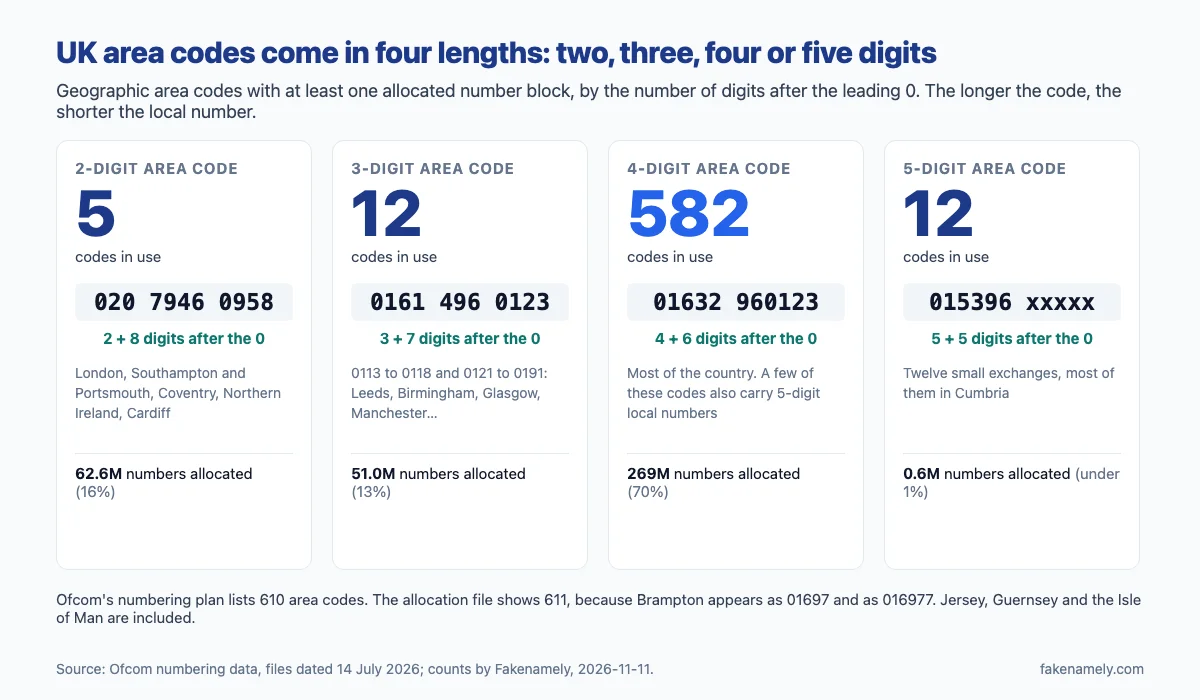
The two-digit and three-digit codes belong to the biggest cities. Together these 17 codes hold 30% of all landline numbers. London alone has 31.4 million allocated numbers, more than any other code. Northern Ireland shares one code, 028, across 37 local exchange areas.
| Area code | Place | Format | Numbers allocated |
|---|---|---|---|
| 020 | London | 020 xxxx xxxx | 31,370,000 |
| 028 | Northern Ireland | 028 xxxx xxxx | 21,596,000 |
| 0161 | Manchester | 0161 xxx xxxx | 7,070,000 |
| 0121 | Birmingham | 0121 xxx xxxx | 6,020,000 |
| 0191 | Tyneside, Durham, Sunderland | 0191 xxx xxxx | 5,860,000 |
| 0151 | Liverpool | 0151 xxx xxxx | 4,730,000 |
| 0141 | Glasgow | 0141 xxx xxxx | 4,620,000 |
| 023 | Southampton, Portsmouth | 023 xxxx xxxx | 4,570,000 |
| 0113 | Leeds | 0113 xxx xxxx | 4,230,000 |
| 0131 | Edinburgh | 0131 xxx xxxx | 3,560,000 |
| 0117 | Bristol | 0117 xxx xxxx | 3,410,000 |
| 0115 | Nottingham | 0115 xxx xxxx | 3,090,000 |
| 0118 | Reading | 0118 xxx xxxx | 2,940,000 |
| 0114 | Sheffield | 0114 xxx xxxx | 2,750,000 |
| 0116 | Leicester | 0116 xxx xxxx | 2,680,000 |
| 029 | Cardiff | 029 xxxx xxxx | 2,660,000 |
| 024 | Coventry | 024 xxxx xxxx | 2,360,000 |
The 12 five-digit codes are small exchanges in and around Cumbria. They include Hawkshead (015394), Sedbergh (015396) and Keswick (017687). All 611 codes, with place names and formats, are in the area code file. The names come from Ofcom's area code tool [areatool].
Is 0207 a London area code?
No, and this is the most common UK formatting error. London has one area code, 020, and eight-digit local numbers. Ofcom's account is that in 2000 'London was given a single area code once again – 020 – and the inner and outer London divide was removed'. Five years later its research 'uncovered a widespread misconception among Londoners that the city still had two area codes – 0207 and 0208'. Only 13% of people named 020 without prompting [london].
The 7 and the 8 are the first digit of the local number. So are 3 and 4, which Ofcom added when the older numbers ran short. In the file, each of the four ranges is a block of ten million numbers under the same code. Write the number as 020 7946 0958. Writing 0207 946 0958 still connects when dialled in full, but it puts the break in the wrong place.
| Numbers starting | Often miswritten as | Numbers allocated | Of 10 million |
|---|---|---|---|
| 020 3 | 0203 | 9,240,000 | 92% |
| 020 4 | 0204 | 1,530,000 | 15% |
| 020 7 | 0207 | 9,840,000 | 98% |
| 020 8 | 0208 | 9,700,000 | 97% |
UK mobile numbers: 07, but not all of 07
A UK mobile number is 07 plus nine digits. It is most often written with a space after the fifth digit: 07700 900123. In international format it is +44 7700 900123. Mobile numbers have no area code, so the number says nothing about where the phone is.
The plan is specific about which 07 numbers are mobile. The ranges 071 to 075 and 077 to 079 are 'Mobile Services'. 070 is 'Personal Numbers' and 076 is 'Radiopaging Service', apart from 07624, which serves the Isle of Man [plan]. The difference costs money. Ofcom warns that 070 numbers 'are different from mobile numbers, and calls to them can be more expensive' [costs]. A form that treats every 07 number as a mobile will accept them.
| Range | Designation in Ofcom's plan | Numbers allocated | Share of the range |
|---|---|---|---|
| 070 | Personal Numbers (not mobile) | 43,240,000 | 43% |
| 071 | Mobile Services | 2,000,000 | 2% |
| 072 | Mobile Services | 0 | 0% |
| 073 | Mobile Services | 71,200,000 | 71% |
| 074 | Mobile Services | 96,700,000 | 97% |
| 075 | Mobile Services | 94,900,000 | 95% |
| 076 | Radiopaging Service (07624: Isle of Man mobile) | 12,520,000 | 13% |
| 077 | Mobile Services | 98,000,000 | 98% |
| 078 | Mobile Services | 97,800,000 | 98% |
| 079 | Mobile Services | 90,900,000 | 91% |
In total, 552,320,000 numbers are allocated in the mobile ranges, held by 74 providers. Four companies hold 94% of them. The file shows who first received each block. It does not show the network a number is on today, because customers can keep their number when they switch.
| Provider in Ofcom's file | Brand | Numbers allocated | Share |
|---|---|---|---|
| Telefonica UK Limited | O2 | 156,400,000 | 28.3% |
| EE Limited (TM) and EE Limited (Orange) | EE | 151,500,000 | 27.4% |
| Vodafone Limited | Vodafone | 115,600,000 | 20.9% |
| Hutchison 3G UK Ltd | Three | 94,000,000 | 17.0% |
| Lycamobile (UK) Limited | Lycamobile | 8,100,000 | 1.5% |
| 68 other entries | 26,720,000 | 4.8% |
03, 08 and 09 numbers
Numbers that start with 03, 08 or 09 are not tied to a place. They follow the same ten-digit rule, and the first digits tell you what the call costs. The table uses Ofcom's own descriptions [costs].
| Starts with | What it is | What Ofcom says about the cost | Numbers allocated |
|---|---|---|---|
| 03 | UK-wide numbers | 'Calls cost no more than calls to geographic numbers (01 or 02).' | 34,079,000 |
| 0800, 0808 | Freephone | 'Calls are free of charge from all consumer landlines and mobile phones.' | 6,396,401 |
| 084 | Service numbers | An access charge plus a service charge 'between 0p and 7p per minute' | 20,316,010 |
| 087 | Service numbers | An access charge plus a service charge 'between 0p and 13p per minute' | 18,424,000 |
| 09 | Premium rate | An access charge plus a service charge that 'can range from 1p to £3.60 per minute' | 77,630,000 |
Two details catch out form builders. First, no UK number starts with 04 or 06, because the plan makes none available [plan]. Second, 0500 numbers no longer exist. Ofcom withdrew the range on 5 June 2017 [costs]. Test data that still contains them is out of date.
UK phone numbers for testing: the ranges Ofcom keeps out of service
If you make up a UK number, it probably belongs to somebody. More than half a billion mobile numbers are allocated, and five of the mobile ranges are over 90% full. A test that sends a text to an invented 07 number is likely to reach a real phone. The safe choice is a number that cannot be given to anyone.
Ofcom publishes such numbers. It keeps a list of ranges 'recommended for TV and radio drama purposes', with 1,000 numbers in each [drama]. They exist so that viewers who dial a number from a programme do not reach a real customer. Ofcom explains that these numbers 'cannot be allocated to communications providers for their customers because of the potential influx of calls'. It adds that they 'will not be allocated to communications providers in the foreseeable future'.
That is the property a test number needs. Ofcom wrote the page for broadcasters and does not call them test numbers. They work for testing for the same reason they work on television. The GOV.UK style guide uses them for its own examples, such as 020 7946 0457 and 07700 900 265 [govuk].
| Area or type | Numbers | Status in Ofcom's file |
|---|---|---|
| Mobile | 07700 900000 to 07700 900999 | Protected, no provider |
| No area | 01632 960000 to 01632 960999 | Protected, no provider |
| London | 020 7946 0000 to 020 7946 0999 | Protected, no provider |
| Birmingham | 0121 496 0000 to 0121 496 0999 | Protected, no provider |
| Manchester | 0161 496 0000 to 0161 496 0999 | Protected, no provider |
| Leeds | 0113 496 0000 to 0113 496 0999 | Protected, no provider |
| Sheffield | 0114 496 0000 to 0114 496 0999 | Protected, no provider |
| Nottingham | 0115 496 0000 to 0115 496 0999 | Protected, no provider |
| Leicester | 0116 496 0000 to 0116 496 0999 | Protected, no provider |
| Bristol | 0117 496 0000 to 0117 496 0999 | Protected, no provider |
| Reading | 0118 496 0000 to 0118 496 0999 | Protected, no provider |
| Edinburgh | 0131 496 0000 to 0131 496 0999 | Protected, no provider |
| Glasgow | 0141 496 0000 to 0141 496 0999 | Protected, no provider |
| Liverpool | 0151 496 0000 to 0151 496 0999 | Protected, no provider |
| Tyneside, Durham, Sunderland | 0191 498 0000 to 0191 498 0999 | Protected, no provider |
| Northern Ireland | 028 9649 6000 to 028 9649 6999 | Protected, no provider |
| Cardiff | 029 2018 0000 to 029 2018 0999 | Protected, no provider |
| UK-wide | 0306 999 0000 to 0306 999 0999 | Protected, no provider |
| Freephone | 0808 157 0000 to 0808 157 0999 | Not listed (not allocated) |
| Premium rate | 0909 879 0000 to 0909 879 0999 | Not listed (not allocated) |
We checked the list against the allocation files instead of taking it on trust. The blocks that contain 18 of the 20 ranges are marked Protected and have no provider. The freephone and premium rate ranges are missing from the 08 and 09 files, which list no protected blocks at all. The blocks next to them are allocated, and these two are skipped. The result is in the drama ranges file.
Two of the ranges answer questions people search for. The 01632 code is not a place. Ofcom lists it as 'No area' and suggests it 'for any geographic area code not listed' [drama]. And nobody owns 07700 900123. If a call or text shows that number, no provider assigned it to the caller.
We tested Faker's UK numbers against Ofcom's files
Faker is a popular open-source library for making test data, and it has a UK setting, en_GB. We generated 10,000 UK phone numbers with it and looked up each one in Ofcom's block list. None fell in a drama range. About one in five, 22.1%, fell in a block allocated to a real provider. Another 33.7% started with digits that are in no Ofcom file at all, such as 0110 and 027. Those are not UK area codes.
| Where the number falls | Faker en_GB | Fakenamely UK generator |
|---|---|---|
| In a block allocated to a provider | 22.1% | 0% |
| In a block Ofcom marks Protected | 38.6% | 0% |
| In a free or quarantined block | 5.6% | 0% |
| Area code or range not in Ofcom's files | 33.7% | 0% |
| In an Ofcom drama range | 0% | 100% |
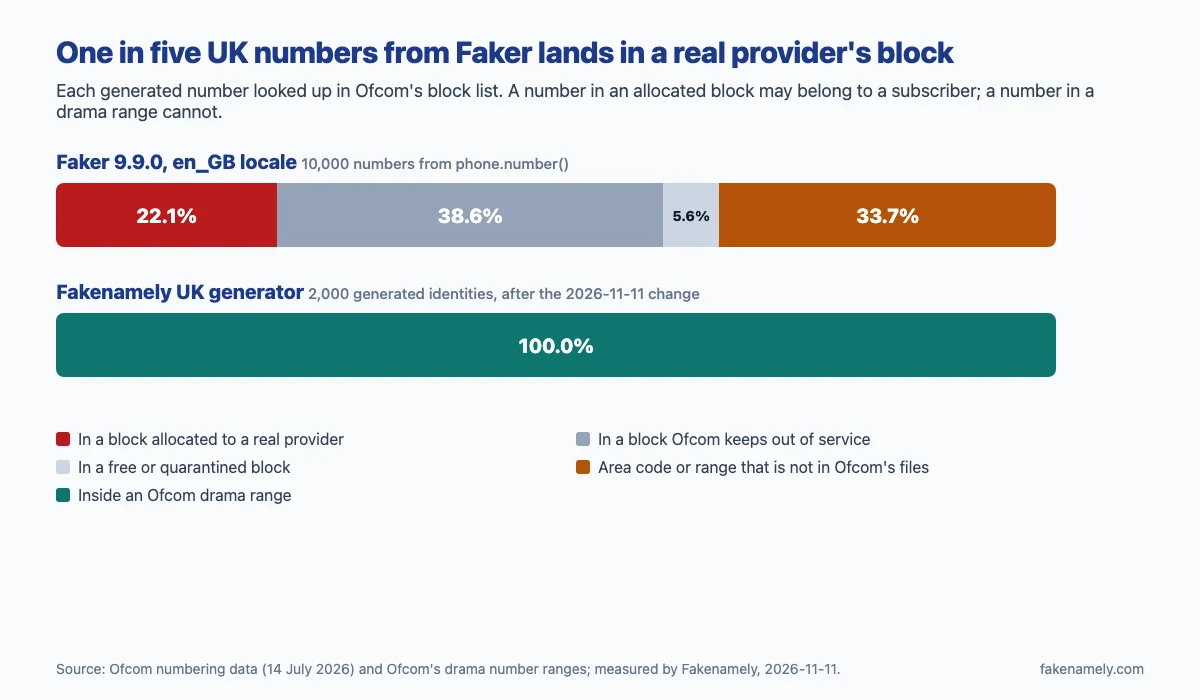
Our own UK generator used Faker's formats until this check, so it had the same fault. We changed it on the day we ran the test. Every UK phone number it produces now comes from a drama range. Half are mobiles on 07700 900. The rest are landlines that match the address: a London profile gets 020 7946 0xxx and a Manchester profile gets 0161 496 0xxx. A city with no range of its own gets 01632 960xxx. In a re-run of 2,000 profiles, all 2,000 numbers were in a drama range and all 995 landlines matched their city.
You can try it on the United Kingdom page, or get London addresses with London numbers from the London address generator. The same rule already applied to US numbers, which use the reserved 555-0100 to 555-0199 block on the phone number generator. One limit applies to every reserved range. The numbers are safe because nothing answers them. To test that a text really arrives, use a number you own or your SMS provider's test numbers.
Checking a UK number in code, and keeping the 0 in Excel
A pattern can check the shape of a UK number. It cannot tell you the number exists. Strip the spaces first, then test the digits. This pattern accepts the national form: ^0[1235789]\d{8,9}$. For the international form, use ^\+44[1235789]\d{8,9}$. Both allow nine or ten digits after the prefix, and both reject numbers starting 04 or 06. Both also reject 0800 1111, so add it by hand if a children's helpline might appear in your data.
For anything more exact, use Google's libphonenumber library rather than a longer pattern. Even that has a limit, which its authors state plainly: 'Do not rely on libphonenumber to determine whether numbers are currently assigned to a specific user and reachable' [libphonenumber]. Only a call or a text can show that. Our post on phone numbers that break software lists the other traps, with test cases.
Spreadsheets cause the last common problem. Excel reads 07700 900123 as a number and drops the 0. Microsoft says so directly: 'Excel automatically removes leading zeros' [excel]. The fix is to format the column as Text before the numbers go in. Select the range, press Ctrl+1 and choose Text on the Number tab. You can also type an apostrophe before a single number. Microsoft adds a warning: 'This will not change numbers that have already been entered.' If the zeros are already gone, the custom format 00000000000, eleven zeros, displays them again for ten-digit numbers.
How we counted, and what the numbers leave out
Ofcom publishes its numbering data for phone companies and updates it most Wednesdays [data]. Each row is a block of numbers: its leading digits, a status, the provider, and the number length. A block of six digits in a ten-digit range holds 10,000 numbers. We added up the numbers in every block marked Allocated. The script, the files it writes and the rules it applies are all published: the script, numbers by range, area codes and mobile providers.
Three limits apply. Allocated means a provider holds the block, not that every number in it is in use, so 1.15 billion is the supply of numbers, not a count of phones. The provider shares show who first received each range, not who serves the customers now. And the files are dated 14 July 2026. Ofcom's website refuses scripted downloads, so we used the latest copy saved by the Internet Archive. To count a newer edition, download the ZIP in a browser and pass it to the script.
References & sources
- The National Telephone Numbering Plan, version with effect from 22 April 2025 (Part A1, paragraph B2.1, Appendix A) — Ofcom
- Download numbering data: telephone numbers, number block allocations and codes — Ofcom
- Telephone numbers for use in TV and radio drama programmes (last updated 11 May 2023) — Ofcom
- Telephone area codes: find UK dialling codes for numbers starting 01 and 02 — Ofcom
- Call costs guide (last updated 31 January 2025) — Ofcom
- London calling: Ofcom to release new '(020) 4' phone numbers (media release, 30 August 2019; archived copy) — Ofcom
- Recommendation ITU-T E.123 (02/2001): Notation for national and international telephone numbers, e-mail addresses and web addresses, clauses 7.1 and 7.2 — International Telecommunication Union
- Recommendation ITU-T E.164 (02/2026): The international public telecommunication numbering plan, clauses 6.1 and 15 — International Telecommunication Union
- Service manual, content style guide: Writing numbers, 'Telephone numbers' — Office for National Statistics
- GOV.UK A to Z style guide, entry 'telephone numbers' — Government Digital Service
- About international phone number format — WhatsApp Help Center
- RFC 3966: The tel URI for Telephone Numbers, sections 5.1.1 and 5.1.4 — Internet Engineering Task Force
- Contacting Childline — Childline (NSPCC)
- libphonenumber FAQ: What does it mean for a phone number to be valid? — Google
- Keeping leading zeros and large numbers — Microsoft Support
Frequently asked questions
How many digits is a UK phone number?
Eleven with the leading 0, ten without it. Ofcom's numbering plan says numbers 'shall comprise ten (10) digits (excluding the national prefix code ‘0’)' unless stated otherwise. In Ofcom's allocation files, 99.94% of the 1.15 billion allocated numbers have ten digits after the 0. The exceptions have nine: some landlines in 41 area codes, such as 01204 Bolton, and older 0800 numbers with six digits after the 0800. Two ranges have seven, including Childline's 0800 1111.
How do I write a UK phone number with the +44 country code?
Remove the leading 0 and put +44 in its place. 020 7946 0958 becomes +44 20 7946 0958, and the mobile 07700 900123 becomes +44 7700 900123. Do not keep the 0 in brackets. The international standard, ITU-T E.123, says brackets 'should not be used in an international number'. For software and WhatsApp, use the same digits with no spaces: +442079460958.
What is the format of a UK mobile number?
07 followed by nine more digits, usually written as 07700 900123. In international format it is +44 7700 900123. Ofcom's numbering plan designates 071 to 075 and 077 to 079 as Mobile Services. All of them have ten digits after the 0.
Do all UK mobile numbers start with 07?
Yes, but not every 07 number is a mobile. 070 is for personal numbers, which Ofcom says 'are different from mobile numbers, and calls to them can be more expensive'. 076 is for pagers, except 07624, which is the Isle of Man's mobile range. In Ofcom's files 552 million numbers are allocated in the mobile ranges and 43 million in 070.
Is 0207 a London area code?
No. London's area code is 020 and the local number has eight digits. A London number is written 020 7946 0958, not 0207 946 0958. Ofcom says that in 2000 'London was given a single area code once again – 020'. Its research later found only 13% of people named 020 correctly. Local numbers now start with 3, 4, 7 or 8, so 0203, 0204, 0207 and 0208 are all the same code.
What UK phone number can I use for testing?
Use one of the ranges Ofcom recommends for TV and radio drama. For a mobile, 07700 900000 to 07700 900999. For a landline with no location, 01632 960000 to 01632 960999. For London, 020 7946 0000 to 020 7946 0999. Ofcom says these numbers 'will not be allocated to communications providers in the foreseeable future', so they cannot ring a real customer. There are 20 such ranges, with 1,000 numbers in each.
Where is the 01632 area code?
Nowhere. 01632 is not assigned to any place. Ofcom lists it under 'No area' and suggests 'using numbers in the 01632 range (no area code) for any geographic area code not listed' when a programme needs a made-up number. In Ofcom's allocation file the whole 01632 code is marked Protected, with no provider.
How do I stop Excel removing the 0 from a UK phone number?
Format the column as Text before you type or paste the numbers. Microsoft's guidance is to select the range, press Ctrl+1 and choose Text on the Number tab, or to type an apostrophe before the number. It warns that this 'will not change numbers that have already been entered'. If the zeros are already gone, the custom format 00000000000 shows them again for ten-digit numbers.
Update history
- Published, with counts from Ofcom's numbering files, the 20 drama ranges checked against them, and a test of 10,000 Faker numbers. Our UK generator now draws every phone number from the drama ranges.